Bicycle Diaries

Recent Posts

18.2.10

Rilke, Tolstoy, and travel...

your house is just
this side of great distances


Of course this has to do with bikes and books ... but first, I figure about half of you out there use Internet Explorer to view Bicycle Diaries. Microsoft's nefarious product doesn't load it very well. It often center justifies the posts putting the right sidebar all the way down to the bottom of the page. Try instead Mozilla Firefox as your browser. It's FREE, only taking a few minutes to load. It also has a great reputation in contrast to the Windows-based Explorer.
Someone who wants to run Windows on servers should first be made to show what they know about servers that Google, Yahoo and Amazon don't know.
You'll not only see my blog as I intend it to be viewed. You and your computer will both be very happy. Firefox is more secure against viruses and hackers as well as less buggy than Explorer.

Speaking of explorers, I've been wanting to post one of my favorite poems about travel.


Entering

Whoever you are: step out in the evening
from your room where all is known to you;
your house is just this side of great distances:
whoever you are.
With your eyes which, exhausted,
barely free themselves from the worn threshold,
you raise up, slowly, a black tree
and place it against the sky: slender, alone.
And you've made the world. And it is vast
and like a word which ripens still in silence.
And as your will begins to grasp its meaning,
your eyes release it gently.

In 1900 Rainer Maria Rilke, a rather restless traveler, sought refuge with Leo Tolstoy at his ancestral estate, Yasnaya Polyana. Rilke, only 25 years old, already had an impressive array of publications to his credit. Unfortunately, this had done almost nothing to help his anxieties about writing. He shared them Tolstoy; later describing their conversation in a letter to friend,
I still lack the discipline, the being able to work, and the being compelled to work, for which I have longed for years. Do I lack the strength? Is my will sick? Is it the dream in me that hinders all action? Days go by and sometimes I hear life going. And still nothing has happened, still there is nothing real about me . . . .
To which Tolstoy gave a completely unexpected response. With neither sympathy nor pity, he simply said, Write!

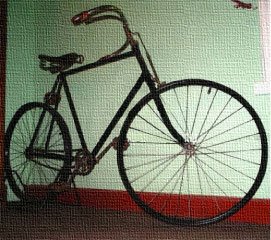
Tolstoy could have easily said, bike! At the age of 67, he started teaching himself to ride. Visitors to Yasnaya often commented rather humorously on the sight of the aging anarchist rolling around his estate. Tolstoy was as brief in his response to them as he had been to Rilke.
I feel that I am entitled to my share of lightheartedness and there is nothing wrong with enjoying one's self simply, like a boy.
Labels: , ,

16.2.10

their passions a quotation

w/apologies
to Oscar Wilde

As I hit the mid-February dull-drums, I've been turning my head towards spring with a little restoration project. It's not only keeping me from self-medicating the darkness away in my local neighborhood joint. There's nothing like scouring several decades worth of rust off steel rims for ruminating about the vélotariat.
  • Why do researchers who've never been on Critical Mass write as if it just popped out of nowhere on the streets of America?
  • Why do they typically recycle masser statements about the anarchy and celebration without ever going deeper beneath the surface?
  • And why do they never explain the mass's staying power, now in it's second decade and spreading around the world?
  • In other words, where the hell did the mass come from and where the hell is it going?

    The simple answer is that Critical Mass began in 1992 in San Francisco. Seven years later, it appeared in Chicago. Most academic research concludes that it's the anarchistic step-child of the aging hippies and student protesters of the 60s. That's usually where it ends.

    Although a good start, refusing to go further ignores the rich history of bike activism both during and after the heyday of counter-culture America. In Chicago, Keith Kingbay was bugging Mayor Daley the Elder for bike lanes which first went in the early 1970s. Hippy longhair? Wild-eyed radical? Not in the least: Keith was the Cycling Activities Director for the Schwinn Bicycle Company and member of President Nixons's Council on Physical Fitness.

    So where to go from here? On to Humboldt Park. Lula's was getting ready for the dinner rush. I decamped to the Black Beetle Bar & Grill in Humboldt Park. There I discovered an obscure (to Americans at least) Parisian group that gave the May 1968 student revolt its intellectual uhmpf. And quite surprisingly, Kingbay seems to have been familiar with many of their essays.

    Led by Guy Debord, The Situationists came down hard on Western society. France had finally emerged from the poverty and despair of the post-WWII period. Rebuilding war-ravaged cities and villages was almost complete. Unemployment was virtually non-existent. Under De Gaulle, France was a serious US Cold War partner. The baby-boom generation was flooding the universities ... and it was bored, angry, and primed for action.

    In contrast to today's conservative revisions of history, the Situationists were much more than a group of spoiled middle class kids. The French were in Algeria. The Soviets were in Czechoslovakia. The US was in Viet Nam. Countries in Africa and Latin America were struggling for national independence or true sovereignty from former colonial masters. Western governments, as well as the traditional opposition parties that did little real opposing, demanded loyalty, rather than questions, from their supporters. They specifically demanded young people to Sois Jeune et Tais Tois, or Be young and shut up.

    It was a mistake to say the least. In this grossly patronizing atmosphere, youthful opposition to foreign policy quickly grew into an overall critique of Western society. Like the revolutionary movements of the 1920s and 1930s the Situationists focused on the power of capitalism, propped up by the state, to overwhelm individual freedom. Unlike their predecessors who sought to revolutionize politics, they sought to revolutionize life itself.

    Raoul Vaneigem, in The Revolution of Everyday Life, observed that poverty in modern Western society went deeper than simple economic depravation. Social conventions, reinforced by political institutions and an all-encompassing media, compelled individuals to not only consume but what to consume and how. Locked in this daily routine of consumption, life was futile, barren, and dull.
    The history of our times calls to mind those Walt Disney characters who rush madly over the edge of a cliff without seeing it, so that the power of their imagination keeps them suspended in mid-air; but as soon as they look down and see where they are, they fall.
    What does this have to do with Critical Mass? The creative, spontaneous, and joyful potential of the human imagination was crushed everywhere in Western societies especially on the very streets of its large cities. Well before the San Fancisco Critical Mass, Debord highlighted the subtle connections between what he called the Spectacle of modern life and the automobile. In fact, his nine Situationist Theses on Traffic reads as if it were a Critical Mass manifesto.
    1. A mistake made by all the city planners is to consider the private automobile (and its by-products, such as the motorcycle) as essentially a means of transportation. In reality, it is the most notable material symbol of the notion of happiness that developed capitalism tends to spread throughout the society. The automobile is at the center of this general propaganda, both as supreme good of an alienated life and as essential product of the capitalist market: It is generally being said this year that American economic prosperity is soon going to depend on the success of the slogan "Two cars per family."

    2. Commuting time, as Le Corbusier rightly noted, is a surplus labor which correspondingly reduces the amount of "free" time.

    3. We must replace travel as an adjunct to work with travel as a pleasure.

    4. To want to redesign architecture to accord with the needs of the present massive and parasitical existence of private automobiles reflects the most unrealistic misapprehension of where the real problems lie. Instead, architecture must be transformed to accord with the whole development of the society, criticizing all the transitory values linked to obsolete forms of social relationships (in the first rank of which is the family).

    5. Even if, during a transitional period, we temporarily accept a rigid division between work zones and residence zones, we must at least envisage a third sphere: that of life itself (the sphere of freedom and leisure — the essence of life). Unitary urbanism acknowledges no boundaries; it aims to form an integrated human milieu in which separations such as work/leisure or public/private will finally be dissolved. But before this is possible, the minimum action of unitary urbanism is to extend the terrain of play to all desirable constructions. This terrain will be at the level of complexity of an old city.

    6. It is not a matter of opposing the automobile as an evil in itself. It is its extreme concentration in the cities that has led to the negation of its function. Urbanism should certainly not ignore the automobile, but even less should it accept it as its central theme. It should reckon on gradually phasing it out. In any case, we can envision the banning of auto traffic from the central areas of certain new complexes, as well as from a few old cities.

    7. Those who believe that the automobile is eternal are not thinking, even from a strictly technological standpoint, of other future forms of transportation. For example, certain models of one-man helicopters currently being tested by the US Army will probably have spread to the general public within twenty years.

    8. The breaking up of the dialectic of the human milieu in favor of automobiles (the projected freeways in Paris will entail the demolition of thousands of houses and apartments although the housing crisis is continually worsening) masks its irrationality under pseudopractical justifications. But it is practically necessary only in the context of a specific social set-up. Those who believe that the particulars of the problem are permanent want in fact to believe in the permanence of the present society.

    9. Revolutionary urbanists will not limit their concern to the circulation of things, or to the circulation of human beings trapped in a world of things. They will try to break these topological chains, paving the way with their experiments for a human journey through authentic life.

    Labels: , ,

    10.1.10

    Bike community 2.0

    the rise of
    the vélosphère


    A major facet of my nostalgie de décennie in The Windy City has been comparing my life in 1999 to that of 2010; especially the differences. Perhaps the biggest is the subtle change in the bike community here. When I did my first Critical Mass in May 06 I was aware of only a few bike groups. There were organized clubs like UIC's College of Cycling and the Chicago Cycling Club. More underground groups included The Rat Patrol and our city's chapter of the Scallywags. Then there were the more informal groupings, organized around regular monthly or annual rides. The Midnight Marauders and Santa Cycle Rampage come to mind. All were supported by a diverse range of bike shops and co-ops; the most famous being Working Bikes.

    I even tried my hand at organizing The Square Wheelmen. My efforts, beyond a nifty graphic and some bike caps given to friends, didn't get that far. It didn't fail as much as sputter because nobody but me got the connection between Lincoln SQUARE (my 'hood) and a none-to-subtle anti-hipster dig. Also, it may've had something to do with the lack of a proper website. Blogs I could do in 06 - HTML was still a mystery. Perhaps things would've been different if I'd had a social networking platform like the one that appeared a year ago: The Chainlink. Since its inception, nearly 3,000 bikers have started and joined over 100 groups. And like in 06, they're spread along a wide spectrum of themes, rides, issues, self-help, and the just plain silly...


    What really fascinates me is that I'm not all that sure if The Chainlink promoted this blossoming of Bike Community 2.0 or is merely a reflection of it. Either way, it's definitely a fact that the city is a far richer place for our idiosyncratic bikers than when I first moved here!

    Labels: , ,

    14.12.09

    Cities for Cycling

    think national
    build local!


    The National Association of City Transportation Officials just launched this new project to share best practices on developing and maintaining world-class bicycle transportation systems. As cities and towns increasingly pioneer new designs it will assist local officials by promoting state-of-the-art innovations that ensure safe traffic conditions for all modes of transportation!

    Labels: , ,

    10.12.09

    Heels on wheels

    Beauty and the Bike


    Directed by Richard Grassick and Beatrix Wupperman, the film follows a group of English teen girls from Darlington as they rediscover cycling via an exchange programme with German teen girls from Bremen. They trial a bike pool made up of Dutch-style sit up and beg town bikes.

    Labels: , ,

    7.12.09

    Tour de Farce


    I agree with your comment 'bout bad cycling clothes
    (Frankly I'd rather wear pink panty hose).
    Please design bike-wear both aero and chic.
    (And helmets that don't bring out everyone's geek).

    As for bikers and stop signs: I do sympathize
    But, indulge for a sec in this mind exercise:
    Suppose when your Yugo was brought to a stop
    you had to unclip from the brake pedal's top
    throw open your door, slam your foot on the ground --
    Wouldn't you tend to instead just slow down?

    I know it's not right, but lets cool the grandstanding.
    Not asking forgiveness -- just more understanding.
    Illegal on sidewalks, un-welcome on streets,
    urban biking is not the most stress-free of feats.
    If I had a nickel for every close shave
    with some cell-talking douche in a big Escalade . . .

    Don't forget that for every damn bike you see out there
    there is one less Corolla polluting the air.
    One less commuter car riding your ass,
    and one less fat dude in your gym's spinning class

    So please give a break to us crazy bike riders.
    It's scary as shit sharing streets with you drivers.
    If you stubbornly want to play chicken instead,
    Note: Your car might get scuffed, but we bikers get dead.


    Labels: , ,

    4.11.09

    Bicycle wheels


    Life is to be lived on the positive tip
    Never lose the ground
    You never gonna slip
    If you never lose the ground Always draw the line
    Never wear the frown

    Should've got myself some bicycle wheels
    Should've got myself some bicycle wheels
    Should've got myself some bicycle wheels

    On the wings of steel
    There's dinosaur's in countries
    Everyone that I've seen
    There's dinosaur's in countries
    If you know what I mean
    I always keep a watch on the ever changing future

    Doing what I want
    And you could do what suits you
    I said throw your hands in the air
    I like to see your armpit hair
    Throw your hands in the air
    I like to see your armpit hair

    Life is to be lived on the positive tip
    I'll never lose the ground
    You know I'm never gonna slip
    Never gonna slip, cause I never lose the ground
    Always draw the line
    You know I never wear the frown

    Labels: , ,

    Shrine of the Vélotariat

    blessing the bike


    On 2 November, The Oregonian reported that St. Stephen's Episcopal Church in downtown Portland has
    become the nation's first church with a permanent indoor shrine honoring the Madonna del Ghisallo, who is the patron saint of cyclists. An entire section of the 80-year-old wood-and-stone sanctuary will be set aside for bike commuters to contemplate their travels and remember those who have died while cycling.
    A painting of the Madonna del Ghisallo (above) by local artist Martin Wolfe will hang above bike parking and a nave where travelers can light candles or sit in reflection.

    Labels: , ,

    20.8.09

    Rolling along

    our hobo legacy

    One thing you'll notice about the bike community in the City of Big Shoulders is diversity. There are hipster beaterbikes, yuppie spandex-wrapped weekend warriors, Latino ice cream vendors, WASPy commuters, freakbikers, teenage BMXers, and more. Although I haven't seen many South Asians, the streets are a celebration of multi-cultural Chicago.

    One group I've begun to notice is what I call The Rollers. They rock! They bike for the sheer joy of the ride, everyday in every kind of weather. Rollers are consummate foxes; or even cats, since they know and do a lot of little things about bikes. You might first think their shared passion for bikes qualifies them as hedgehogs. But the diversity of the bikes themselves as well as values and ideologies is so vast that a hedgehog could never accommodate it all with one big idea.

    So rollers aren't necessarily anarchists, unless they want to be. If that label is incorrectly applied by motorists and government authorities, it's because rollers flourish on the edges of American society. Their very existence poses a threat to middle class conformity and this seems to really irritate some motorists.

    I've had a number of run-ins with motorists who have shouted insults at me as I rolled along ... LEGALLY. Each time I got the distinct impression that I had gravely wounded their sense of middle class propriety. That I might have rolling rights as a legally recognized slow-moving vehicle didn't seem to enter their minds. They either saw me as a big kid on a toy endangering the streets or selfish hobbiest with more time for leisure pursuits than the harried motorists going to work or shuttling the kids to their doctor appointments.

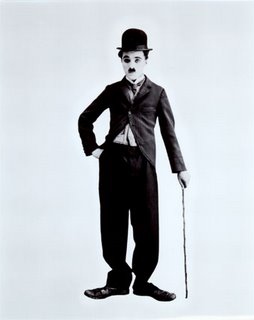
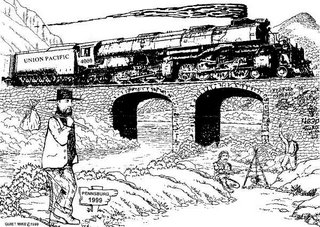
    Such thinking isn't all that surprising. In many ways, rolling against middle class conventions is an old, if odd, American tradition. Rollers are the grandsons and granddaughters of the tramps, loafers, and what the French called flaneurs. They're the sons and daughters of hobos, travellers, vagabonds, and backpackers. They're essentially slackers on two wheels. As such they draw the unwelcome attention of police and politicians as much as did their peculiar ancestors.

    When the Depression of 1893 threw millions of men and women out of work they hit the roads. State legislatures, as well as business leaders, around the US reacted with horror and enacted highly stringent laws against these tramps. In a surprising response, Governor L. D. Lewelling defended their rights against arbitrary arrest by local police. His Tramp Circular is not only a astonishing reminder of a time when Kansas was progressive but a wonderful statement of why today we have the right to roll along.
    The right to go freely from place to place ... in obedience of a mere whim, is part of that personal liberty guaranteed by the Constitution of the United States to every human being on American soil. If voluntary idleness is not forbidden; if a Diogenes prefer poverty; if a Columbus choose hunger and the discovery of a new race, rather than seek personal comfort by engaging in “some legitimate business,” I am aware of no power in the legislature or in city councils to deny; him the right to seek happiness in his own way, so long as he harms no other, rich or poor; but let simple poverty cease to be a crime.
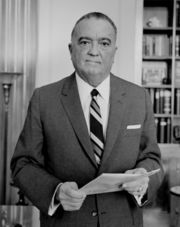
    Not that I'm all that comfortable with labeling rollers, Slackers on Two Wheels. In the wrong mouths, labels can be dangerous. If you think that mere words can't harm, remember that J. Edgar Hoover threw stick and stones at the bones of the rollers' ancestors. During WWI, he was a special agent for the newly formed FBI in charge of Slacker Raids. Agents and civilian vigilantes rounded up foreigners, conscientious objectors, left-leaning idealists, and other outsiders for indefinite detention. Although some were certainly spies and draft-dodgers, most were simply expressing their rights to roll against war hysteria.

    Today, rollers, whatever their particular values or ideologies, continue to ride for the right to seek happiness in their own way.

    Labels: , ,

    10.8.09

    Bikers behaving badly?

    Boston responds...

    Labels: , ,

    7.8.09

    Know when to fold 'em!

    Dominic Hargreaves's
    The Contortionist...


    has been shortlisted for this year's £10,000 James Dyson Award for innovation. The 24-year-old, from Battersea, London, said he wanted to create a decent folding bike after the one he was using collapsed.
    I couldn't find a folding bicycle I liked. I wanted something that could take a bit of punishment and that you could have fun with. So I made one myself.

    Labels: , ,

    3.8.09

    Cops on bikes

    25.7.09

    Pedal to Pierogis

    Whiting, IN turns over
    a new pierogi!


    We're rolling south of the border today! Pierogi Fest is the one-of-a-kind festival that draws people from all over the Great Lakes. Although it revolves around the simple stuffed dumpling, it’s really a huge three-day celebration of Polish culture. With musical entertainment, kids activities, contests and a parade, there’s more to Pierogi Fest than just pierogies. Of course, you’ll find more pierogies there than you ever thought existed, but you’ll also be entertained and warmed by the hospitality and friendliness that the fest produces.

    Labels: , ,

    22.7.09

    Rolling along

    solvitur
    volubilis


    I thought I'd start today's post by brushing up on my high school Latin. I don't think any Roman or Catholic ever said this. My inspiration is a more famous Latin phrase that I've always loved: Solvitur Ambulando.

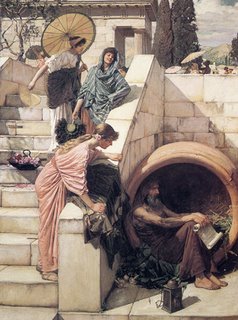
    It is solved by walking was first said by Diogenes the Cynic. It's come to be an appeal to practical experience when confronting any problem. Diogenes believed that pragmatic reason rather than tradition is the only guide for living one's life. If folks don't use reason to guide their conduct it would be better to treat them like animals and lead them on a leash.

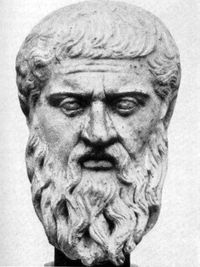
    Diogenes was considered a royal- pain-in-the-ass by his fellow Greeks. His devotion to practical experience was an overt criticism of the herd mentality of conventional Greek society; so much so that Plato referred to him as a Socrates gone mad. Later, Diogenes Laertius, in his Lives of the Eminent Philosophers, described this approach to life:
    Most people, he would say, are so nearly mad that a finger makes all the difference. For if you go along with your middle finger stretched out, some one will think you mad, but, if it’s the little finger, he will not think so.
    It should come as no surprise then that I believe that Diogenes's words offer a good guide for rollers. I've been finding all kinds of examples of folks who have solved problems by rolling.

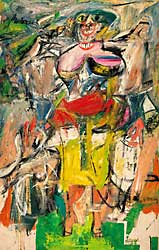
    For example, between 1952 and 1953, Willem de Kooning, the Dutch Abstractionist, painted Woman and Bicycle. Art critics generally agree that this painting is an attempt to come to terms with de Kooning's inner conflicts over women. Some even believe that the aggressively angular image of the woman sitting on a bicycle is inspired by Freud's dream theories of sexual repression.

    Like de Kooning, Charles Wilson Peale, America's first preeminent artist and all around renaissance man, was fascinated by the possibilities of rolling. He invented his own velocipede, Latin for fast foot, "as a welcome diversion from his arduous painting projects". As David V. Herlihy's writes in his book, Bicycle,
    Whenever his back began to ache, he would take a few spins atop his velocipede in the salubrious air of his garden, and return to his easel thoroughly invigorated.
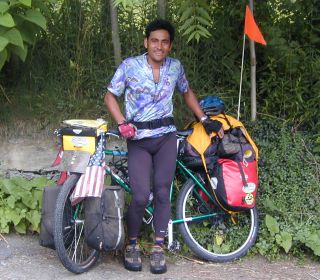
    In our own century, many bikers have realized that it is solved by rolling. Setting out from his home in Nepal on 29 November 1998, Pushkar Shah circumnavigated the world over the next eleven years. Why? In 1990, the Nepalese government arrested him for participating in the country's democracy movement. When he was released, Shah decided to spread the message of peace and hope for his country and for the world. This mission was not about material gain or international fame. It was simply about spreading the message of peace.

    Whether for peace or future opportunities or relaxation or psychological closure, solvitur volubilis recommends itself because the open road is where anyone can think and reflect on their life and times. Utility is certainly important. Many bike just for that. Nevertheless, it is solved by rolling opens us up to many amazing possibilities.

    Labels: , ,

    18.7.09

    Walter Cronkite, biker

    1916-2009


    As a boy, he used his bike as a drugstore delivery boy and enjoyed
    [t]he usual boyhood/early teen activities...: the Boy Scouts and DeMolay (the junior Masonic order), roller hockey and bicycle polo (except on those hot summer days when our wheels sunk in the goo of Houston's Tarvia streets)...
    That got me thinking about Pimp My Mallet, the website for Oxford University bike polo enthusiasts. There's also the article on North American bike polo by Rhiannon Coppin. She's a reporter for The Tyee who played a match in VC/BC (Vancouver) in 2006. Her article, Polo Goes Populist, describes the sport and a bit of its history.
    Vancouver-based chopper-cycle builder, bicycle aficionado, and artist RedSara invited this writer to a weekly 11 a.m. bicycle polo match, held every Sunday in good weather on the gravel turf at Vancouver ’s Britannia Community Centre.

    Played three or four players per side, cyclists – or rather members of Vancouver ’s cycling community and repair centres – mount their steeds and proceed to whack a street-hockey ball across the field and between one of two hastily-constructed upright goal posts.

    The mallets are homemade, constructed from either sawed-off golf clubs or ski poles with hard-plastic tubing or cutting-board cut-outs pinned and duct-taped to the ends. Sometimes frustrating, always challenging, often fun, players finished two games to ten points before they wrapped up another Sunday on the pitch.
    There used to be the International Bicycle Polo Federation based in Jaipur, India and Richland, WA. It hosted seven world championships, the last in 2004. Although India dominated most the USA finally won the 7th in VC/BC. Member countries also include Canada, France, Germany, Malaysia, Pakistan, Sri Lanka, and the UK.

    Over at the Pimp My Mallet blog, which hasn't been updated in a while, there's a link Mad Bike Polo. It's got a YouTube vid of the 2006 Midwest Bike Polo Championships held in Madison, WI. Chicago hosted it the next year.

    Labels: , ,

    17.7.09

    Ode to cigarettes redux

    if only he
    had a bike


    Labels: , ,

    16.7.09

    Fixie prix & elegant chix

    at least
    they roll!


    Something weird is going on with the Vélotariat. The well-trod debates over bike lanes, critical mass etiquette, and proper frame-sizing have given way to a growing rancor towards bike fashions. I'm not talking here about whether you should cover your ride with guerrilla stickers or colorful electrical tape. Rather there's been a fascinating reaction to the clothes in which folks choose to roll. Over at Manolith, a UK-based men's lifestyle site, Yosef Solomon posted 13 Reasons Why the Fixies Fad Should End Now! The usual criticisms of obnoxious attitudes and dicey braking practices take a backseat to fashion posers. As Yusef states:
    It seems to be a sad fact that every “underground” fashion scene will inevitably be taken over by pretentious wannabes. The most recent victim of this trend is that of the once-edgy bike messengers. Actual bike messengers are now faced with the decision to either just suck it up and be confused with mobs of posers, or simply change careers ... Since the whole Fixed Gear trend has finally been maxed out on douche, we thought it fitting to call this fad out for what it is.
    Meanwhile critics are setting their sights on the fixie prix's more well-heeled colleagues. The Pipeline, for example, recently took aim at The Sartorialist. Created by Scott Schuman, this blog documents high-end street fashionistas in New York, Milan, and Paris. Many of the posts show incredibly elegant chics and gents. In contrast to Manolith, Pipeline seems particularly cranked up over Schuman's choice of purportedly upper middle-class subjects. It even provides a helpful flowchart explaining how you can get Shot by Scot. If you're a man, it helps to be old, rich and European. If you're a woman, be model pretty or wear a quirky hat. Either way a vintage bike will pretty much guarantee you a spot. Slate's Julia Turner, who first mentioned this critique, defends Scott even though ...
    Gathered together, his subjects often seem rich and pampered, too many fashionistas wearing the same expensive and unwieldy shoes.
    She can't help loving his work because his focus on facial expressions goes behind the togs. Even though his subjects form a limited spectrum, his photos expose joy, wit, and candor. She feels as if she's met these folks before.

    Labels: , ,

    14.7.09

    Lords of the Ring

    sword swinging,
    bike pedaling warriors
    avenge
    the destruction
    of their friends bike


    Labels: , ,

    11.7.09

    Sierra Club gears up

    to hike, bike,
    and paddle


    The venerable enviro-org has launched a new website, Sierra Club Trails. It's up and running in a beta test now, and they're planning to launch it soon. As far as I know, the site is the first-ever comprehensive hiking wiki where anyone can post their favorite trails for hiking, biking, even water trails for kayaking. Anyone else then can edit the So if I post a route to Milwaukee, anyone who rode it recently can update road conditions, construction, traffic, etc.


    It's also an online community where users can create profiles and meet other bikers, hikers, surfers, you name it, and join discussion forums with topics like the best trail mix recipe or whether guns should be allowed in national parks. Community members can form groups around a particular outdoor interest or place. So it features tips for outdoor adventurers alike, a birding blog, photo contests, and Nature Notes, a series of audio features based on interviews with naturalists and Sierra Club Outings leaders.

    Labels: , ,