Bicycle Diaries: August 2006

Recent Posts

31.8.06

Toronto rolls!

One of the best bike blogs out there is Martino's Bike Lane Diary. He's up north of us in Toronto. Here in Chicago, folks tend to think of our Canadian neighbor as a smaller, cleaner, and ... more polite version of Chicago. I've worked up there a couple of times and can't agree more.

I especially enjoy his photos. Although Martino's posts are less wordy then mine, he really captures the feel of rolling through Toronto. It may be a generational thing. I find that older bikes such as myself rely more on verbal rather than visual expression as do younger bikers.

Also, the site's a good way to get an idea of how bike advocacy translates in Canadian. His links are both comprehensive and interesting without being too serious.

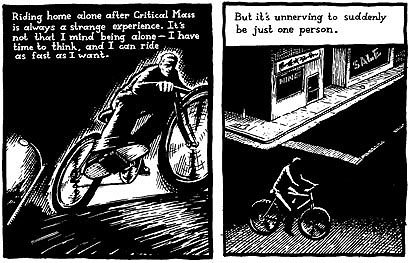
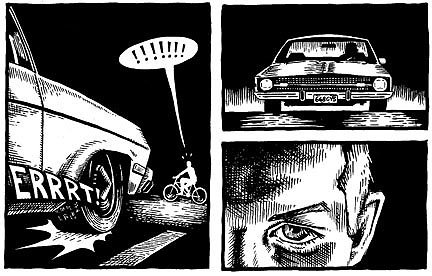
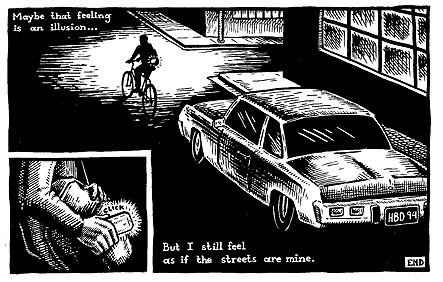
After Toronto's August Critical Mass he posted the following comic from Jim Dyer's Scorcher. I really sums up the feelings I've had each time rolling home from a mass by myself. Enjoy!


Labels: , ,

30.8.06

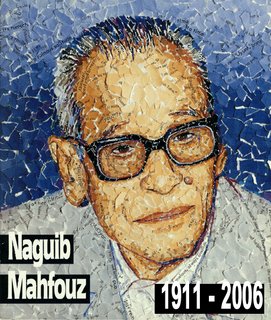
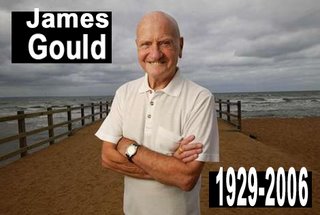
James Gould & Naguib Mahfouz

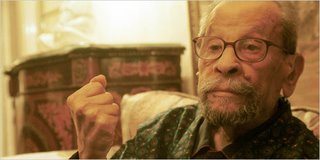
Both gentlemen died last Saturday. Nearly the same age, they had lived on different continents and in different cultures. Bikes were not a small part of their lives. Because of that they left their particular worlds better places for the rest of us, bikers and cagers alike.

Gould, before settling down in Melbourne, Australia, travelled the world by cargo ship and bike. He remained active in his retirement with regular long walks along the Beach Road. His rucksack contained a bird-guide, camera, and precisely filled-in notebooks. Last Saturday, his daily routine came to a shocking end when a biker participating in the Hell Ride hit him at about 60mph. He died the next day.

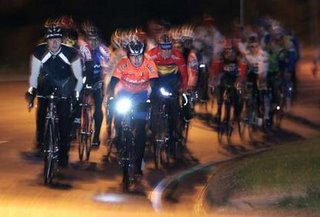
Hell Ride is a weekly bicycle race with no organization and fewer rules. Running red lights, hopping sidewalks, and blocking lanes is common. It's a lycra critical mass fueled by amphetamines. After the accident, the bikers gathered, not unlike massers after a bad confrontation with a cager, to blame their irresponsible colleagues and claim that these few idiots don't represent the majority.

That same day, Naguib Mahfouz died. Winning the Nobel Prize for Literature in 1988, his books have since travelled the world. In a region overwhelmed by angery piety and righteous hatred, his novels explored the blessings and burdens of Islam in a secular world.

So strong was his voice that in 1994 he was attacked outside his home by Muslim extremists incensed by his treatment of religious themes in the book. One of his last works, The Dreams, begins with a brief story about an impoverished narrator searching for a cheap meal.
I was riding my bicycle from one place to another, driven by hunger, in search of a restaurant fit for my limited means.
Neither Mahfouz, internationally reknowned, nor Gould, locally admired, let their own limited means prevent them from enriching our world.

Labels: , , ,

28.8.06

Da Vinci rolled?

Dan Brown's mystery thriller, The Da Vinci Code, as well as the subsequent Tom Hanks film, is not the first attempt to enhance the genius of the already remarkable Renaissance Man. Just google Leonardo da Vinci bicycle; you'll get to choose from 365,000 webpages in English alone.

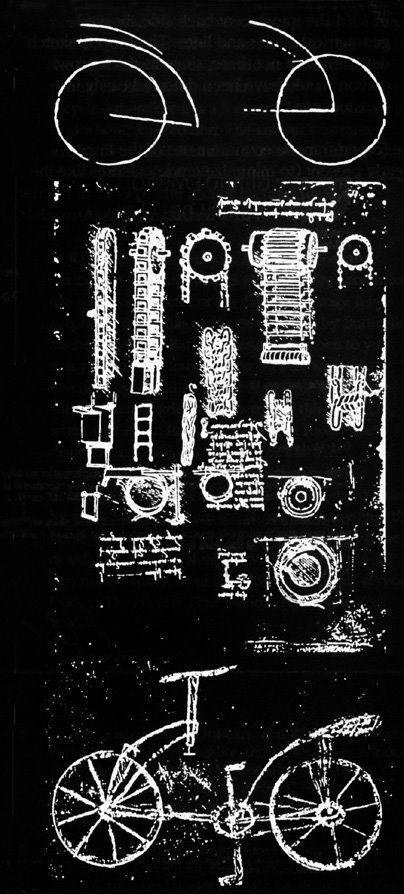
The widespread belief that Da Vinci invented the bike rests on a discovery of this page in the Codex Atlanticus during it's restoration in 1974. I've inverted it using photoshop to highlight the details. The website of the Istituto e Museo di Storia della Scienza in Florence states that the codex
is the largest collection of Leonardo's manuscript sheets, formed at the end of the sixteenth century by the sculptor Pompeo Leoni, who dismembered many original notebooks.
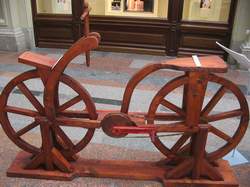
Ever since, Leonardo's bike has provoked intense controversy. What everyone agrees on is that the elements are surprisingly modern. The drive train, headset, and wheels remind me of a fat-tire retro-cruiser.

The only differences are with the handlebars, frame, seat stem, and of course, it's wooden construction. Imagine steering it. You would have to shift your entire body to turn it left or right. I also think you'ld have a tough time trying to keep from sliding down the seat. And what about splinters?

What nobody agrees on is the bike's authenticity. Again, goolge Leonardo d Vinci's bicycle hoax. That will get you 18,500 English webpages. Roughly a quarter celebrates Italy as the apparent birthplace of the modern bike. Museums from Italy to Australia have Da Vinci exhibits feature full-sized models. In May, Moscow's 6th Open Festival of Arts on Sweet Cherry Woods announced,
It is difficult to find essential differences between Leonardo’s wooden bicycle and its modern analogue. The bicycle’s drawings found during the restoration of Atlantic Codex were so unexpected that they raised doubts and debates among scientists.
It isn't necessarily the unexpected modernity that has made most bike historians skeptical. It's how the bike was discovered. Literary historian Augusto Marinoni announced his find in 1974 with a great deal of fanfare as well as arguments anticipating accusations of a probable hoax. Essentially, the restoration process had revealed sketches which had previously gone unnoticed. The technical details of this process are complex so I won't even try to describe them. If you're interested, check out San Francisco-based Cycle Publishing. It has the most popular article arguing that the bike is a hoax.

The ultimate authenticity of Leonardo's bike doesn't actually interest me; although the evidence favoring a hoax is very convincing to me. What actually fascinates me is the often ferocious debate over which country is the birthplace of the bike. Before Marinoni came along 19th and early 20th Century French, Spanish, and German scholars made their own ambiguous claims. And today, Italian museums and scholars with their American supporters contiune to brutally codemn Marinoni's critics.

What this tells me is that the bike is an apt metaphor for a world that is both globalzing and localizing. On the one hand, over 60% of the world's population uses bikes in their daily lives and work. Not surprisngly, the vast majority of bikers are in the developing world. On the other hand, every country has made the bike its own; some going as far as to claim it as their unique invention.

Perhaps anticipating this debate in 1949, the Italian writer (and yet another fascist bike freak), Curzio Malaparte, wrote in the Paris Sport Digest:
In Italy, the bicycle belongs to the national art heritage in the same way as Mona Lisa by Leonardo, the dome of St. Peter or the Divine Comedy. It is surprising that it has not been invented by Botticelli, Michelangelo, or Raffael. Should it happen to you, that you voice in Italy that the bicycle was not invented by an Italian you will see: All miens turn sullen, a veil of grief lies down onto the faces. Oh, when you say in Italy, when you say loudly and distinctly in a café or on the street that the bicycle—like the horse, the dog, the eagle, the flowers, the trees, the clouds—has not been invented by an Italian (for it were the Italians that invented the horse, the dog, the eagle, the flowers, the trees, the clouds) then a long shudder will run down the peninsula’s spine, from the Alps to the Eatna.
This reminds me of those times I have talking with Chicago bikers when I got the distinct feeling that they think they'd invented bikes, if not bike culture. Or take the freakbikers. They certainly have their own claims on the bike's origins as they continuously come up with a dizzying array of new frame contortions. As the heirs of Leonardo's wild experimentations, they should get credit for being the true (re)inventors of the bike.

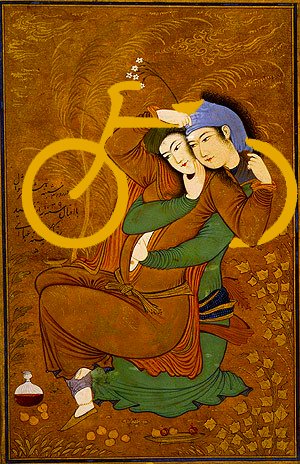
In either case, whether or not Leonardo first imagined the modern bike, the bike has entered the popular imagination of the world. So much so that it has become a prevalent metaphor among writers, musicians, and artists...

... and
this
humble
blogger.

Labels: , , , , ,

27.8.06

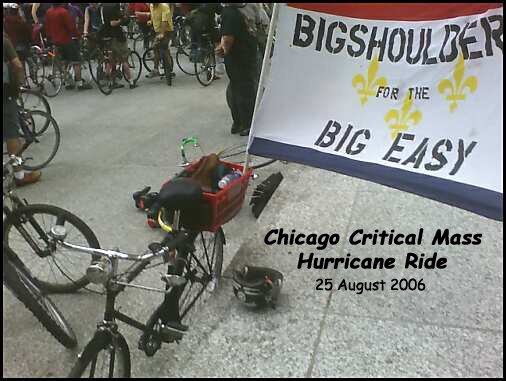
Hurricane ride

This was the first mass that I got to Daley Plaza early, maybe around 5 o'clock. I wanted enough time to hoist my City of New Orleans flag on the back of That Which Rolls. I pitched camp at the east side of the Picasso sculpture.

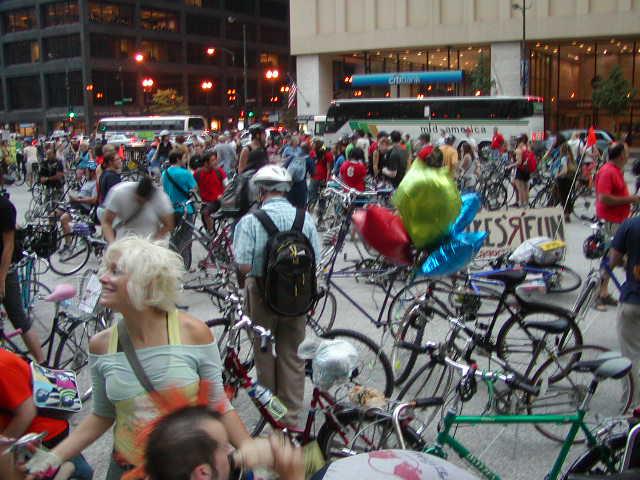
There were a few folks there, mostly bike messengers by themselves in twos and threes. Nobody talked much. A few slowly orbited their bikes round and round the Picasso observing the unhurried increase of the crowd. The rest of us, bikes parked, sat or more comfortably, lounged marking the time with reading or bike decorating. I was writing this.

Pedestrians hurried by on their way to parking garages or trains. Tourists, nearly all familes, coming to see the Picasso, lingered to photograph the freakbikes. Another popular subject was a woman's bike with plastic brown-and-yellow butterflies swarming the back rack and handlebars. A camera team interview Alex who founded and leads West Town Bikes. It's a learning space to teach bicycle maintenance and repair to youth in and around Ukranian Village.

By 5:30, the plaza was beginning to fill. It didn't seem there would be as many massers as we had at the May and June masses. Scattered thunderstorms had been predicted. The air was cool and heavy. Something like thunder ripped towards the north but that was it.

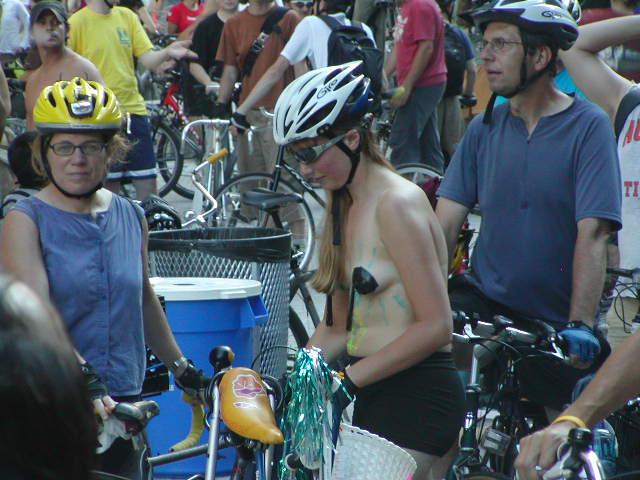
The first massers I knew showed up a little before 6. Willow, the pasties lady, was getting hassled by the cops. I hadn't seen her in 3 or 4 years until I started massing again. She used to date this local writer I once subsidized.

Howard was setting up the sound-system on his bike trailer. He's one of the inner core of mass old-timers. I met him at one of the mass happy hours a few months back. Ever since I've talked to him at various bike events he helps with like the Green Drinks Chicago Eco-Transportation Show.

A little after six the voting for the night's got underway. There were four routes: two to the north and two to the south. It took a while to decide. Eventually, the great xerocracy reached a rather loud compromise based on the two northern routes. The route took us through the more upscale neighborhoods of the northside ending at Foster Beach.

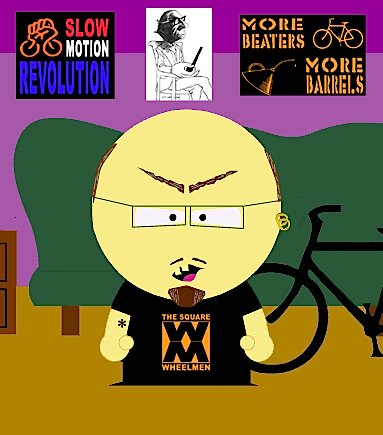
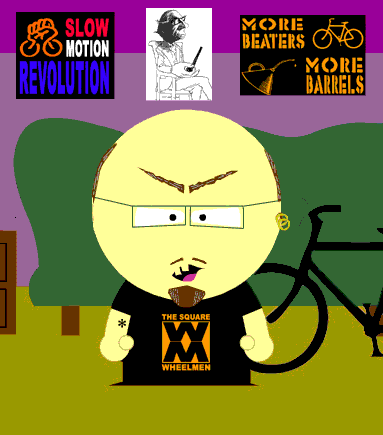
The roll was great. It was the first where I really felt like a part of the crowd as we went along talking and singing. I got so inspired that I plundered my all-time favorite cartoon to portray me new self as a full-fledged masser!
Thanks to Bob Kastigar who supplied all the mass shots accept for my bike and the Southpark plunder. You can check out his other mass photos here. He also has a great biking adventures website here.

Labels:

26.8.06

Taming the bicycle

Bruce Chatwin once said that there are two kinds of reading: for pure pleasure and for plunder. While lounging today after last night's Hurricane Ride for the August Chicago Critical Mass I was pleasure reading the Nichomachus blog. Then I decided to plunder; specifically its post on Camus's roll through Nazi-occupied France. It's a fantastic blog; so much so that it inspired today's post about Mark Twain.

I've known about Twain's famously ironic bike quote for some time now. A couple of weeks ago I used it for a t-shirt design. Recently I discovered its source at The Bike Reader. In 1917, the New York publishers, Harper and Brothers published a collection of his essays seven years after he died.

What is Man? And Other Essays is strange collection. Twain wrote the essays in the last years of his life whis his genious as a wry humorist had given way to a contankerous pessimism. Taming the Bicycle, written but unpublished in 1906, is nevertheless classic Twain. At the turn of the century, Mark Twain learned to ride one of the old high-wheel, or Penny-Farthing, bicycles of that period...
I thought the matter over, and concluded I could do it. So I went down and bought a barrel of Pond's Extract and a bicycle. The Expert came home with me to instruct me. We chose the back yard, for the sake of privacy, and went to work.

Mine was not a full-grown bicycle, but only a colt -- a fifty-inch, with the pedals shortened up to forty-eight -- and skittish, like any other colt. The Expert explained the thing's points briefly, then he got on its back and rode around a little, to show me how easy it was to do. He said that the dismounting was perhaps the hardest thing to learn, and so we would leave that to the last. But he was in error there. He found, to his surprise and joy, that all that he needed to do was to get me on to the machine and stand out of the way; I could get off, myself. Although I was wholly inexperienced, I dismounted in the best time on record. He was on that side, shoving up the machine; we all came down with a crash, he at the bottom, I next, and the machine on top.

We examined the machine, but it was not in the least injured. This was hardly believable. Yet the Expert assured me that it was true; in fact, the examination proved it. I was partly to realize, then, how admirably these things are constructed. We applied some Pond's Extract, and resumed. The Expert got on the other side to shove up this time, but I dismounted on that side; so the result was as before.

The machine was not hurt. We oiled ourselves up again, and resumed. This time the Expert took up a sheltered position behind, but somehow or other we landed on him again.

He was full of surprised admiration; said it was abnormal. She was all right, not a scratch on her, not a timber started anywhere. I said it was wonderful, while we were greasing up, but he said that when I came to know these steel spider-webs I would realize that nothing but dynamite could cripple them. Then he limped out to position, and we resumed once more. This time the Expert took up the position of short-stop, and got a man to shove up behind. We got up a handsome speed, and presently traversed a brick, and I went out over the top of the tiller and landed, head down, on the instructor's back, and saw the machine fluttering in the air between me and the sun. It was well it came down on us, for that broke the fall, and it was not injured.

Five days later I got out and was carried down to the hospital, and found the Expert doing pretty fairly. In a few more days I was quite sound. I attribute this to my prudence in always dismounting on something soft. Some recommend a feather bed, but I think an Expert is better.

The Expert got out at last, brought four assistants with him. It was a good idea. These four held the graceful cobweb upright while I climbed into the saddle; then they formed in column and marched on either side of me while the Expert pushed behind; all hands assisted at the dismount.

The bicycle had what is called the 'wabbles', and had them very badly. In order to keep my position, a good many things were required of me, and in every instance the thing required was against nature. Against nature, but not against the laws of nature. That is to say, that whatever the needed thing might be, my nature, habit, and breeding moved me to attempt it in one way, while some immutable and unsuspected law of physics required that it be done in just the other way. I perceived by this how radically and grotesquely wrong had been the lifelong education of my body and members. They were steeped in ignorance; they knew nothing - nothing which it could profit them to know. For instance, if I found myself falling to the right, I put the tiller hard down the other way, by a quite natural impulse, and so violated a law, and kept on going down. The law required the opposite thing - the big wheel must be turned in the direction in which you are falling. It is hard to believe this, when you are told it . And not merely hard to believe it, but impossible; it is opposed to all your notions. And it is just as hard to do it, after you do come to believe it. Believing it, and knowing by the most convincing proof that it is true, does not help it: you can't any more do it that you could before; you can neither force nor persuade yourself to do it at first. The intellect has to come to the front, now. It has to teach the limbs to discard their old education and adopt the new.

The steps of one's progress are distinctly marked. At the end of each lesson he knows he has acquired something, and he also knows what that something is, and likewise that it will stay with him. It is not like studying German, where you mull along, in a groping, uncertain way, for thirty years; and at last, just as you think you've got it, they spring the subjunctive on you, and there you are. No -- and I see now, plainly enough, that the great pity about the German language is, that you can't fall off it and hurt yourself. There is nothing like that feature to make you attend strictly to business. But I also see, by what I have learned of bicycling, that the right and only sure way to learn German is by the bicycling method. That is to say, take a grip on one villainy of it at a time, and learn it -- not ease up and shirk to the next, leaving that one half learned.

When you have reached the point in bicycling where you can balance the machine tolerably fairly and propel it and steer it, then comes your next task -- how to mount it. You do it in this way: you hop along behind it on your right foot, resting the other on the mounting-peg, and grasping the tiller with your hands. At the word, you rise on the peg, stiffen your left leg, hang your other one around in the air in a general and indefinite way, lean your stomach against the rear of the saddle, and then fall off, maybe on one side, maybe on the other; but you fall off. You get up and do it again; and once more; and then several times.

By this time you have learned to keep your balance; and also to steer without wrenching the tiller out by the roots (I say tiller because it is a tiller; "handle-bar" is a lamely descriptive phrase). So you steer along, straight ahead, a little while, then you rise forward, with a steady strain, bringing your right leg, and then your body, into the saddle, catch your breath, fetch a violent hitch this way and then that, and down you go again.

But you have ceased to mind the going down by this time; you are getting to light on one foot or the other with considerable certainty. Six more attempts and six more falls make you perfect. You land in the saddle comfortably, next time, and stay there -- that is, if you can be content to let your legs dangle, and leave the pedals alone a while; but if you grab at once for the pedals, you are gone again. You soon learn to wait a little and perfect your balance before reaching for the pedals; then the mounting-art is acquired, is complete, and a little practice will make it simple and easy to you, though spectators ought to keep off a rod or two to one side, along at first, if you have nothing against them.

And now you come to the voluntary dismount; you learned the other kind first of all. It is quite easy to tell one how to do the voluntary dismount; the words are few, the requirement simple, and apparently undifficult; let your left pedal go down till your left leg is nearly straight, turn your wheel to the left, and get off as you would from a horse. It certainly does sound exceedingly easy; but it isn't. I don't know why it isn't, but it isn't. Try as you may, you don't get down as you would from a horse, you get down as you would from a house afire. You make a spectacle of yourself every time.

During eight days I took a daily lesson of an hour and a half. At the end of this twelve working-hours' apprenticeship I was graduated -- in the rough. I was pronounced competent to paddle my own bicycle without outside help. It seems incredible, this celerity of acquirement. It takes considerably longer than that to learn horseback-riding in the rough.

Now it is true that I could have learned without a teacher, but it would have been risky for me, because of my natural clumsiness. The self-taught man seldom knows anything accurately, and he does not know a tenth as much as he could have known if he had worked under teachers; and, besides, he brags, and is the means of fooling other thoughtless people into going and doing as he himself had done. There are those who imagine that the unlucky accidents of life - life's "experiences" - are in some way useful to us. I wish I could find out how. I never knew one of them to happen twice. They always change off and swap around and catch you on your inexperienced side. If personal experience can be worth anything as an education, it wouldn't seem likely that you could trip Methuselah; and yet if that old person could come back here it is more than likely that one of the first things he would do would be to take hold of one of these electric wires and tie himself all up in a knot. Now the surer thing and the wiser thing would be for him to ask somebody whether it was a good thing to take hold of. But that would not suit him; he would be one of the self-taught kind that go by experience; he would want to examine for himself. And he would find, for his instruction, that the coiled patriarch shuns the electric wire; and it would be useful to him, too, and would leave his education in quite a complete and rounded-out condition, till he should come again, some day, and go to bouncing a dynamite-can around to find out what was in it.

But we wander from the point. However, get a teacher; it saves much time and Pond's Extract.

Before taking final leave of me, my instructor inquired concerning my physical strength, and I was able to inform him that I hadn't any. He said that that was a defect which would make up-hill wheeling pretty difficult for me at first; but he also said the bicycle would soon remove it. The contrast between his muscles and mine was quite marked. He wanted to test mine, so I offered my biceps -- which was my best. It almost made him smile. He said, "It is pulpy, and soft, and yielding, and rounded; it evades pressure, and glides from under the fingers; in the dark a body might think it was an oyster in a rag." Perhaps this made me look grieved, for he added, briskly: "Oh, that's all right; you needn't worry about that; in a little while you can't tell it from a petrified kidney. Just go right along with your practice; you're all right."

Then he left me, and I started out alone to seek adventures. You don't really have to seek them -- that is nothing but a phrase -- they come to you.

I chose a reposeful Sabbath-day sort of a back street which was about thirty yards wide between the curbstones. I knew it was not wide enough; still, I thought that by keeping strict watch and wasting no space unnecessarily I could crowd through.

Of course I had trouble mounting the machine, entirely on my own responsibility, with no encouraging moral support from the outside, no sympathetic instructor to say, "Good! now you're doing well -- good again -- don't hurry -- there, now, you're all right -- brace up, go ahead." In place of this I had some other support. This was a boy, who was perched on a gate-post munching a hunk of maple sugar.

He was full of interest and comment. The first time I failed and went down he said that if he was me he would dress up in pillows, that's what he would do. The next time I went down he advised me to go and learn to ride a tricycle first. The third time I collapsed he said he didn't believe I could stay on a horse-car. But next time I succeeded, and got clumsily under way in a weaving, tottering, uncertain fashion, and occupying pretty much all of the street. My slow and lumbering gait filled the boy to the chin with scorn, and he sung out, "My, but don't he rip along!" Then he got down from his post and loafed along the sidewalk, still observing and occasionally commenting. Presently he dropped into my wake and followed along behind. A little girl passed by, balancing a wash-board on her head, and giggled, and seemed about to make a remark, but the boy said, rebukingly, "Let him alone, he's going to a funeral."

I had been familiar with that street for years, and had always supposed it was a dead level; but it was not, as the bicycle now informed me, to my surprise. The bicycle, in the hands of a novice, is as alert and acute as a spirit-level in the detecting of delicate and vanishing shades of difference in these matters. It notices a rise where your untrained eye would not observe that one existed; it notices any decline which water will run down. I was toiling up a slight rise, but was not aware of it. It made me tug and pant and perspire; and still, labor as I might, the machine came almost to a standstill every little while. At such times the boy would say: "That's it! take a rest - there ain't no hurry. They can't hold the funeral without you."

Stones were a bother to me. Even the smallest ones gave me a panic when I went over them. I could hit any kind of a stone, no matter how small, if I tried to miss it; and of course at first I couldn't help trying to do that. It is but natural. It is part of the ass that is put in us all, for some inscrutable reason.

I was at the end of my course, at last, and it was necessary for me to round to. This is not a pleasant thing, when you undertake it for the first time on your own responsibility, and neither is it likely to succeed. Your confidence oozes away, you fill steadily up with nameless apprehensions, every fiber of you is tense with a watchful strain, you start a cautious and gradual curve, but your squirmy nerves are all full of electric anxieties, so the curve is quickly demoralized into a jerky and perilous zigzag; then suddenly the nickel-clad horse takes the bit in its mouth and goes slanting for the curbstone, defying all prayers and all your powers to change its mind -- your heart stands still, your breath hangs fire, your legs forget to work, straight on you go, and there are but a couple of feet between you and the curb now. And now is the desperate moment, the last chance to save yourself; of course all your instructions fly out of your head, and you whirl your wheel away from the curb instead of toward it, and so you go sprawling on that granite-bound inhospitable shore. That was my luck; that was my experience. I dragged myself out from under the indestructible bicycle and sat down on the curb to examine.

I started on the return trip. It was now that I saw a farmer's wagon poking along down toward me, loaded with cabbages. If I needed anything to perfect the precariousness of my steering, it was just that. The farmer was occupying the middle of the road with his wagon, leaving barely fourteen or fifteen yards of space on either side. I couldn't shout at him -- a beginner can't shout; if he opens his mouth he is gone; he must keep all his attention on his business. But in this grisly emergency, the boy came to the rescue, and for once I had to be grateful to him. He kept a sharp lookout on the swiftly varying impulses and inspirations of my bicycle, and shouted to the man accordingly:

"To the left! Turn to the left, or this jackass'll run over you!" The man started to do it. "No, to the right, to the right! Hold on! that won't do! -- to the left! -- to the right! -- to the left! -- right! left -- ri -- Stay where you are, or you're a goner!"

And just then I caught the off horse in the starboard and went down in a pile. I said, "Hang it! Couldn't you see I was coming?"

"Yes, I see you was coming, but I couldn't tell which way you was coming. Nobody could -- now, could they? You couldn't yourself -- now, could you? So what could I do?"

There was something in that, and so I had the magnanimity to say so. I said I was no doubt as much to blame as he was.

Within the next five days I achieved so much progress that the boy couldn't keep up with me. He had to go back to his gate-post, and content himself with watching me fall at long range.

There was a row of low stepping-stones across one end of the street, a measured yard apart. Even after I got so I could steer pretty fairly I was so afraid of those stones that I always hit them. They gave me the worst falls I ever got in that street, except those which I got from dogs. I have seen it stated that no expert is quick enough to run over a dog; that a dog is always able to skip out of his way. I think that that may be true; but I think that the reason he couldn't run over the dog was because he was trying to. I did not try to run over any dog. But I ran over every dog that came along. I think it makes a great deal of difference. If you try to run over the dog he knows how to calculate, but if you are trying to miss him he does not know how to calculate, and is liable to jump the wrong way every time. It was always so in my experience. Even when I could not hit a wagon I could hit a dog that came to see me practise. They all liked to see me practise, and they all came, for there was very little going on in our neighborhood to entertain a dog. It took time to learn to miss a dog, but I achieved even that.

I can steer as well as I want to, now, and I will catch that boy out one of these days and run over him if he doesn't reform.

Get a bicycle. You will not regret it, if you live.

Labels: , ,

25.8.06

Reflections

Today I'm in Raleigh 3speed paradise. I found the mother of all 3speed organizations on the web: The Lake Pepin 3-Speed Tour. Noel Robinson and Jon Sharratt founded this Minnesota touring group back in 2003. Every year in May they gather together Raleigh lovers in Red Wing for a two-day, 85 mile role to Wabasha and back. Like the wheelmen groups, they are dedicated to vintage bikes. Unlike the wheelmen, their focus is the mid-2oth Century or as they describe at their website, cycling through the Golden Era of English cycle touring: the 1930s.

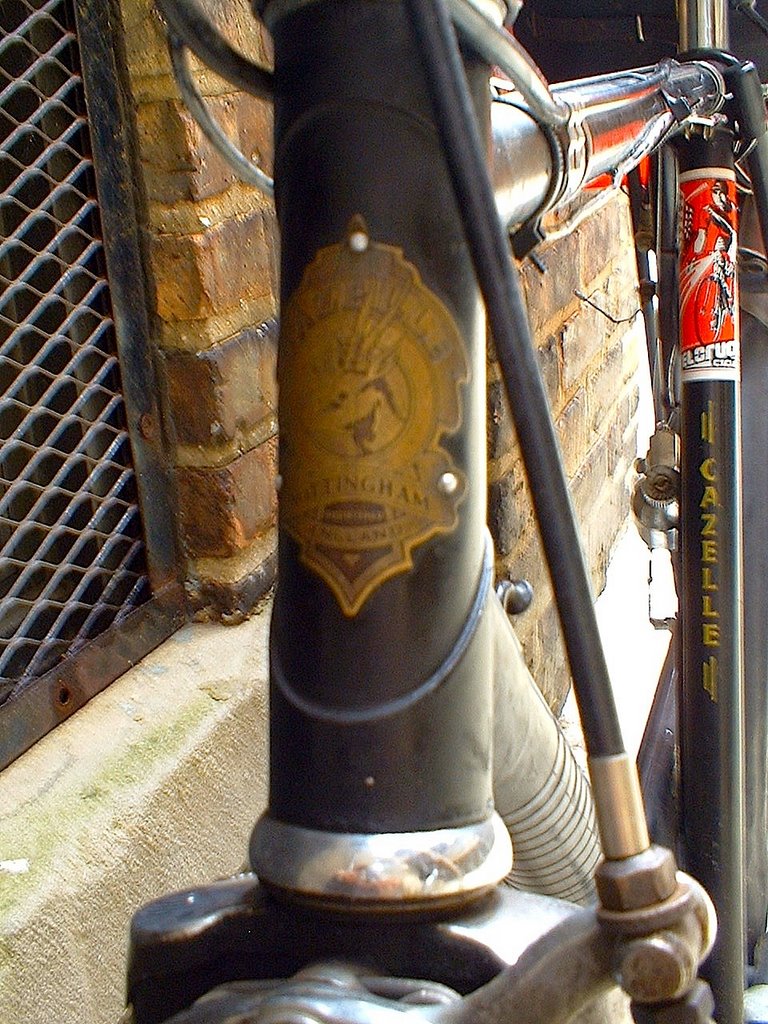
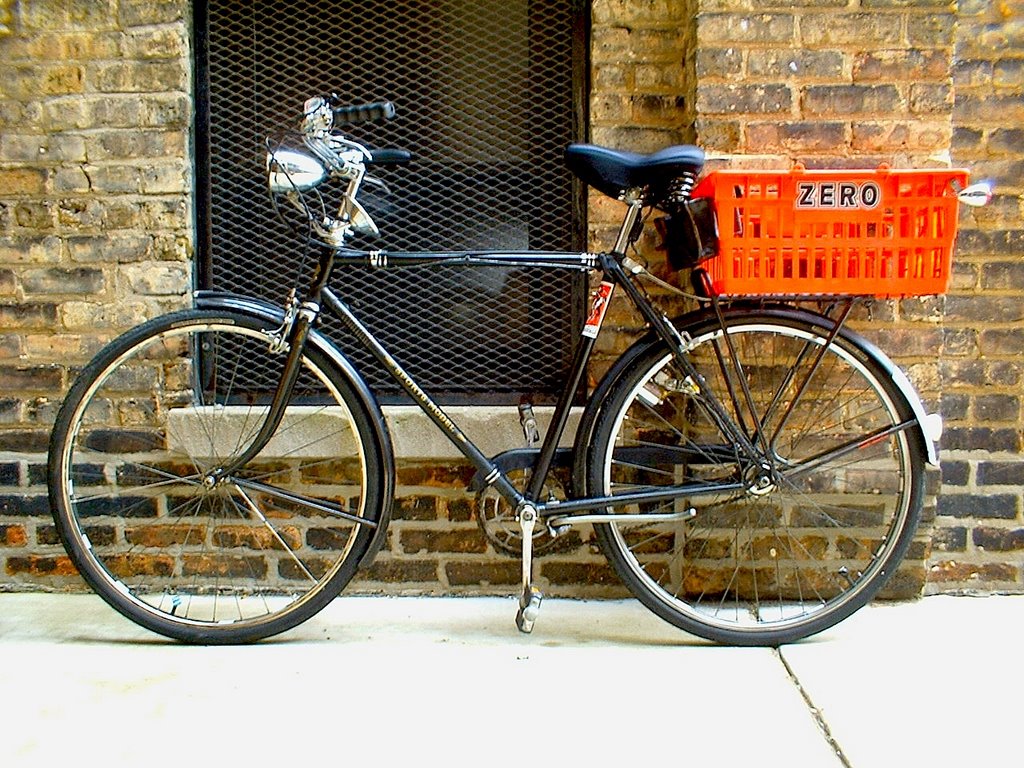
I'm seriously thinking of going in 2007. As many of you know I really love that which rolls, my '62 Raleigh Gazelle. Although it's not from the 30s, it's a classic. I've tried to honor the time period with a Brooks saddle, leather tool bags, as well as bottle generator with rear and front lights. On the other hand, as an urban ultility roller, it has a huge scooter mirror, red plastic Target basket, and Continental tires. So I'm wodnering if I'll be able to join them. The website describes the tour as being
based on cycle touring in pre-war England. It was a gentlemanly time; few people owned a car and recreation based on automobiles was extremely limited. To get away for the weekend they would pack a few things, mount up and head to the country ... To gain a better perspective, here is a list of some of the things we leave behind: derailleurs, lycra, target heart rates, SPD, SIS, STI, HRM, XTR, etc. There will be no sprinting, spinning, drafting nor will there be any carbon fiber, drillium or unobtanium. Please note we are not advocating being a retro-grouch or ridicule those with alloy handlebars but instead we are asking you to strip away all you know modern cycling to be and hop aboard your £5 Thrift Store Raleigh and come with.
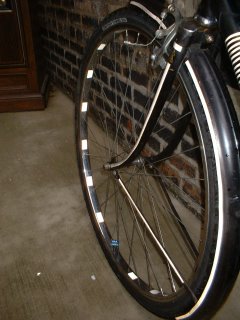
That which rolls also has these incredibly cool pinstripe reflective strips. What makes them cool is that they're virtually invisible during the day. A lot of bikers have these bright fluorescent orange or green strips which would look like hell on my flat black frame. So I spent about three months trawling the web for suitable alternatives.

I finally found them two weeks ago at Reflectively Yours. It's a family business that traces its roots back to 1937 when Grampa Vick launched his successful mail order business out of Gelenview, NY. I usually don't do product endorsements; however, their 3M products are fantastic and relatively cheap.

I took the pictures here in daylight with the flash on. As you can see, it doesn't take much secondary light to brighten up the strips. When I ride at night, which is often, car lights give them an almost neon glow that can be seen for several hundred meters.

I will definitely be rolling the night more often. Perhaps ... I'll even get the chance to do a few rolling dates!?!?!?

Labels: ,

24.8.06

Confessions of a dangerous mind

My good buddy, UffdaDave, has graced us with a post today. He reflects on his adventures in the Two-wheeled Jihad. Dave's one of my closest and oldest friends. We went to college togther with Beaterbike Dave. Yeah, I know but having all your good friends named Dave prevents me from forgetting their names%)

Enjoy...

Bicycle Diaries asked me to write a guest blogitorial – that’s my cross between a guest blog entry and the traditional guest editorial submitted to mainstream media publications. He sent me an email invitation send my thoughts and I responded with a lightening quick yes.

Wow what an honor, I thought, here I am a budding writer and journalist with my own fledgling blog and now I’m being asked to write for someone else. As quickly as the euphoria had set in, so too did the fear of having to produce something that might be interesting to bicyclists reading the blog.
As an avid bicyclist and a self-taught mechanic I thought I would be able to pull plenty of ideas out my brain and create an entry on any given idea. How about the changing of the flat tire that resulted in a complete brake overall – naw, every bicyclist has had that experience. Maybe the long hot summer ride through the cornfields of Ohio after a job layoff – yeah, like that’s a unique experience. Or an in-depth look at Rails-to-Trails - yawn - I love the organization but the thought is making me sleepy.
Then anxiety began to take control. Sure, I have fond memories of numerous rides throughout my riding career, but nothing I would identify as interesting to anyone other than myself. Hell, for many years I had the best of bike commuting situations – I rode five miles to my office and the office had a locker room with shower. I biked almost every day from March to November. The facilities were great; the job sucked.

And still no inspiration.
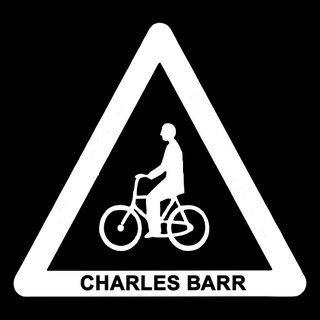
Then I read the August posts of the Bicycle Diaries. If one isn’t too careful, one can become a bit depressed and give up bicycling all together. Too many deaths have occurred as the result of bicycle/car confrontations. Were I live, close to Cleveland, OH, Charles Barr, a young man in his early thirties and a well-respected bassist with the Cleveland Orchestra, lost his life when he lost control of his bike and swerved into the path of a pickup truck. In this case, Mr. Barr was at fault.

But regardless of the fault, in this country there exist very little safe space between auto and bicycle. On too many occasions when tensions run high between the two it is usually the motorist who is unwilling to share the road and the bicyclist who suffers.

Then I got my inspiration.
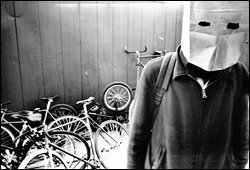
In my younger days I was, what one might call, a bicycle terrorist. I rode the streets and sidewalks like they were paved just for me. I’d weave in and out of traffic, I’d cut off drivers and I’d insult them in a variety of ways. I was hell-on-two wheels and hell-bent on doing things my way despite the consequences.
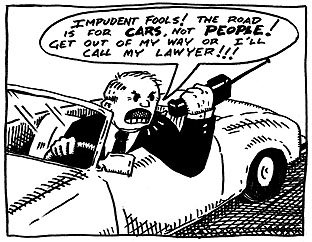
My entry into bicycle terrorism was typical of anyone who eventually winds up in a terrorist organization. As a young man I was a law-abiding citizen; as I grew older I became disillusioned over the inequalities existing between motorist and bicyclist. I turned to the dark side and became a soldier, no a leader, in the jihad against the internal combustion engine.
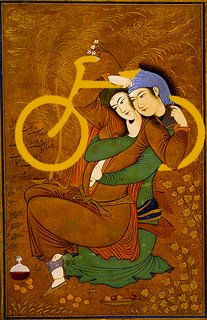
I wonder if 72 virgins would be waiting for me in heaven if I lost my own life while taking the life of an infidel motorist.
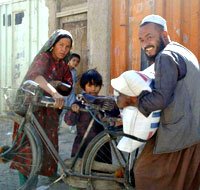
Just as a sidebar, I like writing terrorism and jihad into this article. I have this fantasy that it will send Homeland Security and the Bush Administration into a tizzy trying to figure out my hidden message.

Okay, so back to reality. If someone offended me in traffic I hunted them down and left my mark on their car; if there was a hood ornament I took it a as trophy. I was particularly fond of carrying a piece of brick with me, then if a motorist cut me off I’d mark them right there and then on the spot. My own version of brick-a-hick – a game involving throwing a brick at drunken hicks at small town bars. It was developed by a couple of high school students I met during my teaching days.
[Editor's note: the following from Denmark certainly shows that the US is not the only country suffering from rolling terrorists:

I often hear foreigners saying that Denmark is a quiet country. It's not! It's plagued by gangs of bicycle terrorists. Denmark is a "green" country. That's why so many people are using bicycles as means of transportation. At least that's the official version. The real reason is that new cars are taxed 200%. The bikers are the kings of the road. The highway code does not apply to them, or at least so they think. They bike on pavements, pedestrian crossings, pass red lights, drive opposite the direction in one-way streets, and they don't carry lights when it's dark. Should a police officer dare fining them for such behaviour, they will be seriously offended. When I went to high school in Copenhagen, the teacher came in one morning after having been fined for passing a red light to turn right. He lectured us about how unfair it was. What a way to educate young people! If for some reason they get annoyed with your car driving, they'll politely tell you by bending your antenna or hammering on the roof. Beware that the bicycles enjoy a de facto absolute right of way. If they cause an accident and the car driver is without fault, it's still the car insurance that must pay. This is one of the government's creative ways of punishing car drivers for not riding a bike instead. In communist Denmark, cars are not well seen, because they symbolise the rich. Rich people - or anyone earning an average income or more - are not well seen in Denmark, because they ought to share all their wealth with the poor.]
However, I bought a motorcycle and then a car and soon I was commuting on a regular basis. In time a family came along that resulted in the addition of a minivan (although I still respect bicyclist and will stop a line of traffic behind me to give the right-of-way to a bicycle). It seemed as if my will to tilt against the cars and trucks in America had been sucked from me.
As I got older (and particularly after I became a father) I grew less reactionary – but no less vocal while riding my bicycle. I had put all my bicycle terrorist activities behind me. Bricks are no longer an accessory on my bike but a decoration around the gardens at my house.

Then I read Bicycle Diaries’s tragedy posts and the memories of my evildoer ways all came flooding back to me. America was still cold and heartless to bicycle riders. That was when I realized the jihadist still burned bright deep inside me. Who knows what event will transpire and become the catalyst for another bicycle holy war…

Labels: , ,

23.8.06

Indiana cops killed during charity bike ride

Some bikers roll to provoke the police. I can understand it when they disregard our rights WHEN we're obeying the traffic laws. That being said, I've never had a bad encounter with the Chicago police, even on a Critical Mass. Nor am I some bad-ass anarchist. I've just never been all that comfortable with head-to-head confrontations. It seems no more that pointless grand-standing to me.

My grandfather, Theodore, was the Sheriff of Stuben County in Western New York for almost 30 years. He and my grandmother actually lived over the old county prison in real Mayberry-style. So I grew around police officers. I know the crap they put up with every day.

So at the risk of being called a rolling sell-out by my more edgy colleagues, I'm posting this article on two police officers who were killed while rolling in Indiana yesterday. It's from the AP, courtesy of FOX News.
COVINGTON, Ind. — A van accompanying bicyclists riding to raise money for slain police officers was struck by a truck and spun into the group, killing a state trooper and a retired sheriff's official, authorities said. Another cyclist was injured.

The van, which was marked with a large banner that read "Caution Cyclists Ahead," had been traveling with the group of 10 current and retired police officers and another man on Indiana 63 near the Illinois state line when it was hit by the truck, police said.

Killed were state police Lt. Gary Dudley and Gary Martin, who had retired in April as chief of the Lake County Sheriff's Department. The injured cyclist was airlifted to an Illinois hospital, state police Sgt. Joe Watts said.

The drivers of the two vehicles also were injured, Watts said.

Southbound lanes of Indiana 63 about 50 miles north of Terre Haute were closed Tuesday afternoon. A crumbled red bicycle was in the roadway, along with water bottles, a helmet, shoes and other bikes.

About 30 bicyclists from several police agencies planned to ride portions of 1,100 miles over 13 days, while eight were planning to trek the entire route. The ride was to end Aug. 28 in Indianapolis.

Martin, 63, was an avid cyclist who had retired from the Gary Police Department and was named in 2002 to the No. 2 position in the Lake County Sheriff's Department, the department said.

Karen Shelton, director of operations for the Indiana Troopers Association, said the group hosted the riders last week.

"They were all very upbeat when they were here Friday night," she said. "They do this on their own time which I think is admirable."

Watts said the riders were determined to finish. "My understanding is the ride will continue," he said. "I am sure the officers would not want it any other way."
Money raised supports Indiana Concerns of Police Survivors, which provides support for families of officers killed in the line of duty and helps send them to Washington, D.C., for annual memorial services.

Memorial contributions can be made to Indiana COPS, PO Box 556, Shelbyville, IN 46176

Labels: ,

22.8.06

The chief scout rolls in Bosnia

Today's a short, unoriginal post. I started volunteering for The Working Bikes Co-operative this morning. They're rebuilding bikes to be sold for a College of Cycling fundraiser in September. And I totally rebuilt a Schwinn lady's bike ... YAH! You can't secure the cables in the usual way...

When I got back I discovered this from Lord Baden-Powell. It's my nostalgia roll for two reasons. I was a professional scout between college and grad school and I worked in Bosnia-Herzegovina during and after the war. I never knew until today that Baden-Powell had rooled there.

So here you go with a little photo editorializing.
There is a motto which says, "Be good and you will be happy" — my version of it is, "Be good-humored and you'll be happy." And I want every Scout to be happy, and one of the best ways I know of being happy is to go for a good bike ride. Let me tell you about my biking experiences in Bosnia.

BIKING IN BOSNIA

As you know, Sarajevo is the capital of Bosnia. It was here that the Great War originated, because the Crown Prince of Austria was assassinated in the city, and the Austrian Government accused the Serbs of having planned and carried out the murder; and thus the row began.

Now, perhaps you have forgotten where Bosnia is. It is the bit of country lying south-west of Serbia on the east coast of the Adriatic, adjoining Herzegovina. It is a beautiful, mountainous country with a remarkable history and a quaint mixture of people inhabiting it. They include almost every religion under the sun —Moslem and Greek, Catholic and Jew, etc.

THIS QUAINT BRIDGE AT MOSTAR WAS ACTUALLY BUILT BY THE ROMANS

Well, I was in Sarajevo a very long time ago—so long that when I rode there on my bike it was the first that had been seen in those parts with pneumatic tires.

There had been a boneshaker or two before, but never a fat, rubber-tired one, so I was a bit of a hero before I got there.

I had gone by steamer to Metkovitch, an old pirate lair among considerable marshes on the coast. Then I rode by the mountain gorges up to Mostar. This was a quaint little town on either side of a river rushing through a deep ravine, the bridge across which had been actually built and used by the Romans, and it still continues to carry the traffic of the town over its quaint old humped back.

When I visited it the country was ruled by the Austrians so that the main roads which they had made for moving their troops about were excellent for biking upon, and the post offices, inns etc., were largely run by German-speaking people. So altogether it was not so difficult a country to travel in as one might have expected. But it was very primitive.

WATER-MILLS IN BOSNIA ARE ERECTED ON BARGES ANCHORED IN THE MIDDLE OF THE STREAM!
For instance, all the boats on the rivers were mere dug-outs hollowed out of the trunks of trees. Then the people had a simple way of running their water-mills, and this was by anchoring a barge out in the middle of the stream with a water-wheel attached to it which ground the corn in the hold of the vessel.

The country people were a wild, picturesque lot; and they interested me greatly, but not nearly so much as my bike and I interested them. I remember coasting down a hill on one occasion just after sunset, and as I whizzed past an old Lady on the road she gave a shriek and hurled herself down the bank, thinking she had seen some form of a devil flying by.

THE HORSES DID NOT LIKE THE LOOK OF MY BICYCLE
On another occasion, riding along the face of a mountain, I met a wagon-load of farmers going to the fair. The horses, having never seen a bike before, at once made up their minds to go home, and swung round with the intention of doing so, which would have capsized the wagon and its contents over the cliff. Fortunately I jumped off and hid my bike, while the terrified men got their horses' heads turned the right way again and dragged them past the dreaded monster that I had been riding.

It was a most enjoyable and novel journey altogether. I cannot here go into all the little adventures that I met with in that country, but I must confess that in the end I was beaten by my own machine.

In those days a puncture was a disaster. Patching material, etc., was very primitive, and I got a bad puncture towards the end of my journey. Fortunately I was near the railway and able to finish my trip by train till I got to Agram, the capital of Croatia, where I put the machine into the hands of an old cycle dealer, and it took him the whole day to effect the repair.

In the meantime a deputation of the Agram Shooting Club paid me a visit and offered me a formal welcome after my "wonderful journey," and invited me to a banquet and reception, which decided me to leave the place the very next morning.

It is amusing to look back now and think that half the population of that country are probably riding to and from their work on wheels and to feel that one was once a hero for doing it.

But on the whole, in spite of motors and airplanes, a bicycle is one of the best means of getting about that exists, and every Scout ought to make it his aim to save up his money and be the possessor of a bicycle, so that he can move about where he wants to go with ease and comfort, and also, as a Scout, he can thus be of service to his country for dispatch-riding when necessary.

Labels: ,

21.8.06

They rolled, we lost

Back on 8 January 2006, a Welsh motorist lost control of his car hitting and killing four members of the Rhyle Cycling Club incuding a 14 year old boy. The Independent in the UK ran the article I'm posting below.

I realize that a few of my recent posts have focused on bike fatalaties. Depressing, I know. But it's a damn waste every time someone accidently dies. The unique story of their life ends along with each relationship that person had.

It reminds of the time my father was a high school basketball coach. One night after a game, half the squad was killed in a freakish car accident with a drunk driver. He never coached basketball again.

What little comfort I get at these times comes from a famous quote by Blaise Pascal, the 17th Century French philosopher.
347. Man is but a reed, the most feeble thing in nature; but he is a thinking reed. The entire universe need not arm itself to crush him. A vapour, a drop of water suffices to kill him. But, if the universe were to crush him, man would still be more noble than that which killed him, because he knows that he dies and the advantage which the universe has over him; the universe knows nothing of this.
For me, anyone who is killed in this way automatically possesses a certain nobility of spirit rather than some cliched status as a victim. They chose to live by rolling. They chose to actively engage the universe despite the inherent dangers of oil-powered machinery. In their absence, the road is a lesser place for all of us.
A Fatal Journey:
The story of a cycling tragedy
The Independent (UK)
21 August 2006


For 12 members of Rhyl Cycling Club, it should have been a leisurely Sunday ride along a favourite route. But when an oncoming car hit black ice, the day turned instantly to disaster - three men and a 14-year-old boy were killed in Britain's worst ever bike accident. Ian Herbert hears their stories told by those who survived, and asks why we're still failing to protect our most vulnerable road users.

On a sunny Sunday morning in August, it is easy to see why the former toll road that crosses the Rhuddlan marshes in North Wales has always been held in such affection by the local cycling fraternity. Leave Rhuddlan's 13th-century castle behind, cross the river Clwyd and the road stretches out, long and flat. A sea breeze drifts across from the nearby coast and the horizon is dotted with splendours: Bodelwyddan's majestic marble church, to the south, and the multi-turreted Gwrych Castle to the west.

But after a gentle left-hander just beyond the Conwy county boundary marker comes the spot that will give the road a historical significance for many a dark day. It was here in the watery sunshine of a crisp Sunday morning in January that a dozen members of the local Rhyl Cycling Club who were on a gentle pre-season ride up the coast saw a blue Toyota Corolla heading in their direction. The vehicle hit black ice and veered across the road, crashing straight into them. Four cyclists died, making it the worst accident in British cycling history.

The club was robbed that morning of Thomas Harland, a 14-year-old who had developed under his father's influence into one of its great prospects; Maurice Broadbent, 61, its chairman and all-round life and soul who had cycled for Britain in the 1967 World Cyclo-Cross Championships; Dave Horrocks, 55, perhaps its most enthusiastic recruit, who had caught the cycling bug after he and his wife were given bikes by their son; and Wayne Wilkes, 42, one of its finest individual athletes who was cycling with his own son on the day of the crash.

The cycling world's sense of loss ran deeper. Thousands familiar with life "on the wheel" of a Sunday morning flooded the Rhyl club and the sport's governing body, British Cycling (BC), with messages. "It could have been any of us," one cyclist told BC. "How vulnerable each cyclist is," added another. "I lost my son in similar circumstances," wrote a third. Here, amid the twisted wreck of bike frames and wheels was a reminder of how, despite the Government's £40m annual investment in cycling, those who take up the sport in Britain are far more vulnerable than those in Continental Europe. As every seasoned cyclist knows, their risk of death or injury per mile travelled is five times higher in Britain than in Holland.

The underlying reasons for this discrepancy are to be found in the late 1950s when two of Rhyl Cycling Club's elder statesmen (whose health and work commitments forced them to sit out January's fateful ride) first began messing about with bike parts. Bill Twigg assembled bikes from bits he found at a local junk yard, Paul Loftus from pieces his father had put his way. But their heroes - including Frenchman Louison Bobet, the first man to win the Tour de France three times in succession (1953-55), and Italian Fausto Coppi, Il Campionissimo - the "champion of the champions" - were unknown in Britain, where the national track championships might, at best, have made a brief appearance before the full-time scores on Grandstand.

As they started out in the sport, Twigg and Loftus were to find that riders were just as as marginalised when it came to competitive cycling. With the exception of the annual Milk Race, road racing was all but banned because of its inconvenience to motor vehicles. Even the alternative time-trialling events, in which a procession of cyclists riding against the clock set off at one-minute intervals, were staged surreptitiously. For years, time-triallists would wear black outfits and no numbers to avoid hostile attention. Each had to shout out his number as he crossed the finish line. The race locations were a secret, identified only by a number that was discreetly communicated between clubs. "In those days, the first riders would be out at dawn and the last by 7am, to keep us away from the motorists," recalls Twigg, whose first race was the Tour of Kinder, in the Peak District, in 1957. Even the National Cycling Union would not allow mass-start cycle races on the roads in the 1950s, which were only staged by a small breakaway group of riders who formed the British League of Racing Cyclists

But North Wales was undeterred by the motorists' supremacy. The coast road and the majestic Clwydian mountain range provided a great backdrop and some unlikely cycling strongholds were gradually established - first, Rhos-on-Sea, then Wrexham, Deeside and finally Rhyl, which had no club of its own until four young men who had gathered to watch the Milk Race in the late 1970s resolved to create one. They established the Rhyl Road Club but needed junior members, so in October 1979 they merged with Bill Twigg's nearby Gryphon Road club, which had more than its share of youngsters. The result bore a name would become respected across Wales and northern England: the Rhyl Cycling Club.

It is a source of understandable anguish to the club's members that those families affected by January's crash were those who lived and breathed the club in those early days. One of the four men who met at the Milk Race and helped mould the club into the force it is today was Maurice Broadbent, an engineer and native Lancastrian who, as well as his World Cyclo-Cross Championships appearance in Zurich, had raced in the Tour of Ireland and won the North West Cyclo-Cross Championship in the late 1970s.

Paul Loftus' calm account of Broadbent's role at the club belies a personal distress that is never far from the surface, even eight months on from the tragedy. Loftus remembers Broadbent "in the nicest possible way" as the club's "prime decision-maker". Loftus explains how Broadbent's engineering background gave him an appreciation of fine machinery that helped make him a master of technique, a man who was renowned as much for his ability to "turn a pedal" as for his physical power.

"'Not like that,' he'd say to a young cyclist," Loftus remembers. "But he was always the first senior to drop off the back of a group of riders, wait for the junior stragglers and bring them back into the bunch. Whatever went on down the years he was always at the centre of it, always driving us on, always wanting to bring the youngsters on. When Maurice retired (from nearby Quinton Hazell Automotive, in 1999) it meant he could give the club even more. He led. We followed. He was that kind of man."

Wayne Wilkes, then aged 17, was another founder member of the Rhyl club. Later to become an electronics engineer at RAF Sealand, he became one of its best time-triallists and formidable in the Clwydian and Snowdonian mountains. In turn, his own teenage sons, Jo and Ray, continued with the family tradition.

And alongside Wilkes and Broadbent from the start was Jon Harland - the club's treasurer in the early years and, like Broadbent, a mentor to the youngsters. It was perhaps inevitable that his own son, Thomas, another victim of the crash, should have developed into a cyclist in his father's image. "Thomas was always wanting to learn and I did have great encounters with him," says Loftus. "But I knew it was his dad he had learned from. I always told him: 'Just you listen to your dad.'" This reminiscence is more than Loftus can bear. As he provides it, he breaks down and sobs.

The club had every reason to consider Thomas a prospect for the future. Before the crash, he had just become the first Rhyl cyclist for years to earn a place in the British National Championships. He had been riding from the age of five, competed in the Welsh championships and was making a nine-mile time-trial inside 26 minutes - probably enough to have earned a national second or first category ranking at senior level - a significant achievement.

"This is going to be my year," Thomas told his father over the New Year and it is easy to imagine his excitement as he donned his beloved orange, white and green Rhyl Cycling Club shirt on 8 January for the first Sunday morning ride of the year - a "pipe cleaner", as the cyclists call it - from Rhuddlan to Llanwrst on the fringes of Snowdonia.

Twelve riders assembled that morning at Maurice Broadbent's house in Rhuddlan to follow a route which, like many of the club's "social" rides, was laid out in Wayne Wilkes' immaculately planned training schedule. Like most keen competitors, Wilkes always liked to have at least 1,000 miles under his belt before the season started in early April.

Alongside Wayne, Jo Wilkes and Maurice Broadbent were Harland Snr and Jnr, plus Mel Royles, a building control officer at the local council, and Dave Horrocks, a local TV and washing machine repair man reknowned in his village of Moelfre, Anglesey, for his willingness to fix his neighbours' appliances. Horrocks, who rode the mountain bike his son had bought for him, was a fan rather than a pure athlete. "He just got the bug and was always there, the eternal enthusiast," says Loftus.

At 10am that Sunday, as the sun took the sting out of the biting cold, they set off. Broadbent, Wilkes and Horrocks probably intended to make it to Llanrwst, while Royles and Jon Harland would possibly peel off halfway to accompany the juniors on a shorter circular route around Llandudno's Great Orme.

After five minutes the cyclists were in a tight, "tidy" group and in the mid range of their 30 gears as they crossed the county boundary. They cycled cautiously. One of their new members had experienced a wobble - "a twitch" in cycling parlance - on a tight roundabout where a narrow road out towards the sea meets the main road, and had fallen away. Mel Royles had dropped back to help him. The rest of the pack was approaching the former Bodoryn chapel when motorist Robert Harris, 47, a security guard at the local B&Q store, approached through the right-hand bend they were about to negotiate. His Corolla, in which a minute or so earlier he had overtaken 88-year-old Welsh vicar the Rev Huw Rowlands as he drove out to church, was travelling at a little over 50mph when it hit the ice. The four cyclists died instantly when it struck them.

The Rev Rowlands was first on the scene, and soon encountered Jon Harland. "Someone was lying in the road, obviously dead, and I said a short prayer," he recalls. "Then I saw someone lying on a verge and a man, in shock, saying 'That's my boy.'" When Mel Royles caught up he found a scene of carnage. "Jon [Harland, who suffered a b