Bicycle Diaries

Recent Posts

12.2.10

That to which we should all aspire

roll long
and prosper


From the Daily Mail on-line:
It was six decades ago that Owen Hook fell in love with the shining bicycle in his local department store window. But today, the Raleigh push bike is still going strong. Mr Hook, 72, who paid for the top-of-the-range, three-speed Raleigh bike in 36 monthly installments of just ten shillings (50p) 57 years ago, said yesterday that it showcased British craftsmanship at its best.
Read more here!

Labels: , ,

15.12.09

A new bike adventure

gone but
not forgotten!

Today marks my last official day of work until September 1, 2010. It was a balmy September afternoon when I sprung the idea of an eight month sabbatical on my boss as we biked back to the office from a downtown meeting. She was reluctant but willing to listen. I presented a detailed plan for how my duties could be carried out during the proposed leave. I would like to think my well thought out proposal convinced her to agree, but the prospect of forgoing most of my salary in the upcoming tight budget year probably played a role as well.
So writes Michael Burton, fellow biker and the guy who got me my new gig at Bickerdike. He, his wife Gin and son Miguel are all on their way to join another scion of The Windy City's bike community, Jim Redd at his Eco-Hacienda in Ecuador!

Both Jim and Michael were rather influential in getting me into the bike community; the former by his example and the latter by his enthusiasms. Even though he and his family will be returning, it's sad to see them go. It marks yet another small generational turn among those who've made biking here fun. On the other hand though, their departure on a new adventure is hardly surprising. Having contributed to the ballet of the streets for nearly a decade, I think they've earned it. Besides, it's time for some others to influence the folks coming up ...

Michael, Gin & Co.
Good Luck & Bummel On!!!

Labels: , ,

10.12.09

Heels on wheels

Beauty and the Bike


Directed by Richard Grassick and Beatrix Wupperman, the film follows a group of English teen girls from Darlington as they rediscover cycling via an exchange programme with German teen girls from Bremen. They trial a bike pool made up of Dutch-style sit up and beg town bikes.

Labels: , ,

24.11.09

Disraeli Gears

cycledelia

This second album by British blues-rock group Cream was released in November 1967. It reached 5the place on the UK record charts. It was also incredibly popular in the States, becoming a massive seller in 1968 and reaching 4th on the American charts. It features the two singles Strange Brew and Sunshine of Your Love. But its title is based on an inside joke between Eric Clapton and Ginger Baker.

They were discussing Clapton's idea of buying a racing bike when a roadie, Mick Turner, commented, it's got them Disraeli Gears. What he actually meant was derailleur gears rather than the 19th Century British Prime Minister, Benjamin Disraeli. Both thought this was hilarious, deciding to make it the title of the band's next album. Had it not been for Mick, it would simply have been entitled Cream.

Labels: , ,

22.11.09

The ingenious velocipedeans

30 October 1914: England's The Guardian reports on the latest developments in military technology. Mr. Cook Wilson, Moral Philosophy Professor at Oxford, highlights the advantages of cyclist troops. To me it sounds rather similar to the masser ritual here in The Windy City. To wit:
One officer who loves cavalry work was bitterly disappointed at the futility of employing cavalry against these cyclist troops. If attached in large numbers, the cyclists simply throw their machines in the middle of the road, where the spokes and wheels make a perfect obstacle to charging horses. The riders then take shelter in hedges and pick off their struggling mass.

Labels: , ,

16.11.09

It's about the lycra

not the
commute


Magda Szubansk, a comedienne from Down Under, caught a whole lot of guff from bikers after her rant against lycra-louts last September. To be quite frank, I agree with her up to the point where she starts calling for cagers to run them off the road. Fortunately, she realized that she'd gone over the top and apologised. But aren't the streets, everywhere in the world, dangerous enough without ramping up the rhetoric?

Labels: , ,

4.11.09

Bicycle wheels


Life is to be lived on the positive tip
Never lose the ground
You never gonna slip
If you never lose the ground Always draw the line
Never wear the frown

Should've got myself some bicycle wheels

On the wings of steel
There's dinosaur's in countries
Everyone that I've seen
There's dinosaur's in countries
If you know what I mean
I always keep a watch on the ever changing future

Doing what I want
And you could do what suits you
I said throw your hands in the air
I like to see your armpit hair
Throw your hands in the air
I like to see your armpit hair

Life is to be lived on the positive tip
I'll never lose the ground
You know I'm never gonna slip
Never gonna slip, cause I never lose the ground
Always draw the line
You know I never wear the frown

Labels: , ,

30.10.09

3 cheers for Dutch vélopunk

five minutes
in heaven


With Stardust Memories
by
Artie Shaw

Labels: , ,

29.10.09

3 cheers for Dansk vélopunk

The Voice of the Globe 1937
rolls in Copenhagen


From James A. Fitzpatrick's
Traveltalks

The American documentary film director specialized throughout his career in travel documentaries. Besides directing, he also wrote, produced, and narrated. As well as The Voice of the Globe, MGM distributed a series of his travel films under the umbrella title Fitzpatrick Traveltalks. Paramount also distributed his series, Vistavision Visits. Their hallmarks were Technicolor photography and stolidity.

Labels: , ,

13.8.09

Robot cars...

versus
freedom for technology


The Intelligent Life, the quarterly mag of The Economist, has a fascinating article on the automation of cars. In When Drivers Are Passengers Paul Markillie describes the trend toward cars that drive themselves. While he believes that this could make them safer, he has
... a niggling worry that it could make some drivers lazy and less attentive. If your car can park itself, why bother becoming familiar with its dimensions and learning how to manoeuvre it correctly? Why bother braking when the car will do it for you? ... Accidents will happen, and inevitably it will lead to more drivers blaming the car itself.
Isn't this another good argument for biking? Bikes put you smack dab in the middle of the world. Cagers, on the other hand, are dangerously isolated and, increasingly it seems, less free to interact with their surroundings. It's ironic that the great American icon of mobile freedom is slowly being replaced by our low tech alternative.

Labels: , ,

7.8.09

Know when to fold 'em!

Dominic Hargreaves's
The Contortionist...


has been shortlisted for this year's £10,000 James Dyson Award for innovation. The 24-year-old, from Battersea, London, said he wanted to create a decent folding bike after the one he was using collapsed.
I couldn't find a folding bicycle I liked. I wanted something that could take a bit of punishment and that you could have fun with. So I made one myself.

Labels: , ,

27.7.09

Vélomania

...what Dalí & Hitler
had in common


Rebecca Seal, over at the UK's Observer, highlights some of the fascinating ways bikes have played a key role in the culture and politics of over a dozen countries. Among some of the more amazing things I didn't know:

Salvador Dalí was a real freaky bike freak.
...had an Italian Bianchi cycle in his studio and said he would have liked "the whole of France" to cycle: "The Tour de France on bicycles produces in me such a persistent satisfaction that my saliva flows in imperceptible but stubborn streams."
Bike lanes had Hitler's blessings.
...Germany pioneered the creation of cycle paths in the 1930s - because the Nazi party wanted cyclists off the roads. By 1936 they had outlawed cycling groups.
Bike in Bolivia at your own peril.
The La Paz-to-Coroico route, dubbed "the world's most dangerous road" with a fatality every two weeks, can be cycled with a tour group called Gravity Bolivia. Descending 3,600 metres steeply from the peaks, the narrow track snakes along the side of the mountains, with a perilous drop to one side.

Labels: , ,

24.7.09

Bike abuse

and
cattle mutilations?


Barry Neild wonders aloud in Thursday's Guardian about a worrisome trend in street vandalism. Since returning from the States, he's seen more taco'd rims, slashed tires, and busted lights on London's parked rolling stock. Bike theft is bad enough; but why are some folks sorely temped to take their post-modern angst out on somebody's ride? You might be able to understand the casual abuse of those high-end, composite-framed models favored by the Lyra-clad weekend warrior set. As Barry writes,
...the trend might be dismissed as the cycling equivalent of dragging a bunch of keys across the paintwork of a Porsche: bitter acts of vandalism aimed at punishing the overtly wealthy.
Unfortunately, Lycra Louts aren't the only victims.
...more often than not, the victim is some poor elderly beast replete with industrial chain guard, rusted Sturmey Archer gears and a tragically jaunty child's windmill attached to the handlebars.
Tongue firmly in cheek, this trend reminds him of the horse and cattle mutilations that so electrified UFO enthusiasts, Satan worship worriers, and amateur psychosexual obsessives back in the 1960s. Perhaps though Occam's Razor would be more helpful. Some folks are big, fat douche-bags ... especially when they're drunk!

Labels: , ,

15.7.09

If I was a bicycle seat...

life could be
oh so sweet


When I was a little boy
My momma, she said to me
Son, When you get big grow up
What you wanna be
I said to my momma
Don't wanna be no doctorman
A politician, a movie star
All those things I can
There's one job I'd like to have,
You can never beat
To be bolted to a chrome frame and be a bicycle seat


Life could be oh so sweet
If I was a bicycle seat
Ride, ride limbo treat
sit on me, I'm a bicycle seat
No more hustles, no more deals
No more trying to sneak those wheels
No more cruisin' or cosmic raps
No more staring at ladies laps
No more eyeing little worms
No more chasing after bumms
No more would you like to dance
No more getting in their pants
Everything i really mean
Is riding right to the bumper seat
No more smelling good to waste
With you pressed against my face

Labels: , ,

3.7.09

Ode to cigarettes

Orwell’s obsession
with tobacco


Cigarette smoke so permeates George Orwell's stories it almost leaves stains on one’s fingers when reading his books.
So writes Josh Indar in Bumming Smokes in Paris and London. I was fascinated to read this last week in PopMatters' retrospective on the 60th anniversary of 1984. Anyone who's rolled with me knows that I'm a smoker ... an enthusiastic smoker! What started as the youthful urge to be cool has become a 2-pack a day habit. Having tried to quit cold-turkey several times, I certainly understand the power nicotine must've had over Orwell.

Skulking about smoke-free Eton College with a cigarette dangling provocatively from his lip gave Orwell that particular Bohemian air. Later, the ritual of rolling your own probably appealed to his machismo. Smoking also had its practical side. He writes in both Homage to Catalonia and Down and Out in Paris and London that appetite-suppressing nicotine helped him survive when food was scarce or too expensive.

I certainly can concur. My habit definitely took off when I was working in Bosnia-Herzegovina during the war. While UN food convoys were often blocked by the warlords, Drina cigarettes always seemed to get through. And now, being woefully under-employed, I find myself subsisting on Winston Ultra Lights. There's nothing like war and poverty for reinforcing your existential view of life.

Indar points out that cigarettes were most often associated with the working class characters in Orwell's books. This should come as no surprise since much of his work championed the commoners. And perhaps by identifying with their daily struggles, smoking helped him to camouflage his middle class origins.

This is especially apparent in Homage to Catalonia, Orwell's memoir of the Spanish Civil War. Tobacco is listed as one of the five basic necessities of soldiers in combat. The other four are firewood, food, candles and the enemy. Sharing them at the front also built trust and camaraderie. Describing street fighting in Barcelona, he gratefully acknowledges the small act of heroism performed by a fellow militiaman, who finds two packs of Lucky Strikes under terrible gunfire.

Labels: , ,

30.6.09

Hints for beginners

from Punch

Most folks, today, forget that back of the turn of the 20th Century cages and bikes were BOTH considered the epitome of modern transportation. As each became equally ubiquitous on the highways and byways of Merry Ole' England, the venerable Punch magazine humorously observed their impact. Then in 1910, J. A. Hammerton compiled these observations in Mr. Punch Awheel: The Humours of Motoring and Cycling. What strikes me most are the similarities in the not-so subtle humor of this work and that of Yehuda Moon or Andy Singer. As the French would say, plus ça change, plus c'est la meme chose. Although it's unfortunate that the book is out of print, you can get a peek over at Project Gutenberg. Below is one brief example, Hints for Bike Beginners.

1. Insure your life and limbs. The former will benefit your relations, the latter yourself.

2. Learn on a hired machine. The best plan is to borrow a machine from a friend. It saves hiring. Should the tyre become punctured, the brake be broken, the bell cracked, the lamp missing, and the gear out of gear, you will return it as soon as possible, advising your friend to provide himself with a stronger one next time.

3. Practise on some soft and smooth ground. For example, on a lawn; the one next door for choice. A muddy road, although sufficiently soft, is not recommended—the drawbacks are obvious.

4. Choose a secluded place for practising. It may at first sight appear somewhat selfish to deprive your neighbours of a gratuitous performance which would be certain to amuse them. Nevertheless, be firm.

5. Get someone to hold you on. Engage a friend in an interesting conversation while you mount your bicycle. Do you remember Mr. Winkle's dialogue with Sam Weller when he attempted skating? You can model your conversation on this idea. Friend will support you while you ride and talk. Keep him at it. It will be excellent exercise for him, physically and morally. Also economical for you; as, otherwise, you would have to pay a runner.

6. Don't bike; trike.

Labels: , ,

29.6.09

When I was a child...

I biked as a child

Last Saturday, Rob O'Flanagan, a columnist for Canada's GuelphMercury, wrote Why bike laws fail so abysmally. It poses the theory that they way we bike as kids is the way we bike as adults. Although I agree with his conclusion I think there's more than childhood nostalgia at work here. Biking, like caging in the US, is suffused with a passionate sense of freedom. Below is his piece with more of my reactions.
I have a theory on why it's so hard to enforce bicycle laws, and why it seems nearly impossible to change cycling habits. The theory may extend to all manner of things related to what we learn as children and find hard to unlearn as adults.
Certainly, the ultimate success of bikes as a popular form of alternative form of transportation will depend on getting folks on bikes when they're young.
Every now and then police officers make an effort to crack down on cyclists who pedal on sidewalks or break other bike laws. But there is a futility to the effort because of the embedded cultural reality of the bicycle in Canada.
I've always wondered if the often sporadic enforcement of bike offenses by Chicago's Finest is due mostly to the the large number of bikers compared to the relatively small number of officers. Also, as many of my bike buds like to say, "Don't they have more serious offenses to cite?"
It looks kind of silly for anyone other than a child to ride their bike on the sidewalk, or to fluidly flow from street to sidewalk as though they were one seamless two-wheel thoroughfare. But you see big people do it often. I'll admit I sometimes get the impulse to bodycheck sidewalk riders, but I resist the urge.
I totally agree, especially since in my neighborhood most pedestrians are older folks.
The reason this fluidity exists is because most of us learn to ride bikes when we are kids -- when the sidewalk, the park, the train tracks, the parking lot, the riverbank and all other accessible pathways were travelled at will. Biking was strictly a form of recreation, with very little utility attached, unlike in other cultures where the bike is an indispensable means of transportation, even a means of livelihood. That was the beauty of riding a bike as a kid -- your route was unlimited. A bike was a tool of the imagination more than an object of practicality. That was the beauty of riding a bike as a kid -- your route was unlimited. A bike was a tool of the imagination more than an object of practicality.
This childhood nostalgia is certainly reinforced by the Bikes Are Toys marketing major US manufacturers introduced after WWII. Besides, anyone who's regularly participated in a Critical Mass, or observed one, would've noticed the widespread attitude that you can bike anywhere anytime.
I grew up on a farm, so most of my biking was restricted to dirt roads and fields. But taking my banana bike to town was a massive adventure because so much more territory could be covered on two wheels than two feet, and the energy and excitement of that exploration had a way of expanding the scope of possible routes and destinations. My gang of friends and I biked everywhere -- graveyard, schoolyard, gravel pit, hospital grounds and playgrounds -- up onto sidewalks, blasting across streets, riding on the wrong side of the road, bobbing and weaving through traffic. All at the highest possible speeds our legs could take us.
I too grew up in mostly rural areas where traffic was at a minimum. In fact, I didn't own a helmet until I move here to The Windy City over a decade ago when I was in my mid-40s.
A bike wasn't a bike after all. It was a motorcycle, a racing car or a spacecraft. The rider was Evel Knievel, popping wheelies, jumping gorges. Or Mario Andretti competing in the Indianapolis 500. Or a space traveller hovering over the surface of the moon. Then the controlling hands of civil society reached in to reshape the imagination and impose order. All those biking habits we learned as kids were to be abandoned. Riding on the sidewalk was branded a perilous thing, injurious, even life-threatening. And, most importantly, it is disorderly and therefore must be stopped.
Now, young and older adult bikers are divided into playful sub-cultures: freakbikers, tweedriders, full moon cruisers, midnight marauders, etc. This, I think, is a serious response to our dominant WASPY culture that scolds adults with I Corinthians, Chapter III, Verse 11: When I was a child I spoke as a child, I understood as a child, I thought as a child; but when I became a man I put away childish things.
If we actually rode bikes for utility -- as a carrier of market vegetables or hauler of scrap metal, as they do in a nation like China -- we might take the laws of the road more seriously. We might see the bike as more than a plaything. But a bike is largely a tool of fun, and it just isn't much fun sticking to bike lanes, hugging the curb hoping a car doesn't side-swipe you. The child inside wants unconstrained riding, wants to find his or her own path.
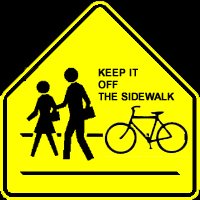
Having biked in Beijing several years back, I would say that utility, though a big one, isn't the one reason why the Chinese take bike laws more seriously. The number of bikers there probably dwarfs that of all the Western countries combined. If our our free-wheelin' style were to be adopted it would surely lead to chaos. Besides, bikers are more prone to follow the law because way more cops ride bikes there than in the US and being representatives of an authoritarian, one-party state, they definitely get more respect.
Labels: , ,

21.6.09

Granny pedal power

yes, she can!

Reuters reports that neither age nor gender ... nor chasing down purse snatchers is a barrier to biking! Over in Buerstadt, Germany an 80-year old woman put the pedal to the meddle after her handbag was stolen from her bike basket by a passing biker. Before she could overtake him on her bike, a sympathetic cager stopped the thief and held him for the authorities.

A surprised police spokesman in nearby Darmstadt stated, The woman had the guts to say, 'I'm not taking that'. With the return of her bag, granny is contemplating better ways to secure her bike basket. Now all she needs to find is someone to pedal!

Labels: , ,

19.6.09

Ghost bikes...

now haunting the Brits


The BBC UK Magazine reports on the haunting trend inspired by the Brit's American Cousins.
Ghost bikes don't just commemorate the dead, they also aim to draw attention to the dangers on the UK's roads. They first appeared in the US in 2003, but the idea has spread around the world and they are now becoming a familiar sight. In the past year, ghost bikes have been spotted in Oxford, Brighton, York and across London. They often appear overnight Cyclist David Pippin has left more than a dozen of the white bikes around the capital.

"They are both a tribute and warning," he says. "They are memorials for a fallen rider. The main point of them is to remember fellow riders who sadly died and also to highlight to other road-users the risks on the roads.

"The white bikes stand out, it makes the drivers aware of cyclists and if it makes one van driver stop and think and not jump the lights or check their mirror and it saves someone's life - it's worth the effort."

An old bike is stripped down so it's left with no pedals, chain or brake cables. This skeleton is then spray-painted white and chained to railings or a lamp post. Often they appear overnight, under the cover of darkness. Latest figures from the National Audit Office show the number of cyclists killed or seriously injured on British roads rose by 11% between 2004 and 2007, despite the amount of cycling staying broadly constant. In 2007 alone over 16,000 cyclists were injured in the UK and 136 were killed.

In May 2009 Adrianna Skrzypiec, 31, was killed in Greenwich while cycling home from work. A ghost bike, adorned with flowers, was placed at the junction where she died. Anthony Austin from Greenwich Cyclists put up the tribute and says her family and friends were very appreciative.

"I'm a cycling instructor and I believe cycling is safe," he says. "I certainly wouldn't want to deter anyone from cycling. But when there's a collision between a vehicle and a cyclist - it's usually the cyclist that comes off worse. It's a temporary reminder of how dangerous it can be."

Giles Carlin is appealing for witnesses to the accident which killed his girlfriend Eilidh Cairns, 30, in west London in February. He says Eilidh was travelling the same route she had done every day for nearly three years and on that particular day she collided with a lorry.

"I knew she thought ghost bikes were a good idea, because we'd discussed it and we'd seen them dotted around London," he says. "Ghost bikes should be there to warn other road users about the vulnerability of cyclists. If that's all they do that's a great thing, but they're also a memorial to someone who's been killed."

Most ghost bikes are temporary - they soon get removed by the authorities, are vandalised or are stolen. But some friends and families of accident victims think the symbols should become permanent memorials. Giles Carlin says:

"A ghost bike as a permanent reminder would be great. As far as I know not many are kept up past six months. If the councils were involved and the Mayor, making them permanent would be a great thing. "

A ghost bike will soon appear at the spot where Eilidh was killed, another haunting reminder of the dangers on our roads.

Labels: , ,

14.6.09

Brit cager kills biker

... & 2008 Beat Bobby
of the Year


From the BBC,
Pc Guy Swatland, 49, who had been with the Leicestershire force for more than 15 years, was a beat officer for the Stoneygate and Knighton area. Named Beat Bobby of the Year in 2008, he collided with a silver Mercedes Sprinter at 0845 BST on Friday on the A6 at Great Glen.

A 43-year-old man has been arrested in connection with the collision. Chief Constable Matt Baggott paid tribute: "Guy was a dedicated and highly respected beat officer. "He was not only hugely popular with his colleagues but was also well-known, liked and truly influential in the community he served. "His death has come as a terrible shock."

Chief Supt Chris Garnham added: "The fact that Guy was named Beat Bobby of the Year last year shows the high regard the people of Stoneygate and Knighton had for him. "He was always there when people needed him. He will be greatly missed."

Labels: , ,