11.11.11

Labels: war stories, worldbeat
posted by Da' Square Wheelman, at 2:14 PM
1 comments


 Serbian President Boris Tadić confirmed during a news conference in Belgrade that Hague fugitive Ratko Mladić has been arrested.
Labels: politix, war stories, worldbeat
posted by Da' Square Wheelman, at 6:17 AM
0 comments


Labels: beaterbikes, politix, Tweed Ride, war stories, worldbeat
posted by Da' Square Wheelman, at 4:02 PM
6 comments
 The annual report is done. The annual meeting is over. The fundraising cycle is finished. And I've passed my 3-month probationary period at the new job! Here comes health insurance, business cards, and keys to the building. Time to rest then get back to my bikey lifestyle, including this blog. The winter is shaping up to ba long one; cold and dark. I want to send The Steel Bitch off for a powder-coating ... something in a navy blue or dark maroon. I'm giving it a rest after 5 years as my commuter bike and restoring it for next year's 3speed Tour. So I'll put Mike Bullis's Robin Hood together for my new commuter. Given the temps, I figure I'll have to covert my home office into a bike shop!
Labels: beaterbikes, Chicago, war stories
posted by Da' Square Wheelman, at 6:10 AM
0 comments
One officer who loves cavalry work was bitterly disappointed at the futility of employing cavalry against these cyclist troops. If attached in large numbers, the cyclists simply throw their machines in the middle of the road, where the spokes and wheels make a perfect obstacle to charging horses. The riders then take shelter in hedges and pick off their struggling mass.

Labels: rolling abroad, velopunk, war stories
posted by Da' Square Wheelman, at 6:38 AM
0 comments
 It's Veteran's Day here in Lincoln Square. It's 55 degrees and sunny with a few puffy clouds. Anyone doing a little shopping near the corner of Western and Leland won't miss the neighborhood's ongoing memorial to our soldiers killed in Iraq. The Chicago Printmakers Collaborative has been putting these pictures in the upper windows of their building since August 2004.
 The memorial is very powerful because you can't possibly avoid the pictures. You can see them if you bike north on the east side of Western Ave. You can see them if you're waiting for a citybound train on the platform of the Brownline station. When the pictures started going up there there was only enough space for 648 pictures. Now the windows on each of the three floors are completely covered. And as of last Thursday, the total number of our soldiers killed in Iraq has reached 2464.
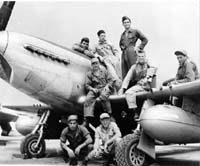
 Each time I pass it I'm reminded of two relatives who died in WWII. Robert Klippel, my mother's brother, flew P-51s out of Iwo Jima in 1945. This photo was taken a few days before he shipped out to the Pacific. On 1 June 1945, a little over two months before Japan surrendered, he flew escort for the B-29s called up on a last minute bombing mission. Before they reached their targets over Osaka, a tsunami engulfed the planes. Only a few ever returned.
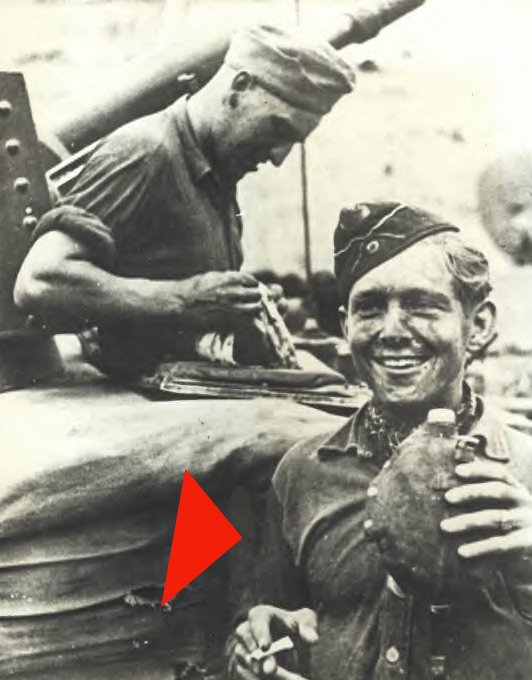 The other relative on my mother's side of the family, Frederick Klippel, was killed in the European Theater. As you can probably tell from the photo here (he's the one with the canteen), Frederick served in the German Wehrmacht. In 1942, his infantry reserve batallion arrived in western Ukraine to consolidate the huge gains made by the German invasion of the Soviet Union the previous year. He was killed by Russian artillery fire on 12 February 1943.
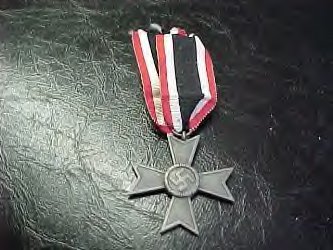
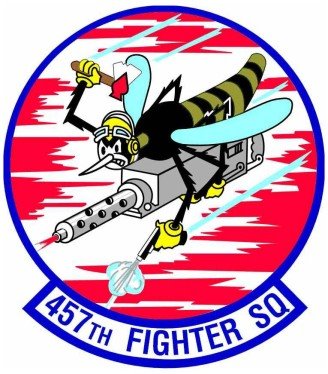 As as a young boy, every time we visited my grandmother she would show us Robert's Army Air Corps insignia and medals. The stuff was always cool to look at; in fact, I've had a bit of an obsession with this uncle who had died 17 years before I was born. Thanks to the web, I've done a lot of research on his squadron and fighter group. A couple of years ago, I even made contact with the veterans from the figher group. But they were in different squadrons and didn't remember my uncle.
 As for Frederick's family, I don't really know how much his death has affected them. I've never met them myself. I didn't even know they or Frederick existed until I googled Klippel. One of the results was a Klippel geneaology posted by a distant cousin who lives on Stanton Island. Since then I've visited him several times. Just like with my grandmother, we look at the pictures and documents he got in Germany when he visited Frederick's family.
Labels: Lincoln Square, war stories, worldbeat
posted by Da' Square Wheelman, at 11:00 AM
1 comments

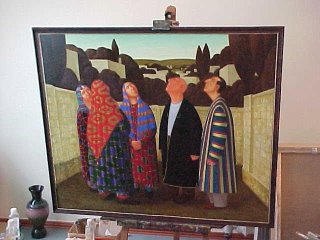 There is another aspect of this enormity. For there are as many meanings of 9.11 (here as well) as there are people who have felt the impact of the attacks over the last seven years. For example, I photographed this painting by Mirshakarov Akmal during a trip to Tajikistan in 2002. It is his response to 9.11. It alone shows that any attempt I could make to capture the meanings of this event would fall woefully short of the mark.
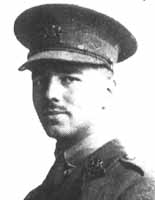 I've decided to let the enormity of 9.11 speak for itself rather than adding to all words that will be written about it today. What little I will add, can be summed by Wilfred Owen, the most famous of the WWI English trench poets. In the Preface to his book, Poems, Owen wrote,
This book is not about heroes.
English Poetry is not yet fit to speak of them.
Nor is it about deeds or lands, nor anything about glory, honour, dominion or power, except War.
Above all, this book is not concerned with Poetry.
The subject of it is War, and the pity of War.
The Poetry is in the pity.
Yet these elegies are not to this generation,
This is in no sense consolatory.
They may be to the next.
All the poet can do to-day is to warn.
That is why the true Poets must be truthful.
If I thought the letter of this book would last,
I might have used proper names; but if the spirit of it survives Prussia, --
my ambition and those names will be content; for they will have
achieved themselves fresher fields than Flanders.

Labels: history, pax, war stories
posted by Da' Square Wheelman, at 7:18 AM
0 comments
 Over at the BBC, the Today programme asked Poet Laureate, Carol Ann Duffy, to write a poem commemorating yesterday's burial of Henry Allingham. He was the last of the British survivors of The Great War.The title of this post refers to WWI's most famous poem written by Wilfred Owen. They're the first words of the Latin phrase popularized in an ode by Horace. The words were widely understood and oft quoted at the start of the WWI. They mean It is sweet and right. The full line ending Owen's poem is Dulce et decorum est pro patria mori or it is sweet and right to die for your country. In other words, it is a great honour to sacrifice yourself for your country. Owen, a British officer, was killed in action at the Battle of the Sambre a week before the war ended, causing news of his death to reach home as the town's church bells declared peace.
In all my dreams, before my helpless sight,
He plunges at me, guttering, choking, drowning.
If poetry could tell it backwards, true, begin
that moment shrapnel scythed you to the stinking mud . . .
but you get up, amazed, watch bled bad blood
run upwards from the slime into its wounds;
see lines and lines of British boys rewind
back to their trenches, kiss the photographs from home —
mothers, sweethearts, sisters, younger brothers
not entering the story now
to die and die and die.
Dulce — No — Decorum — No — Pro patria mori.
You walk away.
You walk away; drop your gun (fixed bayonet)
like all your mates do too —
Harry, Tommy, Wilfred, Edward, Bert —
and light a cigarette.
There’s coffee in the square,
warm French bread
and all those thousands dead
are shaking dried mud from their hair
and queuing up for home. Freshly alive,
a lad plays Tipperary to the crowd, released
from History; the glistening, healthy horses fit for heroes, kings.
You lean against a wall,
your several million lives still possible
and crammed with love, work, children, talent, English beer, good food.
You see the poet tuck away his pocket-book and smile.
If poetry could truly tell it backwards,
then it would.
Labels: kunst, war stories, worldbeat
posted by Da' Square Wheelman, at 6:00 AM
2 comments

Cigarette smoke so permeates George Orwell's stories it almost leaves stains on one’s fingers when reading his books.So writes Josh Indar in Bumming Smokes in Paris and London. I was fascinated to read this last week in PopMatters' retrospective on the 60th anniversary of 1984. Anyone who's rolled with me knows that I'm a smoker ... an enthusiastic smoker! What started as the youthful urge to be cool has become a 2-pack a day habit. Having tried to quit cold-turkey several times, I certainly understand the power nicotine must've had over Orwell.
 Skulking about smoke-free Eton College with a cigarette dangling provocatively from his lip gave Orwell that particular Bohemian air. Later, the ritual of rolling your own probably appealed to his machismo. Smoking also had its practical side. He writes in both Homage to Catalonia and Down and Out in Paris and London that appetite-suppressing nicotine helped him survive when food was scarce or too expensive.
 I certainly can concur. My habit definitely took off when I was working in Bosnia-Herzegovina during the war. While UN food convoys were often blocked by the warlords, Drina cigarettes always seemed to get through. And now, being woefully under-employed, I find myself subsisting on Winston Ultra Lights. There's nothing like war and poverty for reinforcing your existential view of life.
 Indar points out that cigarettes were most often associated with the working class characters in Orwell's books. This should come as no surprise since much of his work championed the commoners. And perhaps by identifying with their daily struggles, smoking helped him to camouflage his middle class origins.
 This is especially apparent in Homage to Catalonia, Orwell's memoir of the Spanish Civil War. Tobacco is listed as one of the five basic necessities of soldiers in combat. The other four are firewood, food, candles and the enemy. Sharing them at the front also built trust and camaraderie. Describing street fighting in Barcelona, he gratefully acknowledges the small act of heroism performed by a fellow militiaman, who finds two packs of Lucky Strikes under terrible gunfire.
Labels: books, rolling abroad, war stories
posted by Da' Square Wheelman, at 6:29 AM
0 comments
 To anyone who thinks that the local and widespread demonstrations against the recent Iranian presidential elections are starting to fail, I have one word: WOMEN! Certainly, much has been made of Twitter, YouTube, Facebook, and a host of other web-based, social networking tools being used by the Iranian protesters. It reminds me of the students in Tienanmen Square who, 20 years ago, communicated by fax with the rest of the world and the young Bosnians who did the same thing in the early 90s using email and web-pages. But tools they only are. It's who wields them that really matters. As Anne Applebaum wrote yesterday in The Washington Post,
Not Obama, not Bush and not Twitter ... but years of work and effort lie behind the public display of defiance and, in particular, the number of women on the streets -- and their presence matters. Their presence could strike the deepest blow against the regime ... Its leadership is legitimate, as is its harsh repression of women, because God has decreed that it is so. The outright rejection of this creed by tens of thousands of women, not just over the past weekend but over the past decade, has to weaken the Islamic Republic's claim to invincibility, in Iran and across the Middle East.
 I can't agree more. To understand this, you should be reading W. Morgan Shuster's The Strangling of Persia. Published in 1912, it recounts his 8 month assignment as the Treasurer-General of the Persian Empire. He and a small group of American treasury experts had been invited by the new constitutional government in 1910 to strengthen the country's finances. It was hoped this would help resist the 1907 Anglo-Russian Entent that effectively divided Persia into two spheres of influence. Needless to say, neither Great Power was happy with Shuster's work. They supported a royalist insurgency against the popular constitutional government that successfully brought it down in 1911. Several months later, Shuster resigned and left Persia. After his return to the US, he wrote his damning indictment of Russian and British meddling in Persia affairs, stating:
[I]t was obvious that the people of Persia deserve much better than what they are getting, that they wanted us to succeed, but it was the British and the Russians who were determined not to let us succeed.
 If you've ever wondered why Iranians are particularly paranoid about the Great Power influence over them, this book will give you great insights. What is especially tragic is that at the beginning of the 2oth Century Iranians strongly supported their constitutional democracy and fervently hoped the US would protect it against Russian and British encroachment. What is most surprising, though, is that Shuster's book includes a small section (pp. 191-199) on the significant role played by Iranian women during and after the 1905-11 Constitutional Revolution. Except for its antique language (as well as attitudes) and the different personalities, it could easily describe the political role Iranian women are playing today.
The Persian women since 1907 had become at a bound the most progressive, not to say radical, in the world. That this statement upsets the ideas of centuries makes no difference. It is the fact.You can read this section as well as the rest of The Strangling of Persian over at Google Books. I highly recommend that you do so!

Labels: books, war stories, worldbeat
posted by Da' Square Wheelman, at 6:16 AM
0 comments

When they kill an innocent child, this is not justice. This is not religion. In no way is this acceptable and I'm certain that the one who shot her will not get a pass from God.
- Panahi
Labels: serious shit, war stories, worldbeat
posted by Da' Square Wheelman, at 6:58 AM
0 comments
It's Memorial Day here in Lincoln Square. Folks are getting together to enjoy the first really good weekend in Chicago. It's 66 degrees and cloudy. Anywhere you go, a wonderful barbecue smell wafts up from backyards, porches, and decks. And anyone doing a little shopping near the corner of Western and Leland won't miss the neighborhood's ongoing memorial to our soldiers killed in Iraq. The Chicago Printmakers Collaborative has been putting these pictures in the upper windows of their building since August 2004. The memorial is very powerful because you can't possibly avoid the pictures. You can see them if you bike north on the east side of Western Ave. You can see them if you're waiting for a city bound train on the platform of the Brownline station. When the pictures started going up there there was only enough space for 648 pictures. Now the windows on each of the three floors are completely covered. And as of Sunday, the total number of our soldiers killed in Iraq has reached 4300 and the wounded now total 31,285.Each time I pass it I'm reminded of two relatives who died in WWII. Robert Klippel, my mother's brother, flew P-51s out of Iwo Jima in 1945. This photo was taken a few days before he shipped out to the Pacific. On 1 June 1945, a little over two months before Japan surrendered, he flew escort for the B-29s called up on a last minute bombing mission. Before they reached their targets over Osaka, a tsunami engulfed the planes. Only a few ever returned. My uncle was one of the unlucky ones. He and his plane were never found. In 1946 his Missing in Action status was changed to Killed in Action.The other relative on my mother's side of the family, Frederick Klippel, was killed in the European Theater. As you can probably tell from the photo here (he's the one with the canteen), Frederick served in the German Wehrmacht. In 1942, his infantry reserve battalion arrived in western Ukraine to consolidate the huge gains made by the German invasion of the Soviet Union the previous year. He was killed by Russian artillery fire on 12 February 1943 when the Wehrmacht retook Kharkov.As as a young boy, every time we visited my grandmother she would show us Robert's Army Air Corps insignia and medals. The stuff was always cool to look at; in fact, I've had a bit of an obsession with this uncle who had died 17 years before I was born. Thanks to the web, I've done a lot of research on his squadron and fighter group. A couple of years ago, I even made contact with the veterans from the figher group. But they were in different squadrons and didn't remember my uncle. It wasn't until I was an adult, many years later, that I realized that Robert's death had torn the heart out of my mother's family. My grandmother firmly believed that he was still alive somewhere on Pacific island or in Japan. Her eldest daughter, my aunt, started to suffer from bipolar disorder at the end of the war. And my mother still can't talk about my uncle with getting extremely emotional.As for Frederick's family, I don't really know how much his death has affected them. I've never met them myself. I didn't even know they or Frederick existed until I googled Klippel. One of the results was a Klippel genealogy posted by a distant cousin who lives on Stanton Island. Since then I've visited him several times. Just like with my grandmother, we look at the pictures and documents he got in Germany when he visited Frederick's family.
Labels: Lincoln Square, serious shit, war stories
posted by Da' Square Wheelman, at 10:17 AM
3 comments


Labels: Tweed Ride, velopunk, war stories
posted by Da' Square Wheelman, at 9:34 AM
2 comments
 Folks who don't roll wonder why I risk my life daily on the seemingly mean streets of The Windy City. Taking a slightly masochistic pleasure in their concern, I usually respond by recounting the three times that I've been doored. Then I wrap up with something like, It ain't so bad ... all y'have to do is keep your eyes and ears open. I frankly don't see myself as a big risk-taker. Ride a freak bike or a brakeless fixie if you really want to be risky.
 That being said, urban biking - even with a helmet, mirror, and lights (front & back) - is not without its risks. So why do 1000s of otherwise sane people do it? Deirdre Fernand may have an answer. Writing in The Economist's Intelligent Life Magazine, she explores the allure of extreme sports. Certainly urban bikers don't encounter the same dangers as those wacky folks who bungee jump, free-run, or BASE-jump. But what they do share is that in taking risks they are not an aberration
The aberration is those of us who are slumped on the sofa of life. If we remove risk from our lives ... we never find out our strengths and weaknesses. We stagnate.
 Finding yourself by confronting and overcoming life's dangers used to be a necessary step on the road to adulthood. Pre-modern societies required adolescents to pass through an often dangerous rite of passage before being considered full members of the community. But in Western societies today, paranoid parents, touchy-feely educators, and insurance companies spend a lot of time removing risks from children's lives. Fernand believes this is a big, big mistake. She cites Mark van Vuyt, professor of psychology at the University of Kent.
In evolutionary terms it pays for young males to compete in excessive risk-taking. If they thought something was too risky and didn’t do it, they wouldn’t distinguish themselves and wouldn’t get female attention.
 The good news is that, despite this nanny state of affairs, folks are confronting and overcoming life's dangers. It's not that they're all doing it to get chicks. Rather, they do it to test themselves and, G-d willing, to finish every day with the satisfaction of surviving to roll another day.
Labels: pensées, velotariat, war stories
posted by Da' Square Wheelman, at 5:58 AM
0 comments
 Times are tough. Since January's Black Monday, the US economy continues to hemorrhage jobs as global financial markets plunge. Personal debt is astronomic. More credit is nearly non-existent. Here in The Windy City the anxiety are palpable; although folks are muddling through. Whether or not it was last week's record warm spell, there are more bikers on the streets. Costco Warehouse memberships are at a record high. Neighborhood taverns and restaurants are quieter than usual on weeknights. The same is true for every large city across the world.
 So it isn't at all surprising that Barter Books, in the UK's Northumberland, now sells a reprint of the WWII propaganda poster above. Several million copies of Keep Calm and Carry On were printed but never distributed. Winston Churchill's Ministry of Information had decided to use them only in the event of a German invasion. Fortunately they were never needed. They would've then been consigned to the dustbin of history if it weren't for the discovery of a single copy by Barter's owners, Stuart and Mary Manley, in 2001. Their subsequent decision to sell reprints at £3.60, or $5.54, has met with great success. While we are nowhere near the dark times of the 1940s, these posters are a wonderful reminder that this current crisis shall pass. Or as Churchill declared,
The English know how to make the best of things. Their so-called muddling through is simply skill at dealing with the inevitable.
Labels: history, pensées, war stories
posted by Da' Square Wheelman, at 6:50 AM
2 comments
These are also tough times for many Americans struggling in our sluggish economy. As we count the higher blessings of faith and family, we know that millions of Americans don't have a job. Many more are struggling to pay the bills or stay in their homes. From students to seniors, the future seems uncertain.
That is why this season of giving should also be a time to renew a sense of common purpose and shared citizenship. Now, more than ever, we must rededicate ourselves to the notion that we share a common destiny as Americans - that I am my brother's keeper, I am my sister's keeper. Now, we must all do our part to serve one another; to seek new ideas and new innovation; and to start a new chapter for our great country.
Labels: Election 08, pensées, war stories
posted by Da' Square Wheelman, at 6:56 AM
0 comments
When I took my first bicycle tour in Germany, I noticed that the German wheelmen carried a whip in a receptacle attached to the handlebars. Upon inquiry, it was for dogs. I carried no whip, for l found a more excellent way. When chased by infuriated dogs, which happened three or four times every day, I waited till the monster got close. Then leaning over. I spit in his eye, becoming with practice uncannily accurate. The animal invariably retired. It wasn't the heat, it was the humidity.
Labels: pensées, rolling abroad, war stories
posted by Da' Square Wheelman, at 5:55 AM
0 comments

Foxes know many small things but hedgehogs know one big thing...








All content on this website (including text, photographs, audio files, and any other original works), unless otherwise noted, is licensed under an
Attribution-NonCommercial-ShareAlike 2.5 License.
DISCLAIMER:
The views and opinions expressed herein are not attributable to girlfriends and wives (old or new) to family, friends and colleagues (current or estranged), and to employers (pains-in-the-ass or otherwise).