It's been a long, long time...
has been happening!

Labels: beaterbikes, politix, Tweed Ride, war stories, worldbeat

Labels: beaterbikes, politix, Tweed Ride, war stories, worldbeat
Labels: beaterbikes, Chicago, war stories
I was just listening to Bob Edward's Weekend on Chicago Public Radio Sunday morning. He did a piece on Charles Kuralt's famous TV essays, interviewing his cameraman, Izzy Bleckman. And he mentioned Jethro Mann who back in the early 80s had started fixing bikes for the kids of his town, Belmont, NC. He told Kuralt that it hurt him to grow up without bikes. So he started a bike lending library. His garage was filled with wrecked bikes. The kids were careful to return the bikes every evening, about suppertime. Then he would work on them, sometimes until one or two o'clock in the morning.Labels: beaterbikes, history, traffic taming
The Boy made an interesting comment on my post, As you spin along... . He wonders where I find the more wacky topics on which I write. In a word - Google - especially its Patents Search. An incredible resource, it enables you to view every invention ever submitted to the U.S. Patent and Trademark Office. Plug in any term and you get the official documents.
I first used it when my interest was peaked by vestiges, mentioned in Tom Cuthbertson's classic, Anybody's Bike Book. According to him, a vestige is [a]nything on a bicycle that isn't essential. Our British Cousins would have referred to them as cyclealities back in the day. Most non-essential accessories were produced in Birmingham, UK. They included everything from bells to bags. Cuthbertson doesn't set much stock by them, though.Extra. Dead weight. Some extras can be worth their weight. The others make me feel like I have appendicitis if I write about them, so I refuse to do much more than mention them ... Filth, Filth. Filth and junk. I refuse to say more about them.
Cuthbertson's attitude is both surprising and misplaced. Certainly things like bells, baskets, lights, and mirrors can clutter up a bike's feng-shui. But they are also a wonderful way to personalize what is essentially a mass-produced consumer item. Moreover, the fascinating history of their invention is virtually unknown among bike enthusiasts. So here are some vestiges that I think are utterly essential and intriguing!
Labels: beaterbikes, kraftwerk, that which rolls


Labels: beaterbikes, Tweed Ride, velopunk
Labels: beaterbikes, kunst, velopunk
Labels: beaterbikes, silly shit, that which rolls
Gizmodo, the gadget blog, has the answer. It features a fancy-schmancy business card by Adam Mayer. The digital design incorporates the ever popular, though always mysterious, SA guts. If you want to expand your origami skills in a whole new direction you can find the directions here. It's a great way to visualize what's going on inside your 3speed hub even if you don't need a business card in this crappy economy.Labels: beaterbikes, kraftwerk, kunst

Labels: beaterbikes, bikeWINTER, velotariat

Take a look at these Tour de Fat videos to find out more!
Labels: beaterbikes, Chicago, silly shit


Labels: beaterbikes, Chicago, critical mass
CrimethInc. began in the mid-1990's. I can't report on the original goals of all the participants, but I can trace my own initial intentions to a discussion among some friends about the revolutionary organization Winston joins in Orwell's 1984. The idea came up that it was actually a branch of the government . . . and from there, we began to consider what the opposite kind of organization would be (one that purported to be a part of the culture industry that rules today, while secretly undermining it), and how to form one. The irony, the margin-walking between contradictions, both were intrinsic to CrimethInc. from the beginning . . . and honestly, I can tell you no better now than I could have then whether we are just indulging reactionary desires by forming yet another "revolutionary organization," or heroically helping humanity to evolve past the despotism of such a thing by detourning/deconstructing the idea of the revolutionary organization.
Nadia C.
Secret-ary of the Interior
Labels: beaterbikes, kraftwerk, velotariat

Labels: beaterbikes, Chicago, velotariat
UffdaDave, a college buddy from Ohio, is our guest blogger today. I don't think there's anyone else out there who appreciates beaters more. As I've written before, Dave first got me rolling with the Roadmaster he gave me. Much to his wife's chagrin, Dave collects and tools them in an old barn at the back of their farm lot. But it's not just about tooling. For Dave, it's also about the moving memories each beater evokes:I have this old barn on my property. It has become a receptacle for my many things. Memorabilia that I don’t want to throw (or give) away; things that crowd the corners of my life and still cling to me for their sentimental value. In many ways it’s all just junk, but junk that comes with a story attached.
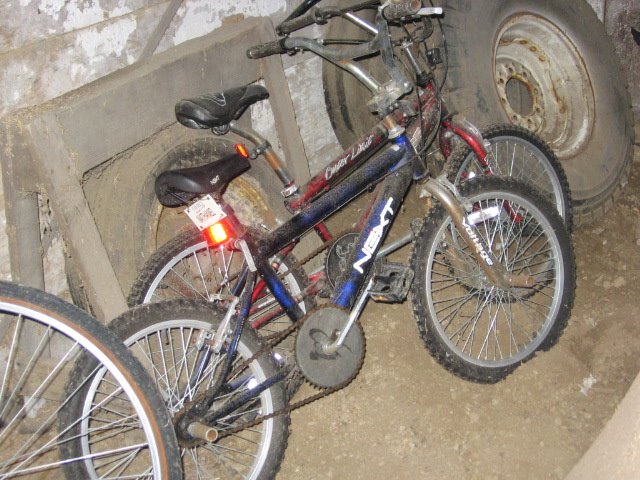
On a recent drizzly Sunday afternoon Nate, the youngest son, and I decided to take a ride. I’ve never minded riding in the rain or drizzle as long as it’s not too cold. We headed to the barn for our bikes and when I threw open the door I found myself confronted with years of accumulation with very little organization.The most prominent of artifacts hiding in my barn are the bikes – and not all mine. In the first stall stood two little BMX bikes bought for my sons several years ago. They were purchased from the local discounter because I have this belief that I wasn’t about to purchase an expensive bicycle for the boys until they stopped growing. Both well used and desperately in need of some maintenance. The boys put many miles on the bikes before Ian (the oldest) decided to focus his energies elsewhere and Nate decided he needed a bigger bike.
Standing along side the BMX bikes are a pair of scooters also purchased for the boys back when the Razor scooters were all the rage. Living on a farm with a gravel drive and lots of land, the Razor was not very practical so we purchased scooters with larger, knobby-style tires. At first the boys were a little disappointed but they soon found that the larger tires were better for negotiating the obstacles along the sled-riding hill.
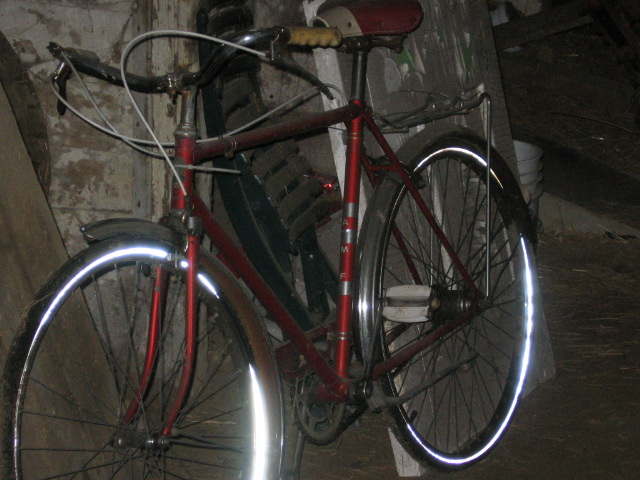
Many of days I would come home from work just in time to witness boys on scooters cruising through the trees from the hayfield above to the gardens below.Back beyond the scooters is my old three-speed Hercules. I traded a 35mm camera for the bicycle and have never regretted the deal. I have a particular fondness for British three-speeds so when the opportunity presented itself I jumped on with a bit of hesitation. I’ve done some work on the Hercules but it still needs a great deal more restoration. I know I’ll get to it in the future but for now I occasionally pull it out and pedal up and down the driveway like some fancy English gentleman riding along a hedge-lined lane.
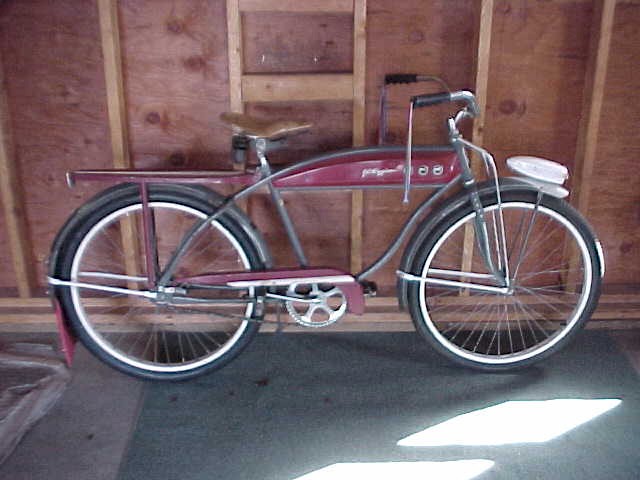
Right after the Hercules is the J.C. Higgins, a balloon-tire bicycle I purchased from Free Bikes for Kids. The bike is a late 40’s early 50’s model with a few pieces missing but I don’t mind, it was functioning and I always wanted a good old balloon-tire bike. Free Bikes for Kids was an organization dedicated to finding old bicycles, fixing them up and getting them into the hands off kids who couldn’t afford a bicycle. They felt ashamed that they were charging me $25 for the old beat up J.C. Higgins; I felt ashamed that I couldn’t give them $1,000 for their mission.
Hanging from the posts is a spare set of rims for my Nishiki touring bike, now nearly 20 years old. The bike has become the favorite of Nate who loves riding it every time we go out, even though the bike is just a little too tall for him. He insists on using the older leather strap toe clip and pedal combination I installed shortly after I purchased the bike at an auction. I had originally purchased it for my wife but she too was too short to ride it so I used it for touring.
Underneath the spare wheels stands my trusty Specialized hybrid bike. My wife bought it for me when Ian was four and Nate was two. This bike replaced the mountain bike she bought me years earlier – a bike I managed to bounce off the back of my car at 60 mph on a two lane highway. She got me a sturdy bike for riding the rough rural roads and for hauling the boys. For many years we would take rides, first with a child carrier and then with the co-pilot bike trailer. Because I could only take one son at a time, every ride became a double for me. Ian liked to explore the town; Nate preferred the trails. I just enjoyed getting out on a bike with the boys.
In the farthest reaches of the barn are two more bikes. The first is the Joshua bike. So named because it once belonged to my nephew Joshua. He wanted a BMX bike and my brother wanted to buy one for him. But not having much money left my brother at a loss until I found a used Varmit. I fixed it up with new tires, pedals and a set of BMX handbrakes. I acquired the bike after Josh outgrew it. I wanted it so I could ride along with my kids on their BMX bikes.
The other bike, the last one in the barn, is an old chain-drive Colson tricycle from the ‘30’s or ‘40’s, or so I’m guessing. It was purchased to replace a damaged tricycle for the oldest niece who is now 23. When I found the old trike it been hand-painted pink; I stripped it, repainted it red with white accents, straightened the axle and got it back in running shape. The niece had a little cheap Murray tricycle, and she had a habit of leaving it out in the driveway – like any kid. One morning her mother ran over the Murray trike and completely destroyed it. With tears in her eyes the little girl looked from the smashed trike to her mother and said, “That’s okay mom, I still love you.” The niece rode the old trike for many years before returning it for us to keep.
“C’mon dad,” Nate called to me from the open door.
“I’ll be there,” I called back.
Maybe it was the dust in the barn, maybe it was the memories but when I left I was a little misty.
Labels: beaterbikes, pensées, writing
When I moved to the City of Big Shoulders in 2000, I brought with me over a thousand books. The challenge for the movers was getting them up four flights of stairs without the benefit of an elevator. They brought the boxes up three or four at a time on their backs supported by a tump line. They asked why I had so many god-damned books. I said they were my tools just like good mechanics who have their own personal set of wrenches they would never go anywhere without. More on that later...
I also came with a red Saturn Coup. It sat in front of the apartment gathering dust and bird shit for two years as I took full advantage of the CTA. I finally got rid of the Saturn when the Connecticut Department of Revenue (where I had moved from) sent me the annual luxury tax assessment on it. I paid the tax and cancelled the lease which was a stupid idea to have in the first place. And then I got a 1957 Raleigh 3-speed Robin Hood from the Working Bikes Co-operative down on the southside. And it's been "two wheels good, four wheels bad" ever since. More on that later...
What does
Blogs are surprising things. Unlike writing a book or an essay there isn't any predetermined structure. Like an old school diary you start out with one thought or goal and end up writing about something else altogether. Try as I might, I have yet to post an entry in which my initial intentions match the finished product. This is why I think blogs are the perfect vehicles for us foxes who know a lot of little things.
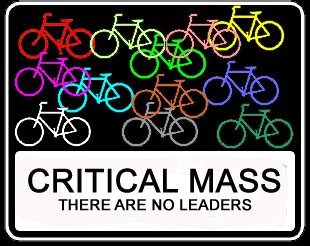
Take today's entry for example. I originally intended to write about the more personal journey of how I got into biking in the first place and then relate it to xerocracy. It's a term I first heard at Chicago Critical Mass. I did some googling to find out what it means. Essentially, it refers to anarchistic communities in which there are no leaders. All voices are welcome. All responsibilities are mutually shared. A number of websites also claim it is the (dis)organizing principle for Critical Mass.
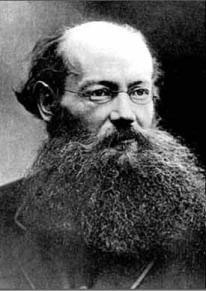
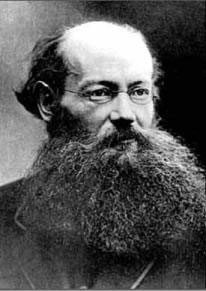
It reminded me of mutual aid, the anarchist concept promoted by 19th Century Russian intellectual, Peter Kropotkin. I think it could do a lot for fleshing out how xerocracy actually works in the critical mass world. So I started googling mutual aid and Kropotkin. That took me to Wikipedia. It quotes Kropotkin's definition of mutual aid as... a system of economics based on mutual exchanges made in a system of voluntary cooperation.But like the fox I am, I haven't quite connected my own reasons for biking with xerocracy. I need some time to noodle it around in my head. It will, nevertheless, most defintitely happen with the help of Kropotkin and mutual aid.
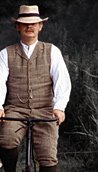
So let me tell you how I got into biking. I was a professor at a small liberal arts college in northeastern Wisconsin. Me and my wife, also a professor there, lived close to a fairly rural, small town campus. Riding up over the bridge everyday seemed just the thing. In fact, I had delusions of grandeur imagining myself living a 1990s version of the movie, Goodby, Mr. Chips.
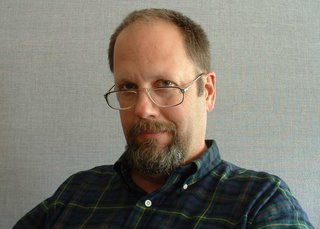
One small problem: I didn’t have a bike, didn’t know much about bikes, and wasn’t too enthusiastic about shelling out the big bucks for a fancy new bike. Luckily, another old college buddy, also named Dave, was visiting from Ohio with his wife and two boys. He’d been working on bikes for years in an old barn on what’s left of his family’s farm. Before they came up, Dave's wife had lovingly given him an ultimatum: "Get rid of some of the bikes, so at least we can get into the barn!"
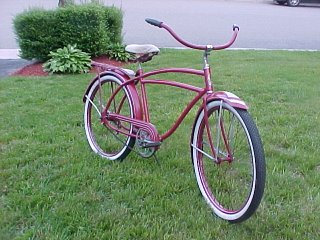
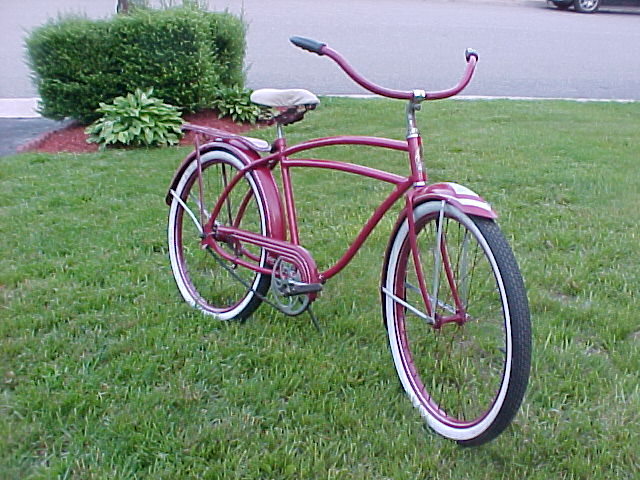
That's why Dave brought a Roadmaster to give to me. He’d done a wonderful restoration job. The thing was huge, blue, and heavy as hell. I got the jpeg of this one off Ebay. Best of all – it was free. I rode the blue beast to my college office almost every day. After work and on the weekends, I rode down to a bike path along the Fox River and back. Then I started branching out to the north towards Green Bay and to the south towards Appleton. I eventually had to mothball it when a mechanic discovered that my increasingly frequent flats were due to shot rims.Labels: beaterbikes, Chicago, Isaiah Berlin
This weekend I was up in Redwing, MN. I joined the 3speed Lake Pepin Tour with 70 other English bike enthusiasts. It's modeled on bike touring in pre-war England. As the website states,For a full (and hilarious) description of the tour, check out Jon Sharratt's blog. This tour was Noel Robinson's idea. Jon took on all the organizational aspects and does a great job.To gain a better perspective, here is a list of some of the things we leave behind: derailleurs, lycra, target heart rates, SPD, SIS, STI, HRM, XTR, etc. There will be no sprinting, spinning, drafting nor will there be any carbon fiber, drillium or unobtanium. Please note we are not advocating being a retro-grouch or ridicule those with alloy handlebars but instead we are asking you to strip away all you know modern cycling to be and hop aboard your £5 Thrift Store Raleigh and come with.
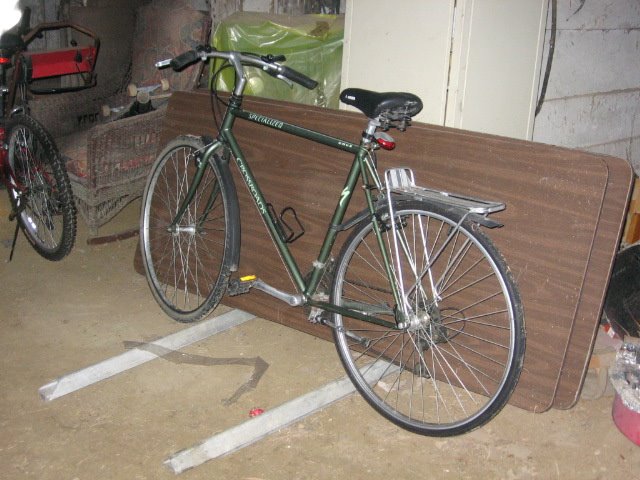
Leave your lycra & Johnny Rebel competitive spirit at home and instead, bring your sense of adventure. Wear something appropriate for eagle watching or sitting in a café and bring an honest-to-goodness rain cape because, of course, it rains in England. Be prepared to make new friends and be swept away by the scenery. Be prepared to stop here and there to take a photo or complain about your hard saddle or make an entry in your Tourbook. Be prepared to keep in mind it's not the destination you'll remember but the journey.
Labels: beaterbikes, velopunk, velotariat