Bicycle Diaries

Recent Posts

16.2.10

their passions a quotation

w/apologies
to Oscar Wilde

As I hit the mid-February dull-drums, I've been turning my head towards spring with a little restoration project. It's not only keeping me from self-medicating the darkness away in my local neighborhood joint. There's nothing like scouring several decades worth of rust off steel rims for ruminating about the vélotariat.
  • Why do researchers who've never been on Critical Mass write as if it just popped out of nowhere on the streets of America?
  • Why do they typically recycle masser statements about the anarchy and celebration without ever going deeper beneath the surface?
  • And why do they never explain the mass's staying power, now in it's second decade and spreading around the world?
  • In other words, where the hell did the mass come from and where the hell is it going?

    The simple answer is that Critical Mass began in 1992 in San Francisco. Seven years later, it appeared in Chicago. Most academic research concludes that it's the anarchistic step-child of the aging hippies and student protesters of the 60s. That's usually where it ends.

    Although a good start, refusing to go further ignores the rich history of bike activism both during and after the heyday of counter-culture America. In Chicago, Keith Kingbay was bugging Mayor Daley the Elder for bike lanes which first went in the early 1970s. Hippy longhair? Wild-eyed radical? Not in the least: Keith was the Cycling Activities Director for the Schwinn Bicycle Company and member of President Nixons's Council on Physical Fitness.

    So where to go from here? On to Humboldt Park. Lula's was getting ready for the dinner rush. I decamped to the Black Beetle Bar & Grill in Humboldt Park. There I discovered an obscure (to Americans at least) Parisian group that gave the May 1968 student revolt its intellectual uhmpf. And quite surprisingly, Kingbay seems to have been familiar with many of their essays.

    Led by Guy Debord, The Situationists came down hard on Western society. France had finally emerged from the poverty and despair of the post-WWII period. Rebuilding war-ravaged cities and villages was almost complete. Unemployment was virtually non-existent. Under De Gaulle, France was a serious US Cold War partner. The baby-boom generation was flooding the universities ... and it was bored, angry, and primed for action.

    In contrast to today's conservative revisions of history, the Situationists were much more than a group of spoiled middle class kids. The French were in Algeria. The Soviets were in Czechoslovakia. The US was in Viet Nam. Countries in Africa and Latin America were struggling for national independence or true sovereignty from former colonial masters. Western governments, as well as the traditional opposition parties that did little real opposing, demanded loyalty, rather than questions, from their supporters. They specifically demanded young people to Sois Jeune et Tais Tois, or Be young and shut up.

    It was a mistake to say the least. In this grossly patronizing atmosphere, youthful opposition to foreign policy quickly grew into an overall critique of Western society. Like the revolutionary movements of the 1920s and 1930s the Situationists focused on the power of capitalism, propped up by the state, to overwhelm individual freedom. Unlike their predecessors who sought to revolutionize politics, they sought to revolutionize life itself.
    Raoul Vaneigem, in The Revolution of Everyday Life, observed that poverty in modern Western society went deeper than simple economic depravation. Social conventions, reinforced by political institutions and an all-encompassing media, compelled individuals to not only consume but what to consume and how. Locked in this daily routine of consumption, life was futile, barren, and dull.
    The history of our times calls to mind those Walt Disney characters who rush madly over the edge of a cliff without seeing it, so that the power of their imagination keeps them suspended in mid-air; but as soon as they look down and see where they are, they fall.
    What does this have to do with Critical Mass? The creative, spontaneous, and joyful potential of the human imagination was crushed everywhere in Western societies especially on the very streets of its large cities. Well before the San Fancisco Critical Mass, Debord highlighted the subtle connections between what he called the Spectacle of modern life and the automobile. In fact, his nine Situationist Theses on Traffic reads as if it were a Critical Mass manifesto.
    1. A mistake made by all the city planners is to consider the private automobile (and its by-products, such as the motorcycle) as essentially a means of transportation. In reality, it is the most notable material symbol of the notion of happiness that developed capitalism tends to spread throughout the society. The automobile is at the center of this general propaganda, both as supreme good of an alienated life and as essential product of the capitalist market: It is generally being said this year that American economic prosperity is soon going to depend on the success of the slogan "Two cars per family."

    2. Commuting time, as Le Corbusier rightly noted, is a surplus labor which correspondingly reduces the amount of "free" time.

    3. We must replace travel as an adjunct to work with travel as a pleasure.

    4. To want to redesign architecture to accord with the needs of the present massive and parasitical existence of private automobiles reflects the most unrealistic misapprehension of where the real problems lie. Instead, architecture must be transformed to accord with the whole development of the society, criticizing all the transitory values linked to obsolete forms of social relationships (in the first rank of which is the family).

    5. Even if, during a transitional period, we temporarily accept a rigid division between work zones and residence zones, we must at least envisage a third sphere: that of life itself (the sphere of freedom and leisure — the essence of life). Unitary urbanism acknowledges no boundaries; it aims to form an integrated human milieu in which separations such as work/leisure or public/private will finally be dissolved. But before this is possible, the minimum action of unitary urbanism is to extend the terrain of play to all desirable constructions. This terrain will be at the level of complexity of an old city.

    6. It is not a matter of opposing the automobile as an evil in itself. It is its extreme concentration in the cities that has led to the negation of its function. Urbanism should certainly not ignore the automobile, but even less should it accept it as its central theme. It should reckon on gradually phasing it out. In any case, we can envision the banning of auto traffic from the central areas of certain new complexes, as well as from a few old cities.

    7. Those who believe that the automobile is eternal are not thinking, even from a strictly technological standpoint, of other future forms of transportation. For example, certain models of one-man helicopters currently being tested by the US Army will probably have spread to the general public within twenty years.

    8. The breaking up of the dialectic of the human milieu in favor of automobiles (the projected freeways in Paris will entail the demolition of thousands of houses and apartments although the housing crisis is continually worsening) masks its irrationality under pseudopractical justifications. But it is practically necessary only in the context of a specific social set-up. Those who believe that the particulars of the problem are permanent want in fact to believe in the permanence of the present society.
    9. Revolutionary urbanists will not limit their concern to the circulation of things, or to the circulation of human beings trapped in a world of things. They will try to break these topological chains, paving the way with their experiments for a human journey through authentic life.
    Labels: , ,

    23.11.09

    Journey of discovery

    just 6 miles
    from home


    A few weeks back, Roger Cohen wrote about The Big Apple's local peculiarities in his NYTimes op-ed column. He pointed out something that I've also noticed about The Windy City. You only have to go a few blocks in any direction and the city completely changes both in terms of culture and economics. I've been aware of this lately because og my shift in work from the high-rise Loop to the low-rent near North Side. Cohen experienced the same thing when the NYTimes moved its Times Square offices a couple of blocks southwest into the Garment District. As he describes it,
    The former headquarters was trapped in the neon tentacles of Times Square, a once seedy part of town re-imagined as the tourist-filled set for a movie called “New York,” a place where people from out of town loiter six-abreast gazing at the flashing lights while New Yorkers try to dodge the phalanxes of flesh.

    The new premises, as I’ve gradually learned, placed us just within the garment district, an area where zoning laws have protected apparel manufacturing space and so held off the developers who would otherwise have turned clothes factories into condos and created yet another gentrified district bereft of seediness, tawdriness, community and that strange high-low alchemy essential to any great city’s mystery and charge.


    Unlike Cohen's, my new digs are defined less by industry than by ethnicity. It's the heart of the city's Puerto Rican communities which are generally much poorer than my former workplace just off North Michigan Avenue. However, like Cohen's Garment District, it's an incredibly vibrant area, despite carrying more of the weight of our current economic crisis.

    It's an area I knew little about beyond the usual fears and prejudices of your typical Northsider. To be frank the first few weeks were a shock. I take regular smoke-breaks along the street next to our building. Most of the buildings opposite are abandoned or inevitably for rent. There's a city ordinance sign on the corner reminding me and my fellow citizens that its illegal to solicit prostitution in public (I guess then it's OK in-doors?).

    But like I said, much of my initial shock resulted from being in a strange, new part of a very large, diverse city. I've started to discover all kinds of hidden, fascinating facets. Hopefully, I'll be able to write more about this as the months go by. For now, I've got to finish this year's Annual Report.

    Labels: , ,

    16.11.09

    It's about the lycra

    not the
    commute


    Magda Szubansk, a comedienne from Down Under, caught a whole lot of guff from bikers after her rant against lycra-louts last September. To be quite frank, I agree with her up to the point where she starts calling for cagers to run them off the road. Fortunately, she realized that she'd gone over the top and apologised. But aren't the streets, everywhere in the world, dangerous enough without ramping up the rhetoric?

    Labels: , ,

    4.11.09

    Shrine of the Vélotariat

    blessing the bike


    On 2 November, The Oregonian reported that St. Stephen's Episcopal Church in downtown Portland has
    become the nation's first church with a permanent indoor shrine honoring the Madonna del Ghisallo, who is the patron saint of cyclists. An entire section of the 80-year-old wood-and-stone sanctuary will be set aside for bike commuters to contemplate their travels and remember those who have died while cycling.
    A painting of the Madonna del Ghisallo (above) by local artist Martin Wolfe will hang above bike parking and a nave where travelers can light candles or sit in reflection.

    Labels: , ,

    28.10.09

    And you thought computers suck...

    what
    about

    books?


    So one day that old mediator between Good & Evil, the Egyptian god Thoth, invents writing. Up till then, folks just filled up their noggins with pretty much everything. And Thoth proudly offering it as a gift to the Pharaoh of Egypt, claiming it'll be
    an elixir of memory and wisdom.
    Pharaoh ain't all that impressed. In fact, he's downright horrified, replying,
    This invention will induce forgetfulness in the souls of those who have learned it, because they will not need to exercise their memories, being able to rely on what is written…rather than, from within, their own unaided powers to call things to mind.

    So it’s not a remedy for memory, but for reminding, that you have discovered. And as for wisdom, you are equipping your pupils with only a semblance of it, not with truth.

    Labels: , ,

    18.10.09

    I've been remiss...

    but now
    I'm back


    It's been a hell of a last 9 months or so. Laid off in February, underemployed until just last month. Among other things, the blog has suffered. First it was the general funk that accompanies what became is the worst unemployment experience in my life. I wasn't turned out of my apartment of a decade; nor did I starve. A lot of good, good friends and close acquaintances had my back. Perhaps the depth of our national economic crisis has brought out in the best of folks or maybe after almost 11 years in the same neighborhood I've found my community: I've certainly learned that it takes a village to survive The Great Recession.

    Whatever the reason, I did survive. I've back in a full-time job thanks to some very fine folks in the bike community here. It's as the Resource Development Manager for the Bickerdike Redevelopment Corporation. That's a fancy title for grant-writer and all around fund-raiser. Bickerdike is a member-based, non-profit community development corporation that advocates for, builds, and maintains affordable housing in the Latino and African-American neighborhoods on the northwest. That's a big change for all kinds of reasons. But I'm liking both the mission and the organization. It's also exposing to a whole new world in this great, grand city.

    Second, nine months is a damned long time. There were days when my own problems coupled with the general mood of the country nearly overwhelmed me. I kept my sanity by riding ... a lot of riding. With a little help from my friends, I put together The 2nd Winston's Tweed Ride on 12 September. A lot of new folks joined us on a Don't Mention the War bummel that ended up at my neighborhood's annual German-American Festival. Get it?

    Then a few weeks ago, Sir Aaron heard about a new tweed ride in Grand Rapids, MI. We loaded up the steeds on his cage and headed over for the day! Amanda, the organizer, as well as her small group of tight friends made us very welcome indeed. I don't think we considered the impact two big city gents would make on our country cousins. And let me say, Grand Rapids is a fantastic city. Imagine a slightly smaller version of Milwaukee, with the same turn of the century architecture, surrounded by rolling meadows and gentle hills a few minutes from Lake Michigan. I would seriously consider moving there if the job were right.


    Even outside the City of Big Shoulders,
    it takes a tweedy village to survive...

    Labels: , ,

    4.9.09

    Why be conservative?

    why
    not?


    I don’t have much faith in my fellow man. In fact, my own conservatism has much to do with the fact that I reject the entire notion of human improvement altogether. Grandiose liberal efforts do not work, not because they are simply led by the wrong kind of men, but because they are led by men, period. “Progressivism” is a great idea. But most progressives can’t balance their checkbooks much less create nirvana. “Feminism” sounds swell. Too bad females are most cruel to other women. “Multiculturalism” is well intentioned. Yet it seems every time different cultures cohabitate it creates more friction than friendship.

    I’m a mess too ... I’m awful with money, eat poorly, drink too much and don’t spend enough time with friends and family. But then again, most of those same friends and family are guilty of the same flaws and faults.

    Jack Hunter
    August 09, 2009

    Labels: , ,

    2.8.09

    Keeping your balance

    w/Albert Einstein

    Labels: , ,

    30.7.09

    The wheel's influence...

    on dinner

    This is casual bike wear? It is ... according to an 1896 column that appeared in the London Spectator. According to Megan Gambino, over at The Smithsonian, it seems that the empire's scribbling classes were rather vexed about the bike's subversive power to undermine the three most important pillars of British hegemony: spiffy dressing, dinner, and enlightened conversation.
    The phase of the wheel’s influence that strike …most forcibly is, to put it briefly, the abolition of dinner and the advent of lunch….If people can pedal away ten miles or so in the middle of the day to a lunch for which they need no dress, where the talk is haphazard, varied, light, and only too easy; and then glide back in the cool of the afternoon to dine quietly and get early to bed…conversation of the more serious type will tend to go out.
    I wonder what these self-appointed guardians of British good taste would've made of Clif Bars and the consequent abolition of even lunch. More interestingly though, I wonder if they would've applauded Vélopunk's revival of snappy togs. Or have we mistakenly overlooked the fact that fastidious Victorians considered breeches, knee socks, ties, and stout tweed jackets to be hopelessly proletarian ... if not pedestrian?

    Labels: , ,

    22.7.09

    Rolling along

    solvitur
    volubilis


    I thought I'd start today's post by brushing up on my high school Latin. I don't think any Roman or Catholic ever said this. My inspiration is a more famous Latin phrase that I've always loved: Solvitur Ambulando.

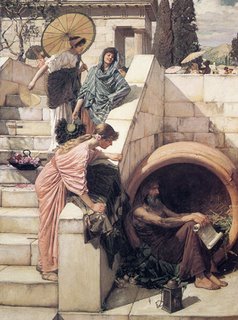
    It is solved by walking was first said by Diogenes the Cynic. It's come to be an appeal to practical experience when confronting any problem. Diogenes believed that pragmatic reason rather than tradition is the only guide for living one's life. If folks don't use reason to guide their conduct it would be better to treat them like animals and lead them on a leash.

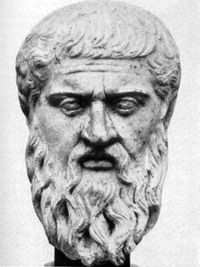
    Diogenes was considered a royal- pain-in-the-ass by his fellow Greeks. His devotion to practical experience was an overt criticism of the herd mentality of conventional Greek society; so much so that Plato referred to him as a Socrates gone mad. Later, Diogenes Laertius, in his Lives of the Eminent Philosophers, described this approach to life:
    Most people, he would say, are so nearly mad that a finger makes all the difference. For if you go along with your middle finger stretched out, some one will think you mad, but, if it’s the little finger, he will not think so.
    It should come as no surprise then that I believe that Diogenes's words offer a good guide for rollers. I've been finding all kinds of examples of folks who have solved problems by rolling.

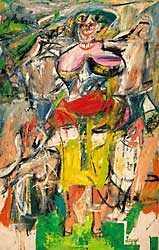
    For example, between 1952 and 1953, Willem de Kooning, the Dutch Abstractionist, painted Woman and Bicycle. Art critics generally agree that this painting is an attempt to come to terms with de Kooning's inner conflicts over women. Some even believe that the aggressively angular image of the woman sitting on a bicycle is inspired by Freud's dream theories of sexual repression.

    Like de Kooning, Charles Wilson Peale, America's first preeminent artist and all around renaissance man, was fascinated by the possibilities of rolling. He invented his own velocipede, Latin for fast foot, "as a welcome diversion from his arduous painting projects". As David V. Herlihy's writes in his book, Bicycle,
    Whenever his back began to ache, he would take a few spins atop his velocipede in the salubrious air of his garden, and return to his easel thoroughly invigorated.
    In our own century, many bikers have realized that it is solved by rolling. Setting out from his home in Nepal on 29 November 1998, Pushkar Shah circumnavigated the world over the next eleven years. Why? In 1990, the Nepalese government arrested him for participating in the country's democracy movement. When he was released, Shah decided to spread the message of peace and hope for his country and for the world. This mission was not about material gain or international fame. It was simply about spreading the message of peace.

    Whether for peace or future opportunities or relaxation or psychological closure, solvitur volubilis recommends itself because the open road is where anyone can think and reflect on their life and times. Utility is certainly important. Many bike just for that. Nevertheless, it is solved by rolling opens us up to many amazing possibilities.

    Labels: , ,

    20.7.09

    The Eagle has Landed!

    one small step for
    Walter Cronkite


    And what a difference
    40 years would've made...


    without him.

    Labels: , ,

    8.7.09

    North by ...

    by northwest

    Vic McDaniel and Ray Francisco, just out of high school, set out from Santa Rosa, CA on second-hand bikes, bound for the great Alaska-Yukon-Pacific Exposition in Seattle. Travelling on dusty roads, roads of logs, of planks, even of corn stalks, and often no roads at all, they pedaled, pushed, and walked a thousand miles north for fifty-four days.

    They started out with only $5.65 between them. Camp was wherever, whenever the sun was gone; food was an occasional meal from a kindly farm wife and what they could fish, hunt, or glean. But they learned that all strangers were not kind, not even close. Vic and Ray reported their adventures to their home-town newspaper. And what adventures they had. They traveled paths beside railroad tracks, fought their way around boulders and up brushy hillsides, and crossed rivers layered with salmon.

    Evelyn Gibb, daughter of one of the cyclists, has drawn on her father's recollections to tell this incredible adventure in his voice. Winner of the Pacific Northwest Writers Association Nonfiction Book Award, Two Wheels North is a fascinating account of a journey that today we can only dream about--one that finds two boys on the road not only to Seattle, but also to manhood.

    Labels: , ,

    29.6.09

    When I was a child...

    I biked as a child

    Last Saturday, Rob O'Flanagan, a columnist for Canada's GuelphMercury, wrote Why bike laws fail so abysmally. It poses the theory that they way we bike as kids is the way we bike as adults. Although I agree with his conclusion I think there's more than childhood nostalgia at work here. Biking, like caging in the US, is suffused with a passionate sense of freedom. Below is his piece with more of my reactions.
    I have a theory on why it's so hard to enforce bicycle laws, and why it seems nearly impossible to change cycling habits. The theory may extend to all manner of things related to what we learn as children and find hard to unlearn as adults.
    Certainly, the ultimate success of bikes as a popular form of alternative form of transportation will depend on getting folks on bikes when they're young.
    Every now and then police officers make an effort to crack down on cyclists who pedal on sidewalks or break other bike laws. But there is a futility to the effort because of the embedded cultural reality of the bicycle in Canada.
    I've always wondered if the often sporadic enforcement of bike offenses by Chicago's Finest is due mostly to the the large number of bikers compared to the relatively small number of officers. Also, as many of my bike buds like to say, "Don't they have more serious offenses to cite?"
    It looks kind of silly for anyone other than a child to ride their bike on the sidewalk, or to fluidly flow from street to sidewalk as though they were one seamless two-wheel thoroughfare. But you see big people do it often. I'll admit I sometimes get the impulse to bodycheck sidewalk riders, but I resist the urge.
    I totally agree, especially since in my neighborhood most pedestrians are older folks.
    The reason this fluidity exists is because most of us learn to ride bikes when we are kids -- when the sidewalk, the park, the train tracks, the parking lot, the riverbank and all other accessible pathways were travelled at will. Biking was strictly a form of recreation, with very little utility attached, unlike in other cultures where the bike is an indispensable means of transportation, even a means of livelihood. That was the beauty of riding a bike as a kid -- your route was unlimited. A bike was a tool of the imagination more than an object of practicality. That was the beauty of riding a bike as a kid -- your route was unlimited. A bike was a tool of the imagination more than an object of practicality.
    This childhood nostalgia is certainly reinforced by the Bikes Are Toys marketing major US manufacturers introduced after WWII. Besides, anyone who's regularly participated in a Critical Mass, or observed one, would've noticed the widespread attitude that you can bike anywhere anytime.
    I grew up on a farm, so most of my biking was restricted to dirt roads and fields. But taking my banana bike to town was a massive adventure because so much more territory could be covered on two wheels than two feet, and the energy and excitement of that exploration had a way of expanding the scope of possible routes and destinations. My gang of friends and I biked everywhere -- graveyard, schoolyard, gravel pit, hospital grounds and playgrounds -- up onto sidewalks, blasting across streets, riding on the wrong side of the road, bobbing and weaving through traffic. All at the highest possible speeds our legs could take us.
    I too grew up in mostly rural areas where traffic was at a minimum. In fact, I didn't own a helmet until I move here to The Windy City over a decade ago when I was in my mid-40s.
    A bike wasn't a bike after all. It was a motorcycle, a racing car or a spacecraft. The rider was Evel Knievel, popping wheelies, jumping gorges. Or Mario Andretti competing in the Indianapolis 500. Or a space traveller hovering over the surface of the moon. Then the controlling hands of civil society reached in to reshape the imagination and impose order. All those biking habits we learned as kids were to be abandoned. Riding on the sidewalk was branded a perilous thing, injurious, even life-threatening. And, most importantly, it is disorderly and therefore must be stopped.
    Now, young and older adult bikers are divided into playful sub-cultures: freakbikers, tweedriders, full moon cruisers, midnight marauders, etc. This, I think, is a serious response to our dominant WASPY culture that scolds adults with I Corinthians, Chapter III, Verse 11: When I was a child I spoke as a child, I understood as a child, I thought as a child; but when I became a man I put away childish things.
    If we actually rode bikes for utility -- as a carrier of market vegetables or hauler of scrap metal, as they do in a nation like China -- we might take the laws of the road more seriously. We might see the bike as more than a plaything. But a bike is largely a tool of fun, and it just isn't much fun sticking to bike lanes, hugging the curb hoping a car doesn't side-swipe you. The child inside wants unconstrained riding, wants to find his or her own path.
    Having biked in Beijing several years back, I would say that utility, though a big one, isn't the one reason why the Chinese take bike laws more seriously. The number of bikers there probably dwarfs that of all the Western countries combined. If our our free-wheelin' style were to be adopted it would surely lead to chaos. Besides, bikers are more prone to follow the law because way more cops ride bikes there than in the US and being representatives of an authoritarian, one-party state, they definitely get more respect.

    Labels: , ,

    21.6.09

    Granny pedal power

    yes, she can!

    Reuters reports that neither age nor gender ... nor chasing down purse snatchers is a barrier to biking! Over in Buerstadt, Germany an 80-year old woman put the pedal to the meddle after her handbag was stolen from her bike basket by a passing biker. Before she could overtake him on her bike, a sympathetic cager stopped the thief and held him for the authorities.

    A surprised police spokesman in nearby Darmstadt stated, The woman had the guts to say, 'I'm not taking that'. With the return of her bag, granny is contemplating better ways to secure her bike basket. Now all she needs to find is someone to pedal!

    Labels: , ,

    10.6.09

    Why we bike - Part II

    28 more answers!

    Thanks to all who replied to last week's post, Why we bike? I've been painting a friend's third floor so I've had time to think about more answers to the question.Then I remembered Martino's Bike Lane Diary. A post from a couple of years back links over to The Bike Path Project at the University of Central Florida Environmental Management Department. Check it out!
    1. Increase in local property values.
    2. Correlation with Overall Wealth.
    3. Less Public Money Is Needed To Create a High Quality Transportation System.
    4. High-Tech Business Is Attracted by a Perceived Better Quality of Life
    5. Improved Personal Finances
    6. Better Physical Health
    7. Better Mental and Emotional Health
    8. Fewer Overweight and Obese Citizens
    9. More Free Time
    10. More Beauty
    11. Greater Mobility
    12. Inclusion of Senior Citizens
    13. More Equitable Living for Low Income Earners
    14. Increased Sense of Community
    15. Individual Opportunities for Safer Travel
    16. Less Congested Roads
    17. Safer, Quieter Neighborhoods
    18. More Resources for Public Use
    19. Enhanced and More Credible Metropolitan Image
    20. Better Air Quality
    21. Visually More Appealing Metropolitan Area
    22. Cleaner Surface and Ground Water
    23. Quieter City
    24. Slowed Pace of Global Warming
    25. More Sustainable Lifestyle
    26. Recognition for Leadership in Sound Environmental Policy
    27. Readiness for Other Environmental Initiatives
    28. Enhanced Quality of Life for Women

    Labels: , ,

    2.6.09

    Why we bike?

    Let me know!

    Labels: , ,

    27.5.09

    Philosophy of travel

    29.4.09

    Stupidest bike lane

    17.4.09

    Yanking our chain

    A Brit's hilarious
    take
    on US news

    A clip from Charlie Brooker's 8th April 2009 episode of Newswipe in which he compares TV News shows on both sides of the pond. Especially funny is Fox's Bill O'Reilly, five minutes in!

    Labels: , ,

    14.4.09

    Risky business?

    or
    rite of passage?


    Folks who don't roll wonder why I risk my life daily on the seemingly mean streets of The Windy City. Taking a slightly masochistic pleasure in their concern, I usually respond by recounting the three times that I've been doored. Then I wrap up with something like, It ain't so bad ... all y'have to do is keep your eyes and ears open. I frankly don't see myself as a big risk-taker. Ride a freak bike or a brakeless fixie if you really want to be risky.

    That being said, urban biking - even with a helmet, mirror, and lights (front & back) - is not without its risks. So why do 1000s of otherwise sane people do it? Deirdre Fernand may have an answer. Writing in The Economist's Intelligent Life Magazine, she explores the allure of extreme sports. Certainly urban bikers don't encounter the same dangers as those wacky folks who bungee jump, free-run, or BASE-jump. But what they do share is that in taking risks they are not an aberration
    The aberration is those of us who are slumped on the sofa of life. If we remove risk from our lives ... we never find out our strengths and weaknesses. We stagnate.
    Finding yourself by confronting and overcoming life's dangers used to be a necessary step on the road to adulthood. Pre-modern societies required adolescents to pass through an often dangerous rite of passage before being considered full members of the community. But in Western societies today, paranoid parents, touchy-feely educators, and insurance companies spend a lot of time removing risks from children's lives. Fernand believes this is a big, big mistake. She cites Mark van Vuyt, professor of psychology at the University of Kent.
    In evolutionary terms it pays for young males to compete in excessive risk-taking. If they thought something was too risky and didn’t do it, they wouldn’t distinguish themselves and wouldn’t get female attention.
    The good news is that, despite this nanny state of affairs, folks are confronting and overcoming life's dangers. It's not that they're all doing it to get chicks. Rather, they do it to test themselves and, G-d willing, to finish every day with the satisfaction of surviving to roll another day.

    Labels: , ,