11.11.11

Labels: war stories, worldbeat
posted by Da' Square Wheelman, at 2:14 PM
1 comments


 Serbian President Boris Tadić confirmed during a news conference in Belgrade that Hague fugitive Ratko Mladić has been arrested.
Labels: politix, war stories, worldbeat
posted by Da' Square Wheelman, at 6:17 AM
0 comments


Labels: beaterbikes, politix, Tweed Ride, war stories, worldbeat
posted by Da' Square Wheelman, at 4:02 PM
6 comments
 And so begins The Little Golden Calf (Золотой телёнок or Zolotoy telyonok) by Soviet authors Ilya Ilf and Evgeny Petrov. A new English translation of the 1931 book, by Konstantin Gurevich and Helen Anderson, is getting a lot of enthusiastic reviews. When I went looking for it, I came upon another, but incomplete, translation by Maciej Ceglowski and Peter V. Gadjokov. The novel's hilarious and, much to my surprise, rather apropos to this humble blog. The opening pages continue with a clever, trenchant comparison of pedestrians and cagers!
... The best part, no less. Pedestrians created the world. It was they who built the cities, raised skyscrapers, laid sewage and water lines, paved the streets and lit them with electric lights. It was they who spread civilization throughout the world, invented movable type, thought up gunpowder, flung bridges across rivers, deciphered Egyptian hieroglyphs, introduced the safety razor, abolished the slave trade and established that soybeans can be used to prepare 114 tasty, nutritious dishes.
And when everything was ready, when our home planet had taken on a comparatively comfortable form, the drivers appeared.
We should note that the automobile was also invented by pedestrians. But drivers somehow instantly forgot about that. They started running over the peaceful, intelligent pedestrians. They took over the streets the pedestrians had created. The pavement doubled in width, the sidewalks narrowed to the size of a tobacco pouch, and pedestrians had to start pressing themselves against the walls of buildings in fear.
Pedestrians in the big city lead a martyr’s life. A kind of transportation ghetto has been created for them. They are only permitted to cross the streets at pedestrian crossings, that is, in precisely those places where traffic is the heaviest and where it is easiest to sever the hair by which a pedestrian’s life usually hangs.
In our expansive country, the ordinary automobile—designed by pedestrians for the transportation of goods and people—has taken on the terrifying outlines of a fratricidal missile. It mows down rows of union members and their families. And if a pedestrian somehow manages to escape from under the car’s silver nose, he is fined by police for violating the rules of the traffic catechesis.
And in general, the authority of the pedestrian has been rather severely shaken. Having given the world such notable persons as Horace, Boyle, Mariotte, Lobachevsky, Gutenberg, and Anatole France, he must now go the most undignified lengths simply to remind the world of his existence. Oh God, oh great God who does not actually exist, what have you brought the pedestrian to?
Labels: books, traffic taming, worldbeat
posted by Da' Square Wheelman, at 5:42 AM
2 comments
 I just finished reading a fascinating book lent to me by a drinking buddy. The Lost City of Z: A Tale of Deadly Obsession in the Amazon, by New Yorker writer David Grann, is actually a tale of two obsessive journeys, separated by nearly a century, to the same place in the Amazon jungles. The first concerns the repeated attempts of Col. Percy Harrison Fawcett to find material evidence for a lost civilization, or El Dorado, in the Green Deserts. The other involves the author trying to find what happened to Fawcett and two others after they disappeared on there in 1925. After going to the region where Fawcett was last reported, Grann simply ends his narrative. It's the most surprising thing that's ever happened to me as a reader. We'll never know what happened to the early 2oth Century British explorer - FULL STOP.
posted by Da' Square Wheelman, at 5:26 AM
1 comments
 I wrote, back in November, about my new journey of discovery in the Boricua neighborhoods of the West Side. My intention was to start a series of posts focusing on interesting things I discover on my daily commute to and from my new job at North Avenue & Rockwell.
 My first discovery, so far, is this community mural along the viaduct at Rockwell & Bloomingdale. I have no idea who or what organization might've painted it but it's a beautiful adaptation of one of my favorite Picasso paintings, Guernika. I first viewed the original in Madrid at the Museo del Prado about eight years ago.
 All along the wall opposite Guernika there is long and wide, light blue smudge about three feet from the floor. When I asked a guard what it was, he replied wryly smiling, blue jeans. It seems that so many people lean their asses against it, lost in contemplation, that they've left a faint, collective reminder of their awe. I won't belabor Guernika's history or meaning here. There are plenty of links that already do that quite well. Suffice it say, I appreciate the personal connection it creates with my new neighborhood .
posted by Da' Square Wheelman, at 5:06 AM
0 comments
 It's Veteran's Day here in Lincoln Square. It's 55 degrees and sunny with a few puffy clouds. Anyone doing a little shopping near the corner of Western and Leland won't miss the neighborhood's ongoing memorial to our soldiers killed in Iraq. The Chicago Printmakers Collaborative has been putting these pictures in the upper windows of their building since August 2004.
 The memorial is very powerful because you can't possibly avoid the pictures. You can see them if you bike north on the east side of Western Ave. You can see them if you're waiting for a citybound train on the platform of the Brownline station. When the pictures started going up there there was only enough space for 648 pictures. Now the windows on each of the three floors are completely covered. And as of last Thursday, the total number of our soldiers killed in Iraq has reached 2464.
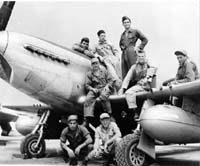
 Each time I pass it I'm reminded of two relatives who died in WWII. Robert Klippel, my mother's brother, flew P-51s out of Iwo Jima in 1945. This photo was taken a few days before he shipped out to the Pacific. On 1 June 1945, a little over two months before Japan surrendered, he flew escort for the B-29s called up on a last minute bombing mission. Before they reached their targets over Osaka, a tsunami engulfed the planes. Only a few ever returned.
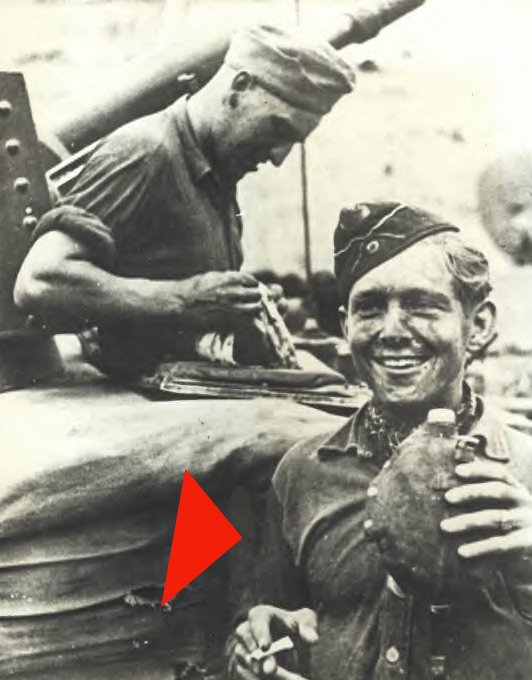 The other relative on my mother's side of the family, Frederick Klippel, was killed in the European Theater. As you can probably tell from the photo here (he's the one with the canteen), Frederick served in the German Wehrmacht. In 1942, his infantry reserve batallion arrived in western Ukraine to consolidate the huge gains made by the German invasion of the Soviet Union the previous year. He was killed by Russian artillery fire on 12 February 1943.
 As as a young boy, every time we visited my grandmother she would show us Robert's Army Air Corps insignia and medals. The stuff was always cool to look at; in fact, I've had a bit of an obsession with this uncle who had died 17 years before I was born. Thanks to the web, I've done a lot of research on his squadron and fighter group. A couple of years ago, I even made contact with the veterans from the figher group. But they were in different squadrons and didn't remember my uncle.
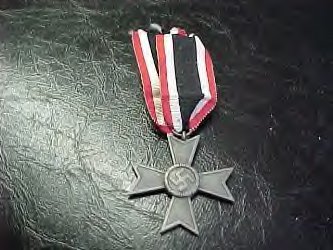 As for Frederick's family, I don't really know how much his death has affected them. I've never met them myself. I didn't even know they or Frederick existed until I googled Klippel. One of the results was a Klippel geneaology posted by a distant cousin who lives on Stanton Island. Since then I've visited him several times. Just like with my grandmother, we look at the pictures and documents he got in Germany when he visited Frederick's family.
Labels: Lincoln Square, war stories, worldbeat
posted by Da' Square Wheelman, at 11:00 AM
1 comments


Labels: history, Lincoln Square, worldbeat
posted by Da' Square Wheelman, at 5:52 AM
0 comments
 Over at the BBC, the Today programme asked Poet Laureate, Carol Ann Duffy, to write a poem commemorating yesterday's burial of Henry Allingham. He was the last of the British survivors of The Great War.
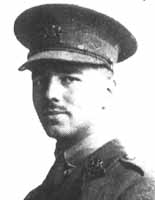 The title of this post refers to WWI's most famous poem written by Wilfred Owen. They're the first words of the Latin phrase popularized in an ode by Horace. The words were widely understood and oft quoted at the start of the WWI. They mean It is sweet and right. The full line ending Owen's poem is Dulce et decorum est pro patria mori or it is sweet and right to die for your country. In other words, it is a great honour to sacrifice yourself for your country. Owen, a British officer, was killed in action at the Battle of the Sambre a week before the war ended, causing news of his death to reach home as the town's church bells declared peace.
In all my dreams, before my helpless sight,
He plunges at me, guttering, choking, drowning.
If poetry could tell it backwards, true, begin
that moment shrapnel scythed you to the stinking mud . . .
but you get up, amazed, watch bled bad blood
run upwards from the slime into its wounds;
see lines and lines of British boys rewind
back to their trenches, kiss the photographs from home —
mothers, sweethearts, sisters, younger brothers
not entering the story now
to die and die and die.
Dulce — No — Decorum — No — Pro patria mori.
You walk away.
You walk away; drop your gun (fixed bayonet)
like all your mates do too —
Harry, Tommy, Wilfred, Edward, Bert —
and light a cigarette.
There’s coffee in the square,
warm French bread
and all those thousands dead
are shaking dried mud from their hair
and queuing up for home. Freshly alive,
a lad plays Tipperary to the crowd, released
from History; the glistening, healthy horses fit for heroes, kings.
You lean against a wall,
your several million lives still possible
and crammed with love, work, children, talent, English beer, good food.
You see the poet tuck away his pocket-book and smile.
If poetry could truly tell it backwards,
then it would.
Labels: kunst, war stories, worldbeat
posted by Da' Square Wheelman, at 6:00 AM
2 comments
 To anyone who thinks that the local and widespread demonstrations against the recent Iranian presidential elections are starting to fail, I have one word: WOMEN! Certainly, much has been made of Twitter, YouTube, Facebook, and a host of other web-based, social networking tools being used by the Iranian protesters. It reminds me of the students in Tienanmen Square who, 20 years ago, communicated by fax with the rest of the world and the young Bosnians who did the same thing in the early 90s using email and web-pages. But tools they only are. It's who wields them that really matters. As Anne Applebaum wrote yesterday in The Washington Post,
Not Obama, not Bush and not Twitter ... but years of work and effort lie behind the public display of defiance and, in particular, the number of women on the streets -- and their presence matters. Their presence could strike the deepest blow against the regime ... Its leadership is legitimate, as is its harsh repression of women, because God has decreed that it is so. The outright rejection of this creed by tens of thousands of women, not just over the past weekend but over the past decade, has to weaken the Islamic Republic's claim to invincibility, in Iran and across the Middle East.
 I can't agree more. To understand this, you should be reading W. Morgan Shuster's The Strangling of Persia. Published in 1912, it recounts his 8 month assignment as the Treasurer-General of the Persian Empire. He and a small group of American treasury experts had been invited by the new constitutional government in 1910 to strengthen the country's finances. It was hoped this would help resist the 1907 Anglo-Russian Entent that effectively divided Persia into two spheres of influence. Needless to say, neither Great Power was happy with Shuster's work. They supported a royalist insurgency against the popular constitutional government that successfully brought it down in 1911. Several months later, Shuster resigned and left Persia. After his return to the US, he wrote his damning indictment of Russian and British meddling in Persia affairs, stating:
[I]t was obvious that the people of Persia deserve much better than what they are getting, that they wanted us to succeed, but it was the British and the Russians who were determined not to let us succeed.
 If you've ever wondered why Iranians are particularly paranoid about the Great Power influence over them, this book will give you great insights. What is especially tragic is that at the beginning of the 2oth Century Iranians strongly supported their constitutional democracy and fervently hoped the US would protect it against Russian and British encroachment. What is most surprising, though, is that Shuster's book includes a small section (pp. 191-199) on the significant role played by Iranian women during and after the 1905-11 Constitutional Revolution. Except for its antique language (as well as attitudes) and the different personalities, it could easily describe the political role Iranian women are playing today.
The Persian women since 1907 had become at a bound the most progressive, not to say radical, in the world. That this statement upsets the ideas of centuries makes no difference. It is the fact.You can read this section as well as the rest of The Strangling of Persian over at Google Books. I highly recommend that you do so!

Labels: books, war stories, worldbeat
posted by Da' Square Wheelman, at 6:16 AM
0 comments

When they kill an innocent child, this is not justice. This is not religion. In no way is this acceptable and I'm certain that the one who shot her will not get a pass from God.
- Panahi
Labels: serious shit, war stories, worldbeat
posted by Da' Square Wheelman, at 6:58 AM
0 comments
CHICAGOANS TO RALLY IN SOLIDARITY WITH IRANIAN PROTESTERS EVENT SCHEDULED FOR SATURDAY JUNE 20, 2009, 4-6PM AT DALEY CENTER PLAZA
Supporters in Chicago have secured permission to stage a peaceful rally at Daley Plaza, where a crowd of approximately two-hundred is expected to gather. Rally participants will attempt to amplify the stifled voices of Iranian protesters who struggle to be heard amid a media clampdown in Iran.The rally, which will take place on Saturday, June 20, 2009 from 4-6pm, is organized by a group of young Iranians who have become acutely aware of the power and value of their civil rights as U.S. citizens and residents. They understand that electoral fairness and freedom of assembly are precisely what the Iranian protesters are pursuing in the face of tear gas, police batons, and gunfire. Planned and carried out almost entirely through social networking sites, e-mail, and text messaging, the rally itself seeks to mirror the activities of Iranian protesters whose use of technology in furtherance of democratic ideals has captured the attention of the world.
Labels: politix, serious shit, worldbeat
posted by Da' Square Wheelman, at 4:48 AM
0 comments
 Back in 2006, I posted a NYTimes op-ed piece by David Brooks eulogizing the passing of the old school, streetwise skeptics of the Chicago press corps. It, as well as comments from a couple of readers I wrote about in Second thoughts, reminded me of the author, Bruce Chatwin. Although he was sometimes careless with the facts, his writing reflected a connoisseur's fascination with the gritty details of people's lives around the world. I guess that's why I've been reading him recently after a ten year hiatus.
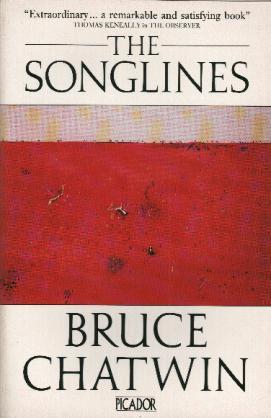 In 1989, I first read Chatwin's The Songlines. It was the year I started grad school at the Unieversity of Illinois in Urbana-Champaign. It was also the year he died of what I later learned was AIDS. Not that I was ignorant of HIV/AIDS back in those early days of the epidemic. My cousin, a virologist living in Macon, GA, had just appeared in a photo for the National Geographic Magazine HIV/AIDS cover story ... or at least his hands did. They were in a photo of a rural AIDS hospice where my cousin was examining the residents.
 Chatwin's death is a tragedy in both personal and literary terms. Salman Rushdie, a close friend who joined him on a road-trip through central Australia, has said that his books and essays, all of which dealt with travel as a way of life, have changed the way writers write and readers read travel books. Chatwin wouldn't have agreed though. He hated being pegged as a travel writer. He thought of himself as a writer who simply happened to travel ... a lot and everywhere.
 Chatwin's great appeal for me lies in an apparent contradiction: he was a hedgehog with one big idea who pursued it like a fox. On the one hand, he believed that the nomads' travelling way of life is the natural state of humanity and having lost this for the most part, the world is now a more neurotic, violent place.
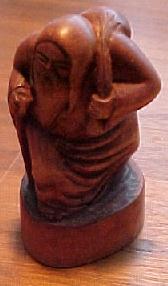 On the other hand, Chatwin rambled across six continents looking for this Nomadic Alternative. While many authors have written about exotic locales, from the comfortable security of their dens, Chatwin loved to visit them. Infamous for his non-stop, rapid chatter, he was yet a sensitive listener. He had intense discussions with a dizzying array of other travellers and writers as well as nomads, warriors, conquerors, cowboys, artists, shepherds, mystics, and mercenaries.
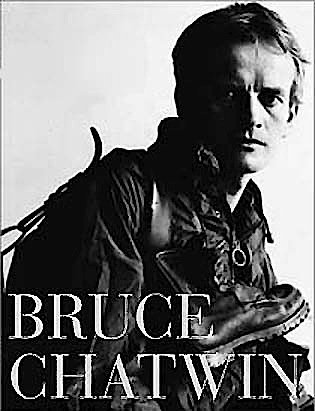 So I've returned to Bruce Chatwin as I write this blog. It seems to me that he offers a natural bridge between travel as a way of life and bikes as a means for travel. In purely Chatwinesque fashion, he asks questions... the right questions:
Why is man the most restless, dissatisfied of animals?
Why do wandering people conceive the world as perfect whereas sedentary ones always try to change it?
Why have the great teachers - Christ or the Buddha - recommended the Road as the way to salvation?
Do we agree with Pascal that all man's troubles stem from his inability to sit quietly in a room?
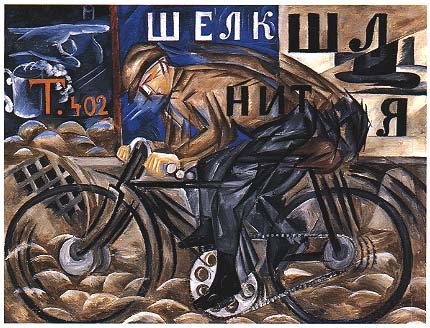 All I got to do now is answer them
Labels: books, Isaiah Berlin, worldbeat
posted by Da' Square Wheelman, at 5:57 AM
1 comments
Labels: pensées, silly shit, worldbeat
posted by Da' Square Wheelman, at 5:45 AM
0 comments
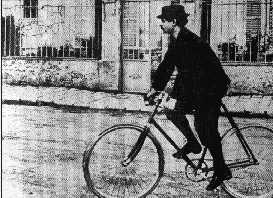
Barabbas, slated to race, was scratched.
Pilate, the starter, pulling out his clepsydra or water clock, an operation which wet his hands unless he had merely spit on them -- Pilate gave the send-off.
Jesus got away to a good start.
In those days, according to the excellent sports commentator St. Matthew, it was customary to flagellate the sprinters at the start the way a coachman whips his horses. The whip both stimulates and gives a hygienic massage. Jesus, then, got off in good form, but he had a fiat right away. A bed of thorns punctured the whole circumference of his front tire.
Today in the shop windows of bicycle dealers you can see a reproduction of this veritable crown of thorns as an ad for puncture-proof tires. But Jesus's was an ordinary single-tube racing tire.
The two thieves, obviously in cahoots and therefore "thick as thieves," took the lead.
It is not true that there were any nails. The three objects usually shown in the ads belong to a rapid-change tire tool called the "Jiffy."
We had better begin by telling about the spills; but before that the machine itself must be described.
The bicycle frame in use today is of relativelv recent invention. It appeared around 1890. Previous to that time the body of the machine was constructed of two tubes soldered together at right angles. It was generally called the right-angle or cross bicycle. Jesus, after his puncture, climbed the slope on foot, carrying on his shoulder the bike frame, or, if you will, the cross.
Contemporary engravings reproduce this scene from photographs. But it appears that the sport of cycling, as a result of the well known accident which put a grievous end to the Passion race and which was brought up to date almost on its anniversary by the similar accident of Count Zborowski on the Turbie slope -- the sport of cycling was for a time prohibited by state ordinance. That explains why the illustrated magazines, in reproducing this celebrated scene, show bicycles of a rather imaginary design. They confuse the machine's cross frame with that other cross, the straight handlebar. They represent Jesus with his hands spread on the handlebars, and it is worth mentioning in this connection that Jesus rode lying flat on his back in order to reduce his air resistance.
Note also that the frame or cross was made of wood, just as wheels are to this day.
A few people have insinuated falsely that Jesus's machine was a draisienne , an unlikely mount for a hill-climbing contest. According to the old cyclophile hagiographers, St. Briget, St. Gregory of Tours, and St. Irene, the cross was equipped with adevice which they name suppedaneum. There is no need to be a great scholar to translate this as "pedal."
Lipsius, Justinian, Bosius, and Erycius Puteanus describe an other accessory which one still finds, according to Cornelius Curtius in 1643, on Japanese crosses: a protuberance of leather or wood on the shaft which the rider sits astride -- manifestly the seat or saddle.
This general description, furthermore, suits the definition of a bicycle current among the Chinese: "A little mule which is led by the ears and urged along by showering it with kicks."
We shall abridge the story of the race itself, for it has been narrated in detail by specialized works and illustrated by sculpture and painting visible in monuments built to house such art. There are fourteen turns in the difficult Golgotha course. Jesus took his first spill at the third turn. His mother, who was in the stands, became alarmed.
His excellent trainer, Simon the Cyrenian, who but for the thorn accident would have been riding out in front to cut the wind, carried the machine.
Jesus, though carrying nothing, perspired heavily. It is not certain whether a female spectator wiped his brow, but we know that Veronica, a girl reporter, got a good shot of him with her Kodak.
The second spill came at the seventh turn on some slippery pavement. Jesus went down for the third time at the eleventh turn, skidding on a rail.
The Israelite demimondaines waved their handkerchiefs at the eighth.
The deplorable accident familiar to us all took place at the twelfth turn. Jesus was in a dead heat at the time with the thieves. We know that he continued the race airborne -- but that is another story.
Labels: Situationists, that which rolls, worldbeat
posted by Da' Square Wheelman, at 5:45 AM
1 comments
Labels: enviromatters, silly shit, worldbeat
posted by Da' Square Wheelman, at 6:30 AM
0 comments


posted by Da' Square Wheelman, at 5:32 AM
1 comments

Labels: pensées, Situationists, worldbeat
posted by Da' Square Wheelman, at 2:25 PM
0 comments

Foxes know many small things but hedgehogs know one big thing...








All content on this website (including text, photographs, audio files, and any other original works), unless otherwise noted, is licensed under an
Attribution-NonCommercial-ShareAlike 2.5 License.
DISCLAIMER:
The views and opinions expressed herein are not attributable to girlfriends and wives (old or new) to family, friends and colleagues (current or estranged), and to employers (pains-in-the-ass or otherwise).