Bicycle Diaries

Recent Posts

26.1.10

Let your tweed flag fly!


Once again, the Central Committee of the BBC chose an unseasonably warm day to gather together nearly 40 ladies & gentleman for a fab tour of the Windy City's posh fireplace pubs. As always there were a lot of new punters who joined last Saturday; but a lot of cheery ole' timers and Ocean Pearls as well. We also had a journalism student along to vid the first stop at Jack's Bar & Grill on Southport just below Lincoln.

The growing interest in our little collective reminds of an article that appeared in The Spectator a few weeks back. It so often happens on the opposite shores of the Atlantic. The Brits despair over the passing of a well-worn tradition just their American cousins herald its rebirth. This time around it's the demise of that dowdy English fashion sense: the threadbare, genteel poverty so valued by the upper classes since the late 18th Century. Harry Mount writes,
The idea was born that it should always take a few seconds to notice if someone is well-dressed. Nobody who was really smart wanted to appear so — that would be ostentatious. Enter those frayed shirt collars, jumpers with the elbows gone, battered chintz rather than fresh new seat covers.
The usefulness of things, no matter how old or time-worn, is what mattered. But now both the masses and classes of Merry Olde are in the thrall of the new, the minimal, and the modern. Think of London's Millennium Wheel and Beetham Tower, both representing the UK's squeaky clean embrace of the 21st Century.
For the first time in history we live in a civilisation where, the richer you are, the fewer things you have, and the newer, cleaner and more stripped-down those things must be.
When I read this I looked around the genial clutter of my apartment and realized that shabby chic is indeed alive and well in this colonial outpost. It's even catching on among the punters on Madison Avenue. Back in November last year, The New York Times described the new wave of hipsters giving up their skinny jeans for tweed trousers and spotty t-shirts for high-lapel vests. And here our Tweed Rides are attracting more bikers than the venerable Midnight Marauders.


Perhaps it has something to do with George Bernard Shaw's observation that England and America are two countries separated by a common language.

Labels: , ,

11.11.09

Two minutes of silence...

for their sacrifice

It's Veteran's Day here in Lincoln Square. It's 55 degrees and sunny with a few puffy clouds. Anyone doing a little shopping near the corner of Western and Leland won't miss the neighborhood's ongoing memorial to our soldiers killed in Iraq. The Chicago Printmakers Collaborative has been putting these pictures in the upper windows of their building since August 2004.

The memorial is very powerful because you can't possibly avoid the pictures. You can see them if you bike north on the east side of Western Ave. You can see them if you're waiting for a citybound train on the platform of the Brownline station. When the pictures started going up there there was only enough space for 648 pictures. Now the windows on each of the three floors are completely covered. And as of last Thursday, the total number of our soldiers killed in Iraq has reached 2464.

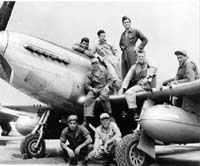
Each time I pass it I'm reminded of two relatives who died in WWII. Robert Klippel, my mother's brother, flew P-51s out of Iwo Jima in 1945. This photo was taken a few days before he shipped out to the Pacific. On 1 June 1945, a little over two months before Japan surrendered, he flew escort for the B-29s called up on a last minute bombing mission. Before they reached their targets over Osaka, a tsunami engulfed the planes. Only a few ever returned.

My uncle was one of the unlucky ones. He and his plane were never found. In 1946 his Missing in Action status was changed to Killed in Action.

Some of his friends who survived visited my mother's family soon after the war. They said that the last time they saw his plane it was trying to climb out over the storm. Years later I got my hands on the afteraction peport from a veterans' organization. It states that this mission was the largest loss of life and equipment in the Pacific Theater.

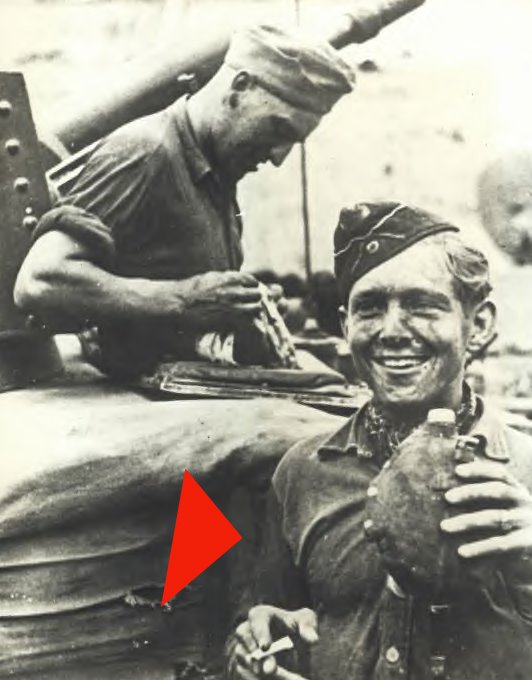
The other relative on my mother's side of the family, Frederick Klippel, was killed in the European Theater. As you can probably tell from the photo here (he's the one with the canteen), Frederick served in the German Wehrmacht. In 1942, his infantry reserve batallion arrived in western Ukraine to consolidate the huge gains made by the German invasion of the Soviet Union the previous year. He was killed by Russian artillery fire on 12 February 1943.

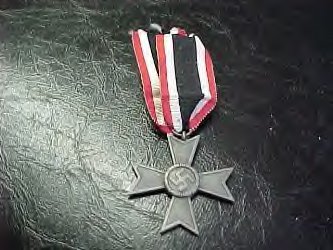
As as a young boy, every time we visited my grandmother she would show us Robert's Army Air Corps insignia and medals. The stuff was always cool to look at; in fact, I've had a bit of an obsession with this uncle who had died 17 years before I was born. Thanks to the web, I've done a lot of research on his squadron and fighter group. A couple of years ago, I even made contact with the veterans from the figher group. But they were in different squadrons and didn't remember my uncle.

It wasn't until I was an adult, many years later, that I realized that Robert's death had torn the heart out of my mother's family. My grandmother firmly believed that he was still alive somewhere on Pacific island or in Japan. Her eldest daughter, my aunt, started to suffer from bipolar disorder at the end of the war. And my mother still can't talk about my uncle with getting extremely emotional.

As for Frederick's family, I don't really know how much his death has affected them. I've never met them myself. I didn't even know they or Frederick existed until I googled Klippel. One of the results was a Klippel geneaology posted by a distant cousin who lives on Stanton Island. Since then I've visited him several times. Just like with my grandmother, we look at the pictures and documents he got in Germany when he visited Frederick's family.

But I do know that once a soldier's ghost sits down at the dinner table it doesn't ever really go away. The one that started sitting with my mother's family in 1945 now sits with me as well as with my cousins and their children. This is why those 648 faces staring out of the windows of the Chicago Printmakers Collaborative have become an important part of my bike travels along Western Ave.

Today there are too many ghosts sitting at dinner tables or in backyards or on porches and decks around Chicago and the country.

Labels: , ,

9.11.09

The fall

20 years ago
today


the joke's (still) on you
Uncle Joe!


(Stalin
is captured in this photograph by Lt. Gen. Nikolai Vlasik, the Soviet dictator's bodyguard. Vlasik's off-the-record photos of Stalin caused a sensation in the early 1960s when an enterprising Soviet journalist spirited some out, selling them to newspapers and magazines worldwide.)


and our piece of the wall
in Lincoln Square

Bliss it was in that dawn to be alive,
but to be young was very heaven.


William Wordsworth

on the French Revolution

Labels: , ,

10.7.09

Tonight's Northside Mass...

Jason's last
%-{(>


Jason, biking stalwart and all around great guy, is leaving The City of Big Shoulders for the greener, if not more humid, pastures of The Big Easy. He's got a pretty good job offer down there in his hometown. All of us who've got to know him on the Northside Mass, FBC Full Moon Fiasco, Chicago Mass, and Winston's Tweed Ride are going to be sad tonight. Hopefully with cash in his pockets now he'll get some sister rides up and rolling down there. So although he's soon to be gone, he certainly won't be forgotten!

Labels: , ,

25.5.09

Memorial Day

ghosts at the barbecue

It's Memorial Day here in Lincoln Square. Folks are getting together to enjoy the first really good weekend in Chicago. It's 66 degrees and cloudy. Anywhere you go, a wonderful barbecue smell wafts up from backyards, porches, and decks. And anyone doing a little shopping near the corner of Western and Leland won't miss the neighborhood's ongoing memorial to our soldiers killed in Iraq.

The Chicago Printmakers Collaborative has been putting these pictures in the upper windows of their building since August 2004. The memorial is very powerful because you can't possibly avoid the pictures. You can see them if you bike north on the east side of Western Ave. You can see them if you're waiting for a city bound train on the platform of the Brownline station. When the pictures started going up there there was only enough space for 648 pictures. Now the windows on each of the three floors are completely covered. And as of Sunday, the total number of our soldiers killed in Iraq has reached 4300 and the wounded now total 31,285.

Each time I pass it I'm reminded of two relatives who died in WWII. Robert Klippel, my mother's brother, flew P-51s out of Iwo Jima in 1945. This photo was taken a few days before he shipped out to the Pacific. On 1 June 1945, a little over two months before Japan surrendered, he flew escort for the B-29s called up on a last minute bombing mission. Before they reached their targets over Osaka, a tsunami engulfed the planes. Only a few ever returned. My uncle was one of the unlucky ones. He and his plane were never found. In 1946 his Missing in Action status was changed to Killed in Action.

Some of his friends who survived visited my mother's family soon after the war. They said that the last time they saw his plane it was trying to climb out over the storm. Years later I got my hands on the afteraction report from a veterans' organization. It states that this mission was the largest loss of life and equipment in the Pacific Theater.

The other relative on my mother's side of the family, Frederick Klippel, was killed in the European Theater. As you can probably tell from the photo here (he's the one with the canteen), Frederick served in the German Wehrmacht. In 1942, his infantry reserve battalion arrived in western Ukraine to consolidate the huge gains made by the German invasion of the Soviet Union the previous year. He was killed by Russian artillery fire on 12 February 1943 when the Wehrmacht retook Kharkov.

As as a young boy, every time we visited my grandmother she would show us Robert's Army Air Corps insignia and medals. The stuff was always cool to look at; in fact, I've had a bit of an obsession with this uncle who had died 17 years before I was born. Thanks to the web, I've done a lot of research on his squadron and fighter group. A couple of years ago, I even made contact with the veterans from the figher group. But they were in different squadrons and didn't remember my uncle. It wasn't until I was an adult, many years later, that I realized that Robert's death had torn the heart out of my mother's family. My grandmother firmly believed that he was still alive somewhere on Pacific island or in Japan. Her eldest daughter, my aunt, started to suffer from bipolar disorder at the end of the war. And my mother still can't talk about my uncle with getting extremely emotional.

As for Frederick's family, I don't really know how much his death has affected them. I've never met them myself. I didn't even know they or Frederick existed until I googled Klippel. One of the results was a Klippel genealogy posted by a distant cousin who lives on Stanton Island. Since then I've visited him several times. Just like with my grandmother, we look at the pictures and documents he got in Germany when he visited Frederick's family.

But I do know that once a soldier's ghost sits down at the dinner table it doesn't ever really go away. The one that started sitting with my mother's family in 1945 now sits with me as well as with my cousins and their children. This is why those 648 faces staring out of the windows of the Chicago Printmakers Collaborative have become an important part of my bike travels along Western Ave.

Today there are too many ghosts sitting at dinner tables or in backyards or on porches and decks around Chicago and the country.

Labels: , ,

18.1.09

My wintry city

love it or
leave it


The day after New Year's, The Boston Globe ran the article, How the city hurts your brain. It's author, Jonah Lehrer, cites the latest research to declare that city life ain't easy.
Just being in an urban environment, they have found, impairs our basic mental processes. After spending a few minutes on a crowded city street, the brain is less able to hold things in memory, and suffers from reduced self-control. While it's long been recognized that city life is exhausting -- that's why Picasso left Paris -- this new research suggests that cities actually dull our thinking, sometimes dramatically so.
Really? I just simply love when the social sciences state the obvious. But my biggest beef isn't with green (nostalgia) tinted research like this.
One of the main forces at work is a stark lack of nature, which is surprisingly beneficial for the brain ... fleeting glimpses of nature improve brain performance, it seems, because they provide a mental break from the urban roil.
Instead, it's his conclusion. Over the last couple of months, me and my neighbors here in The Windy City have been up to our navels in nature ... very, very frigid nature. Its benefits are not so obvious. Aleksandar Hemon, an author and transplant from Sarajevo, writes in today's NYTimes Op-Ed Section,
Once, on a very cold winter day at a North Side El stop, I saw three or four freezing Chicagoans huddled together under the heating light like newly hatched chickens. It was 30 below zero, with wind chill, the kind of cold that makes your bones hurt because the frozen flesh is beyond the reach of pain. There was closeness in the huddle, but no touching; there was solidarity, but no eye contact. And I realized I, too, could huddle along and partake in the scarce warmth; I was no longer a tourist. At 30 below zero we were all Chicagoans.

Another transplant and longtime Chicagoan once told me that weather extremes were just fine for him. Surving winter's sub-zero lows and summer's sticky highs always gave him a sense of accomplishment. One that's not easliy experienced in other locals. Besides, while we all may be operating at reduced brain power, at least we're all in this together!

Labels: , ,

6.9.08

What's in your neighborhood?

more than
you think


Criminal Searches provides the scary-but-useful data on how many crimes are committed in your neighborhood. It's all culled from public records, and is presented as a Google Maps mashup. You can restrict your search to sex offenders, search on a specific name to get a criminal history, or do a general search for criminals by city or ZIP code. This kind of data is certainly not for the faint of heart but can be useful in assessing the safety of your neighborhood.

Labels: , ,

11.2.08

What's in your bag?

Can you dig it?

Both Jen in Chicago and Cyclelicious have posted on the contents in their bike bags. That and yesterday's plunging temps inspired me to do a little digging of my own. I found the following short story, Bang, Bang, Bang, in one of the travel notebooks I keep in my bike bag. I wrote it a few months after I moved into my four-flat here in Lincoln Square. It describes a Bosniak contractor who spent a week rebuilding our back porches.

BANG
BANG
BANG
The slow, rhythmic sound starts deep in the center of my building and reverberates up, out through my top-floor apartment. It was a late night so the impact has much more of an impact on me this morning than it should. Most likely, it's the crew my landlady hired to build the new decks out back. I get up, look out the kitchen window. I see no one.

BANG
BANG
BANG
I make an espresso, light a cigarette and go down the front stairs, because there's a stack of 1 x 6's blocking my back door. I go into the alley alongside my building. Big chunks of concrete are piled waist-high against the wall. Around the corner, in back, there are higher piles of concrete. It looks like those black-and-white shots of Berlin after the war when little old ladies and children were cleaning up the rubble.

BANG
BANG
BANG
No one's around except for this one guy breaking up the entire walkway with a long, pointed iron bar. He's sweating at nine in the morning. I remember seeing him last week when he and the rest of the crew were putting up the flooring and stairs. The whole crew is from the Balkans, like my landlady, Ezma. The boss is Macedonian, another is Serb, and two others are Bosniaks: Muslims from Bosnia-Hercegovina. He's one of the Bosniaks. I don't remember speaking to him.

BANG
BANG
BANG
He apparently remembers me too, and stops breaking the concrete. We talk about nothing in particular - the decks, the weather. The conversation slowly turns to the more personal. He tells me that he came to the States six months ago, directly from Bosnia-Herzegovina. He has a wife and two sons, aged 19 and 16. The youngest is good in school. The other is a problem. He doesn't work much. Has a girlfriend and a car here in America.

We talk about the war, because I happened to have been there in 1991 when it all began. I then came back in '93 to teach at an underground university in Tuzla. He knows Tuzla well; he went to mining school there. He's from a small village near Doboi, half an hour to the east, and worked in Kladanj, one hour south. Kladanj is famous for its mineral springs - they call the water from there Muzshe Voda, or Man's Water. It's good for restoring a man's vigor.

BANG
BANG
BANG
"War, no good," he says flatly, imitating a gun with his fingers and shooting no one in particular. The Serb paramilitaries drove him and his family from Teslik in '92. He joined the army, fought against them in Central Bosnia with the 7th Armija for 3 years. "War, no good," he repeats, opening his arms, hands parallel with the blasted concrete. He shows me two ugly scars on his right leg. He doesn't explain where they come from, but they look like shrapnel wounds: ragged, star-shaped, one on the inside of the calf and one near his knee. Same thing on the other side, a little farther up.

BANG
BANG
BANG
I get him some water with ice. We smoke his cigarettes. He tells me he's very proud of the work they're doing, as he gives the supports a firm shake. The main floor beams are notched and bolted at every joint. He shows me how they have sanded down all the rough edges on the stairs, railings, and banisters. Everything is steady, solid.

In '93 there wasn't a building left standing out in the countryside. When I was there in 2001 most of them had been rebuilt. It seems like every Bosnian knows how to lay foundations, raise walls, and set the roof in just a few days. They have an extraordinary skill for knocking things down and building them back up.

BANG
BANG
BANG
If everything goes well, he tells me, he won't have to work weekends or holidays much longer. It's apparently been a rough time for them recently: he had been shuffling bags at the Loop Sheraton but was let off during the recession. He and his family lost their apartment, and now they live with the crew boss. He's saving up money to go back to school, maybe get back into engineering. That, or open a restaraunt.
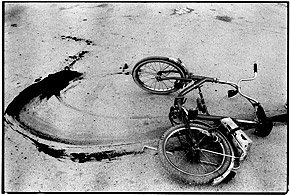
[Editor's note: This last picture of a bicycle on a blood-stained Sarajevo street was taken by Annie Leibovitz in 1993. It appears in her new 2006 book, A Photographers Life, Random House. I found it over at The Washington Post.]

Labels: , ,

31.1.08

Polka ride

critical mass
w/the Polkaholics


Last Friday's mass in The Windy City got off to a chilly start with somewhere around 300 bikers. It wasn't all that cold but cold enough to keep the presence of Chicago's Finest to a minimum. The two bike cops who started out with us peeled off after 30 minutes.

It was also the quickest mass I've been on. Not because of the cold. Rather our goal was to hook up with The Polkaholics. Each January we roll to wherever this punk polka band is playing. This year it was up in my 'hood at the Lincoln Square Lanes, our local bowling alley. What could be better than music that's hot as a grilled kielbasa & crunchy as a potato pancake?

The band even performed a new song about Critical Mass. So we drank, we danced, we sang, and we bowled. PirogiJohn even got into the spirit with his succulent bike attire.

Labels: , , , ,

27.9.07

Hoofin' it

how walkable is
your neighborhood?


Another cool application of Google Maps is Walk Score. It was originally intended for home buyers. Now it's making the rounds of the bike blogs since The WashCycle first discovered it. Essentially the site measures neighborhood walkability. Top points go to those where you DON'T need a car. It's also a great way to find out exactly what's near you. My own humble 'hood gets an 85 - Very Walkable! Just pop in your street address to get the score.
90 - 100 = Walkers' Paradise: Most errands can be accomplished on foot and many people get by without owning a car.

70 - 90 = Very Walkable: It's possible to get by without owning a car.

50 - 70 = Some Walkable Locations: Some stores and amenities are within walking distance, but many everyday trips still require a bike, public transportation, or car.

25 - 50 = Not Walkable: Only a few destinations are within easy walking range. For most errands, driving or public transportation is a must.

0 - 25 = Driving Only: Virtually no neighborhood destinations within walking range. You can walk from your house to your car!

Labels: , ,

15.6.07

Bikelane luv'

yesterday afternoon...

She's rolling a couple of meters in front of me in the bike lane up Lincoln Avenue. It's somewhere around the first third of my daily commute home from work in the Loop. Could be Armitage. The first thing I notice is her bike: a Dutch Oma 3speed; chainguard and everything, more rust than metal. But man, oh man, the rear rim is true. Probably does it herself.

As usually happens, she has to swerve left to miss a cager blocking half the bike lane. Helmetless, she elegantly stretches out her left arm, hand pointing toward the spot where she'll enter the traffic. The cager alongside me doesn't notice or perhaps doesn't care.

Looking slightly left over her shoulder, she points again to where she's going. But this time slight ever so slightly waggles her finger. An old teacher scolding a troublesome student. Without having to, the cager slams on the breaks and as I roll past I catch a sheepish look.

I'm smitten...

I spend the rest of the commute trying to catch up to her. Is she Dutch? The finger waggle was classic Amsterdam biker. She breaks cheats every stop sign and rolls, though slowly, through the red lights. Though she does stops for cagers crossing in front of her. At one point, one stops even though they've got the light. She stops too. I stop behind her. Who is going to be more polite? The cager doesn't move. She takes the favor but before rolling gives an old school What are you? An Idiot? shrug. Yep, she's definitely Dutch.

What am I going to say when I catch up to her ... or if I catch up to her? (I pretty much mostly obey the stop signs and traffic lights) We cross Fullerton then Belmont still just a few meters apart, me still behind but closing fast. I don't know if she notices me as other bikers pass left around us. So what am I going to say?

I definitely don't want ask in English, Are you Dutch? On the one hand, she might not be. On the other hand, if she is ... I've got about six seconds to impress her with my worldliness. Problem is ... I don't know enough Dutch to ask. I'm gonna' have to fall back on German, learned mostly in bed with an old girlfriend: Sind Sie Holländer?

Unfortunately, my weinig Nederlands meisje (little Holland girl) turns right onto Hermitage, heading north. OK, Plan B. I speed up, armed with the only Dutch I know, learned mostly in an Amsterdam bed with another old girlfriend (It's a long, long story). I yell as loud as I can, Doei!!! You say dewey, clipping it at the end like a farmer saying yep. It translates pretty much as "See'ya!!!

She hears me; slows down, looks around, sees me. Again, that elegant, old world, finger. It waggles, now up at the sky. She smiles big and shouts a perfectly clipped Doei!!!

Yep, Zij is Nederlands: she's Dutch.

Labels: , , ,

27.4.07

Da' square & da' world

why I love this 'hood

I've been a global educator for over a decade. What that means is that I work with American education institutions, mostly colleges and universities, that want their students exposed to the world. And overseas, I work with NGOs (non-governmental organizations or non-profits) that are working to improve local education in the global context.

There are a lot of different ways to do global education. Much of my work concentrates on three areas:
1. Civic Education, encouraging young people to be more engaged politically
2. Leadership Development, preparing them to be the next generation of communiity leaders
3. Education Reform, training educators how to be better teachers inside and outside the classroom
I guess that's why I like biking around Chicago. Every time I get on my bike it's like a little foreign adventure in what is decidedly a global city. Each of its 80 or so neighborhoods has origins in an immigrant community. And over the years while the boundaries of these neighborhoods have remained the same, the faces have changed. For example, Lincoln Square where I live has always been known as the German neighborhood. But since the 1960s it's seen an influx of Greeks, Yugoslavs, Latinos, and Thais.

If you appreciate and enjoy this kind of diversity, you should definitely read Isaiah Berlin. His work provides the right tools for dealing with difference in our daily encounters with other peoples and communities. He wrote that each community naturally feels its particular values and ways of doing things are the best in the world. How then should each community deal with the fact that all others have their own idea of what is best?

The trick is for every community to accept the reality of fundamental differences while each remains loyal to its own ideals. To explain this, Berlin uses the metaphor of fans along a football pitch. Since they stand throughout the match they have to constantly shift their weight from foot to foot.

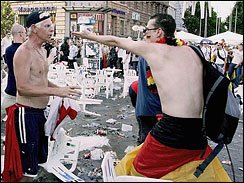
Basically tolerating diversity is a constant balancing act shifting between the weight of our own community loyalties and our acceptance of other fundamentally different communities. Without it, we would be brawling in the streets...

Off to
Critical Mass!

Labels: , , ,

2.2.07

Now this is winter!

temps are dropping
in the windy city

Highs are expected to reach no more than 14 degrees over the weekend. But I won't be a hermit in my dusty apartment surrounded by mountains of books, empty pizza boxes, or unopened mail. before I get my office up and running I'm going to be hitting the local wifi enabled cafes.

When I first moved to Chicago, freshly divorced and without knowing anyone, I decided I wasn't going to become the creepy, lonely guy in my building. You see, this was the first time I had really ever been on my own. Until 2000, I had been been in one relationship after another, all of them nearly overlapping, going all the way back to junior high school. So what I had to figure out was how to be on my own without being lonely and, more importantly, how to create relationships (family, friends, lovers, etc.) on my own.

Reading in bars, restaurants, cafes, and coffee shops BY MYSELF was the answer. And over the last 6 years I've found a number of perfect places for outside reading.

What I need for a perfect place is:
a) natural light since most places dim their lights to preserve the bar-fly atmosphere for which Chicago is famous
b)
comfy seats with plenty of space for my bag, books, palm pilot, notebooks, pens, and, of course, victuals,
c)
an accommodating staff that doesn't immediately assume that you're a creepy, lonely guy,
d)
a solid contingent of regular customers who also don't immediately assume that you're a creepy, lonely guy and don't take offense when what I'm reading is more interesting than the idle chit-chat, and
e)
smoking which is getting more and more difficult with the creeping smoking ban instituted by our otherwise beloved mayor.
Beyond that, each of the perfect places I've found has its own unique and often peculiar qualities from outside reading. Feed the Beast, for instance, is my favorite by far. It opened early last summer, replacing a seedy sports bar that was really only good for finding late night, provisional hook-ups. The light is phenomenal, the seats comfy, and the staff as well as the regulars are very accommodating. The only problem recently has been it's growing popularity with the kind of folks, typically from the hipster'hoods, coming in to see and be seen.

When I get too many inquiries about what I'm reading; as if the book were an invitation for idle chit-chat rather than a request for solitude, I'll usually head up north to The Leadway. It too used to be a dangerous place before Frank, an affable Romanian sculptor, bought it. He's filled it with his huge metal sculptures and tons of watercolors done in the bar by customers for which he provides the materials gratis.

But the really cool thing about it is that the bartenders, mostly Romanians, and the regulars, mostly neighbors, are about as laid back as you can get in a local Chicago bar. If you read, no worries. If you want to talk politics, no hassles. If you want to watch heavy metal videos, you're in like Flynn.

I've been slowly posting about other perfect places and I hope to continue over the next couple of weeks.

Labels: , , , ,