Bicycle Diaries

Recent Posts

24.9.06

Queasy Rider

I won't be continuing with Beijing Bicycle - The Hutong Tour today. A new buddy, Pete, and I are taking a roll down Halstead Avenue. Then we'll show up at Chicago Community Bike Project Monthly Bike Clinic at West Town Bikes. There's also a Ghost Bike Ride later tonight.

Nevertheless, in an effort to have something interesting every day, I'm posting this article from today's New York Times. Steven Kurutz writes about NYC bike commuters and the advocacy roles played by Critical Mass and Transportation Alternatives. Now if only Chicago's papers of note could write about us as sympathetically...
PAUL FORD, a soft-spoken, sturdily built 32-year-old who works as an editor at Harper’s Magazine, sometimes describes his commute between his apartment in Gowanus, Brooklyn, and his office on Broadway near Bond Street as feeling “like a video game, except you can get killed.”

And in fact, watching Mr. Ford weave through the city’s traffic-clogged streets one recent morning, pedaling steadily atop his black and gray Fuji Sanibel cruiser, called to mind a two-wheeled, life-and-death version of the 80’s arcade game Frogger.

At 7:40 a.m., wearing jeans and a black T-shirt, Mr. Ford set out from his apartment near the Gowanus Canal and was soon moving briskly down Third Avenue in Boerum Hill. Mr. Ford is a physical presence on the road, a big guy atop a seven-speed bike, a shiny black helmet covering his short brown hair. But the motorists whizzing by pay him little mind.

Near Third Avenue and Douglass Street, he slowed and hugged the curb to avoid a delivery truck passing on his left. Pulling onto the street again, it was in the firm but cautious way a person might wade into a fast-moving river. Or, as Mr. Ford put it: “You’re fragile out here in traffic. Nothing bad comes from being paranoid.”

Mr. Ford is among an estimated 120,000 regular cyclists in New York, 40,000 of whom commute to work by bike. And increasingly, these cyclists are waging an ever more ferocious turf war with the city.

Like Mr. Ford, the majority of these commuters do daily battle on the city’s 6,000 miles of often jam-packed roadways. At the same time, a small number of cycling advocates lobby City Hall with almost religious fervor, seeking everything from more bike racks to legislation requiring office building owners to install storage space for bikes.

The most public lobbying efforts are the Critical Mass rides in Manhattan, consciousness-raising events that take place on the last Friday of every month — the next one is Friday — and resemble nothing so much as 1960’s political rallies. Before the most recent ride, a bleached-blond hipster preacher named Reverend Billy recited the First Amendment through a bullhorn. Later, police officers issued 65 moving violations and made one arrest.

Despite the obstacles, this may be an ideal moment for seeking a bike-friendlier New York. With issues like global warming and high gas prices at the forefront of public consciousness, many advocates say that after years of struggle, they finally have the political capital to make cycling a top priority in the city.

“This is absolutely a moment of opportunity,” said Walter Hook, executive director of the Institute for Transportation and Development Policy, a New York-based organization that designs mass transit in developing countries. “The mayor stood up and took a bold stance and banned smoking. The next step is to stop the air pollution coming out of the tailpipe.”

The Path Less Traveled

Mr. Ford had left home early, hoping to beat the morning rush, but five minutes into his commute, cars were already lined up bumper to bumper at a red light on Third Avenue. Knifing through traffic, he hung a left onto Bergen Street in Boerum Hill, where he could enjoy a sliver of comfort in the form of a five-foot-wide bike lane, designated by two painted white lines. A few cyclists overtook him, pedaling furiously on expensive-looking machines.

Mr. Ford began biking to work two months ago because he wanted to lose weight but didn’t feel like going to the gym. While his legs and lungs are stronger now, he by no means regards his ride as a test run for the Tour de France. “I’m just a chubby guy on a bike,” he joked as he made a right onto Smith Street and scooted across Atlantic Avenue.

New York is arguably the most challenging city in the country in which to ride a bike. The streets are crowded, the pace is furious and danger lurks everywhere, from crater-size potholes to car doors that snap open. When Mr. Ford began biking to his office, he was filled with the sense that he was an irrelevancy to motorists, a moving abstraction. Even now, he feels dangerously exposed. “Everyone is your enemy,” he said. “You don’t want to get killed, and you don’t want to kill anyone.”

Mr. Ford has yet to suffer any injuries on his daily commute, but he is fatalistic. “It’s only a matter of time until I have one of those near-death experiences that everyone who bikes in the city has had,” he said.

According to the latest figures provided by the city, 109 cyclists were killed from 2000 through 2005. During the same period, there were 21,484 bicycle injuries recorded.

This June, in a grim reminder of the perils of urban cycling, three riders were killed in a three-week period. A 23-year-old aspiring filmmaker was pinned beneath a tractor-trailer on Houston Street in Manhattan on a weekday morning. A 41-year-old woman was hit by a truck on Rockaway Parkway in Brooklyn in the evening. And a 56-year-old doctor collided with a Police Department tow truck while taking a midnight ride on the Hudson River Greenway in Manhattan.

On June 29, in response to the deaths, about 75 cyclists staged a rally on the steps of City Hall. Standing in front of a “ghost bike” painted white to honor the fallen, Paul Steely White, executive director of Transportation Alternatives, the advocacy group that organized the rally, described the city’s streets as “out of control.” A week later, Andrew Vesselinovitch, resigned as director of the Bicycle Program of the city’s Department of Transportation after five years in the job, saying he planned to return to school. In leaving his position, he criticized the Department of Transportation for not making New York safer for cyclists and for creating less than 20 miles of new bike lanes in the past two years.

The numbers seemed all the more striking given the fact that Chicago, with a population of nearly three million, announced a plan this year to put every resident within a half-mile of a bike path. And Chicago’s program seems paltry in comparison with that of Davis, Calif., a city of 60,000 that Bicycling magazine said “has cycling in its veins.” Among Davis’s features are a $7.4 million bike tunnel and a network of bike paths so comprehensive and safe that the city has eliminated its public school buses.

Shifting Gears

As Mr. Ford pedaled along Jay Street, cut across a traffic tie-up at Tillary Street and squeezed precariously through a two-foot gap between a delivery truck and a concrete barrier to get onto the Manhattan Bridge, it was clear that orchestrating the flow of traffic is much more challenging in a city like New York than in a laid-back college town like Davis.

By some measures, New York is doing reasonably well for a large city. In May, a bike lane was built along Eighth Avenue in Manhattan, and, more significant, in 2001 the Hudson River Greenway, an 11.5-mile stretch that runs from Inwood to Battery Park City, was completed. With as many as 10,000 cyclists on the busiest days, Transportation Alternatives says, it ranks as the nation’s busiest bike path.

Two weeks ago, the Department of Transportation announced a plan to build 200 more miles of bike lanes over the next three years, at a cost of nearly $9 million. That would bring the city’s total to more than 600 miles.

The Parks Department also has several projects under way toward its long-term goal of a greenway all along the waterfront in the five boroughs. Bike paths beside every mile of Manhattan waterfront may be completed as soon as the end of 2008, according to Carli Smith, a department spokeswoman.

And this year, Bicycling magazine ranked New York the country’s third-best city for cycling among cities with population of more than one million, just behind San Diego and Chicago.

“New York is by no means a laggard,” said Andy Clarke, executive director of the League of American Bicyclists, a lobbying group in Washington that issues an annual list of what it calls Bicycle Friendly Communities. “New York is better than Los Angeles, and certainly better than Houston or Dallas.”

But many advocates say the city is making progress too slowly and is not fully committed to bicycling.

“We did 100 miles of bike paths and lanes in the past five years,” said Mr. Vesselinovitch, the former director of the Bicycle Program. “I think we could have doubled it. At D.O.T., we would support bicycling as long as it didn’t interfere with anything else.”

Iris Weinshall, the transportation commissioner, declined to respond specifically to Mr. Vesselinovitch’s comments. “I don’t want to look back,” she said. “I want to look forward.” She then said the city had made progress over the past five years; she cited the Manhattan Bridge bike lane, which was refurbished in 2001 and is used by an average of 840 riders a day.

As Mr. Ford made his way across that lane the other day, isolated from traffic and free to finally experience what he described as “a closer sense of the city,” he was enjoying the one truly peaceful moment of his commute. Halfway through his ride, his pace slackened. The morning air was crisp. The view from the bridge, which took in the entire East Side of Manhattan, was breathtaking. The moment was tempered only by a quarter-mile uphill grade, which left him breathing hard.

“With the subway,” Mr. Ford said, “you’re literally in a tunnel. When I bike, I see faces. I see storefronts. I’ll stop to visit someone. I’m engaged in the city.”

Imagining Bike Heaven

Up to this point, Mr. Ford’s ride had been a journey of extremes. He had passed through a leafy neighborhood of brownstones in Boerum Hill, plunged into the traffic-clogged heart of Downtown Brooklyn and been cosseted high above the East River. Now, with a light sheen of sweat on his face, he cruised off the bridge onto Canal Street into the pedestrian bustle of Chinatown.

The one constant of Mr. Ford’s ride was the persistent feeling that he was carving out a space for himself as a biker on streets where in many cases no such space existed. Except for the Manhattan Bridge, he hadn’t been on a bike lane since Bergen Street. If he were the city’s bike czar, he would change this.

“Cars are here to stay,” he said. “I don’t expect New York City to become bike utopia. But more share-the-road signs would be great, more bike lanes, more places to lock your bike.” All in all, “a little more room here and there.”

The city’s plan to add 200 miles of bike lanes would undoubtedly create much more room for cyclists like Mr. Ford. The new lanes, from Claremont Village in the Bronx to Downtown Brooklyn, would be a sort of interstate highway system for bikes throughout the five boroughs. Responding to safety concerns, the city is also installing five miles of protected lanes, in which riders are shielded from car traffic by barriers like concrete curbs.

But while cycling advocates have applauded the idea of protected lanes, their goals are far more ambitious.

“We’d like to see bike facilities on all the major arterials in the five boroughs, like Flatbush Avenue in Brooklyn and Houston Street,” said Mr. White, of Transportation Alternatives. “We’d also like to ban private vehicular traffic altogether on some streets.”

Mr. Hook, of the Institute for Transportation and Development Policy, heartily endorses the idea. “If you did something radical,’’ he said, “like taking Broadway out of the street grid and making it a greenway, not only would you create a north-south bike facility, but you would create a soul to the city and entirely change the feel of the place.”

When it was suggested that such a plan might produce havoc for Midtown drivers and stores relying on truck deliveries, Mr. Hook responded, “We could do what a hundred European cities do, which is allow trucks in during certain times of the day — say, between 8 and 10 a.m.”

But even more modest solutions far from Midtown can pit cyclists against nearly everybody else. That is the situation on Houston Street, which has become a prime point of contention between bike advocates and the Department of Transportation. The cyclists want a bike lane installed along Houston; the department, at least so far, has not concluded that this is a good idea.

In recent years, many cycling advocates have said that while the city officially supports biking, its decisions routinely favor drivers.

“When the city decides whether or not to put a bike lane on Houston Street, they think, ‘Well, we’re going to lose traffic volume,’ ” Mr. White said. “That’s the tradeoff that isn’t going our way, time and again.”

Ms. Weinshall, the transportation commissioner, would be the first to agree that the issue is complicated. “You have to parcel out the real estate to all of these different users,” she said. “Does it make sense to put a bike lane along Houston Street? Would we have to widen the sidewalks? These are things you consider. Bike riding is not made for everybody.”

The Home Stretch

Just a couple of minutes from the front door of his office, Mr. Ford was poised on Chrystie Street, considering a wide, loping left turn onto Houston Street that would deliver him into one of the busiest roadways in the city. “Two months ago I was terrified to make this turn,” he said as he merged with traffic and headed west on Houston toward Broadway. “But now it’s no big deal. You get used to it.”

Still, not everyone is so intrepid. Even if the necessary infrastructure like widespread bike lanes were in place, there would remain the question of how many New Yorkers would commute by bike, given practical concerns like safety, weather and health issues.

“I’ll bet not one person out of 20 would think to ride a bike to work,” said Kenneth T. Jackson, a professor of history at Columbia University who for years has led a bike ride around the city for his students. The ride takes place after midnight, the time Mr. Jackson most feels safe navigating around the city.

There is another issue, even apart from safety, that has to do with how biking in the city is perceived. “We take pride in our use of mass transit and the fact that we walk,” Professor Jackson said, “but somehow cycling doesn’t complete the trinity. It doesn’t seem normal.”

In addition, there is no consensus on whether an increase in cyclists would do much to help improve the city’s environment. City Councilman John Liu, of Flushing, Queens, chairman of the Council’s Transportation Committee, argues that subways and buses are the answer. “The use of cycles has a place,’’ Mr. Liu said. “But it doesn’t come anywhere near the capability of mass transit in making our city greener.”

For Mr. Ford, however, biking to work offers him a satisfaction that riding the subway or a bus does not. “There’s something great about getting to work under my own mode of power,” he said.

After making a right on Lafayette Street and a left on Bond, Mr. Ford was finally in the home stretch of his commute. He pulled up to the door of his office, dismounted and peeled off his helmet, sweaty but contented. “The hardest part of my day is already over,” he said. His four-mile commute had taken 32 minutes, about as long as it would have taken him on the R train.
Copyright 2006 The New York Times Company

Labels: , ,

6.9.06

One more reason for a beater

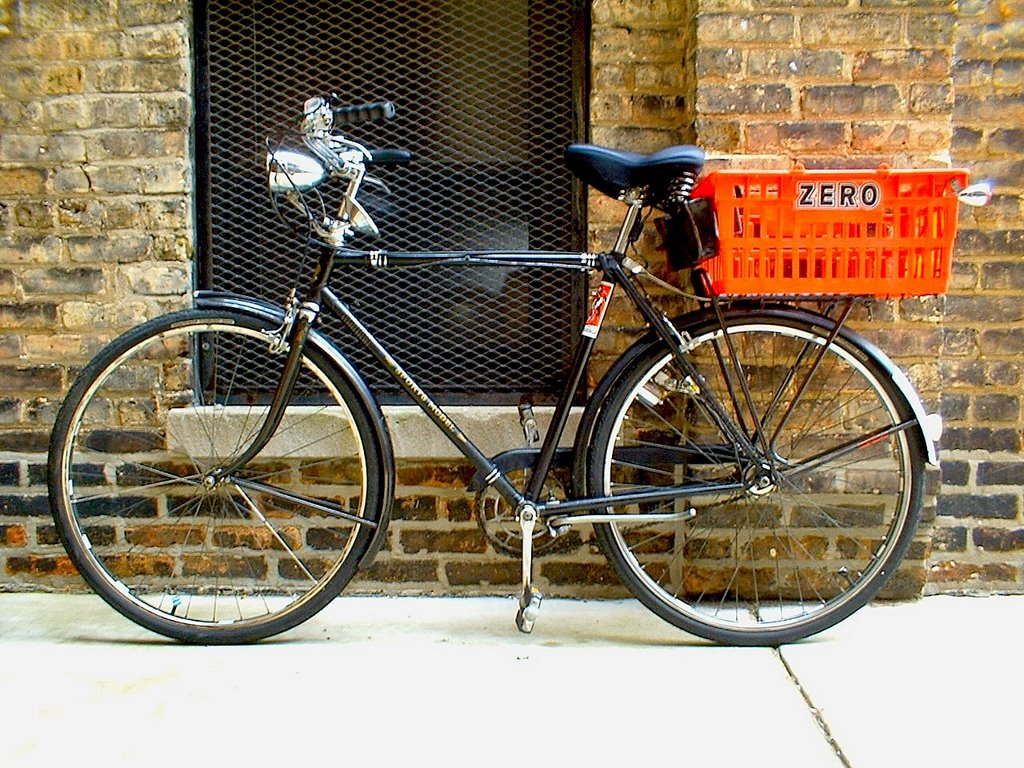
This beauty (a 1960 Raleigh, of course) will probably cost you $70 if you get it at a yard sale or bike co-op. Throw in the replacement parts such as new tubes, brakes, cables, and a decent seat. Then you'll probably spend $150 tops.

In contrast, this Swedish titanium and carbon-fiber doo-hickey will set you back anywhere from $1500 to $2500. Don't even get me started on maintenance, parts, spiffy lycra outfits...

Now the good news is that bike sales are booming in North America. To quote Paul Glader who writes for The Wall Street Journal,
About 19.8 million bicycles were sold last year in North America, up 8.2 percent from 2004, according to the National Bicycle Dealers Association. Sales of bikes and bike-related parts topped $6 billion last year, up from $5.7 billion in 2004. Some bike makers estimate that 30,000 cyclists each year spend $3,000 or more on a new bike, a $90 million market.
But the bad news is that what I call exotic materials are shifting new bike prices higher. According to Paul,
A booming aerospace industry is bringing bad news to cycling enthusiasts by sparking higher prices for fancy bikes. This means bike makers -- along with makers of sailboats, lacrosse sticks, tennis rackets, jewelry and bone screws -- are paying 25 percent more for raw materials and passing along costs to consumers.
This basically means that
Prices for high-end bikes from makers such as Trek Bicycle Corp., Cannondale Bicycle Corp., and Serotta Competition Bicycles, some of which already cost more than $10,000, could rise 5 percent to 25 percent.
It's not only the materials which are responsible for SUV-priced bikes:
But the growth also reflects the ever-escalating upgrades in bike models. Bike makers now use laser measurements, computer simulations, test-ride videos and drawings of a rider's body dimensions to create a more perfect ride. The desired growth in sales, coupled with tightening demand for raw materials, puts the bike industry in a bind.
And I thought prying open my Sturmey-Archer 3speed hub was a modern technological feat. In any case, thank g-d for the resourceful American consumer.
Some wealthy cyclists, however, say they don't worry much about escalating prices for bikes. John Machette, a consultant for Accenture Ltd. in Chicago, says he keeps bikes at his apartments in Houston, Chicago and Washington, D.C., where he travels for work. Still, he bought a $1,200 Trek 1500 road bike recently to keep in Washington, rather than paying $5,000 for another model.
Others are not so sanguine.
Some consumers such as Jamie Hintlian are beating the increases. Hintlian, a 46-year-old pharmaceutical-industry consultant in Boston, rides about 3,000 miles a year, owns half a dozen bikes made of various materials and keeps his eyes open for new bikes and parts. Hintlian bought a $4,000 bike made by Seven Cycles Inc. this summer to beat the expected price rise this fall, saying he's noticed that prices tend to increase annually. "I'm not going to go over the top for the sake of having the latest and greatest at any expense," he says.
Got that? He SAVED money by spending ONLY $4000.
But bike makers believe high prices eventually will hurt sales for middle-class buyers and could cause a return to other, cheaper materials such as lightweight steel. Cheaper bikes at retailers such as Wal-Mart Stores Inc. are typically made of steel.
Do the math: at the top end of the marketplace the bikes will continue to be astronomically expesnive. At the bottom end the affordable bikes, thanks to the box stores, will get crappier and crappier.

And in between? Get a beater, you'll never regret it ... if you live %)

Labels: , ,

16.10.08

Yet another bike test

how safe
is your bike?


How long does it take for an unchained bike to get stolen? Mariano Pasik, an Argentine publicist, thinks he knows the answer: about one hour. However, the safer the location, the longer will it take. Pasik recently decided to prove his hypothesis on the streets of Buenes Aires, a city of 12 million. Using cheap bikes and a hidden camera, he simply waited for the thieves to show up; all men, no women. Now he hopes others will join his nonprofit Bicycle Test project to create a worldwide insecurity index. He believes
...[i]t could become an informal crime gauge akin to the "Big Mac Index", which compares the cost of the same McDonald's sandwich in different countries to give an idea of buying power of people in different places...

Labels: , ,

9.10.06

Another small country heard from...

I intended to write about bike advocacy in Armenia today. Grave international events have intruded however. Early this morning North Korea announced its first successful underground nuclear test. This map shows the country's 22 nuclear facilities.

Little can be said with certainty about the global impact, other than one thing: the world now knows that North Korea has a functioning nuclear weapon. Whether the international community is less safe will depend on its actions over the next weeks and months.

The following is the full text of the announcement carried on North Korea's official Korean Central News Agency as reported on the Reuters news agency:
The field of scientific research in the Democratic Peoples' Republic of Korea [North Korea] successfully conducted an underground nuclear test under secure conditions on October 9, Juche 95 [2006] at a stirring time when all the people of the country are making a great leap forward in the building of a great, prosperous, powerful socialist nation.

It has been confirmed that there was no such danger as radioactive emission in the course of the nuclear test as it was carried out under a scientific consideration and careful calculation.

The nuclear test was conducted with indigenous wisdom and technology 100%. It marks a historic event as it greatly encouraged and pleased the KPA [Korean People's Army] and people that have wished to have powerful self-reliant defence capability.

It will contribute to defending the peace and stability on the Korean peninsula and in the area around it.
Reactions from the international community have been swift and unsurprisingly negative. President Bush, who is otherwise distracted by domestic scandals and the Iraqi debacle, announced,
Today's claim by North Korea serves only to raise tensions while depriving the North Korean people of the increased prosperity and better relations with the world offered by the implementation of the joint statement of the six-party talks. The oppressed and impoverished people of North Korea deserve that brighter future.
Roh Moo-Hyun, President of South Korea, North Korea's closest neighbor, agrees.
It raises a serious threat to peace, not only for the Korean peninsula, but for the region ... In the long run, this is a dangerous play that could spark a nuclear arms build-up in other countries.
Even China, North Korea's closest ally, is pissed. Condemning the test as a brazen act, Foreign Ministry Spokesman Qin Gang declared,
[North Korea] has ignored the widespread opposition of the international community and conducted a nuclear test brazenly on 9 October... The Chinese government is firmly opposed to this... The Chinese side strongly demands the North Korean side abide by its pledges on denuclearisation and to stop any action that would worsen the situation.
Japan's new Prime Minister, Shinzō Abe, fearing his country is the primary target of the North Korean bomb, warned,
We need to make a stern response and North Korea will be responsible for all the consequences ... Japan for its part will immediately start studying a response with stern measures.
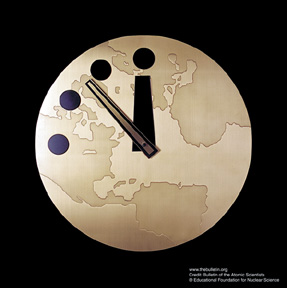
Since its inception in 1947, The Bulletin of Atomic Scientists has followed the threat posed by nuclear weapons and other developments in global security. Its famous Doomsday Clock has been moved 18 times to reflect the danger of the period. It currently stands at 7 minutes to midnight. It could well move even closer to midnight with North Korea's successful nuclear test.

Labels: , ,

11.10.08

Bike speed test

is bike commuting
the quickest option?

It's commonly accepted wisdom here in The Windy City that getting around by bike is faster than driving or using mass transit. How much faster depends on the route, traffic conditions, as well as your overall willingness to flout city and state laws. Several weeks ago I did my own experiment when I put an out-of-town guest on the Brown Line at Belmont Avenue bound for Addison Street while I biked there. I showed up a good 10 minutes before he did.


Today, while rummaging around The NYTimes On-line Archives, I discovered a similar but decidedly more scientific experiment conducted here on 9 October 1937. It put up a biker against a taxi, The L, a private car, a horse, a bus, a street car, and a pedestrian. The course was a little more than a mile starting at Dearborn & Quincy and finishing at Halstead & Van Buren, southwest of the Loop. The results were impressive:

Labels: , ,

3.9.08

The romance & ritual

... of velopunk

What with our enthusiasm for all things British; it looks like the classic lightweight crowd are the kool kids now. I got my first inkling when I was trawling the bike groups on Flickr. I ran across Ladies & Gents Hubb Geared Vintage Roadsters, a cool collection of vintage steeds and those who, suitably attired, love them. In our own way, we're quite the little sub-group of Steampunk. Although I have yet to see a steam-powered lightweight at the Lake Pepin Tour or the A.B.C.E., for that matter.


Our more mechanized cousins have been getting a bit of attention lately. Ruth La Ferla wrote in the NYTimes, 8 May 08:
If steampunk has a mission, it is, in part, to restore a sense of wonder to a technology-jaded world. “Today satellite photos make the planet seem so small,” Mr. Brown lamented. “Where is the adventure it that?” In contrast, steampunk, with its airships, test tubes and time machines, is, he said, “sort of a dream , the way we used to daydream. It’s like part of your childhood’s just bursting forward again.”
While I agree with the sense of wonder part, it's exactly the smallness of the planet that makes velopunk possible. Many gentlemen cyclists, and their ladies, come to Lake Pepin from as far away as Canada and California. The rest of the year we communicate by email and listserve. And where would any of us be without eBay's vintage bike and spare parts categories?

More importantly, at least for me, velopunk is all about the traditions of English Cycle Touring. Gentlemen cyclists bring their own interpretations of style and etiquette to each lightweight gathering including knickers, Norfolk jackets, and afternoon teas. That's where you fully recognize the family resemblance between velopunk and steampunk. Again, Ruth La Ferla:
Steampunk style is also an expression of a desire to return to ritual and formality. “Steampunk has its tea parties and its time-travelers balls,” said Deborah Castellano, who presides over salonconvention.com, which organizes neo-Victorian conventions. “It offers an element of glamour that some of us would otherwise never experience.”

Labels: , ,

11.7.09

Sierra Club gears up

to hike, bike,
and paddle


The venerable enviro-org has launched a new website, Sierra Club Trails. It's up and running in a beta test now, and they're planning to launch it soon. As far as I know, the site is the first-ever comprehensive hiking wiki where anyone can post their favorite trails for hiking, biking, even water trails for kayaking. Anyone else then can edit the So if I post a route to Milwaukee, anyone who rode it recently can update road conditions, construction, traffic, etc.


It's also an online community where users can create profiles and meet other bikers, hikers, surfers, you name it, and join discussion forums with topics like the best trail mix recipe or whether guns should be allowed in national parks. Community members can form groups around a particular outdoor interest or place. So it features tips for outdoor adventurers alike, a birding blog, photo contests, and Nature Notes, a series of audio features based on interviews with naturalists and Sierra Club Outings leaders.

Labels: , ,

14.4.09

Risky business?

or
rite of passage?


Folks who don't roll wonder why I risk my life daily on the seemingly mean streets of The Windy City. Taking a slightly masochistic pleasure in their concern, I usually respond by recounting the three times that I've been doored. Then I wrap up with something like, It ain't so bad ... all y'have to do is keep your eyes and ears open. I frankly don't see myself as a big risk-taker. Ride a freak bike or a brakeless fixie if you really want to be risky.

That being said, urban biking - even with a helmet, mirror, and lights (front & back) - is not without its risks. So why do 1000s of otherwise sane people do it? Deirdre Fernand may have an answer. Writing in The Economist's Intelligent Life Magazine, she explores the allure of extreme sports. Certainly urban bikers don't encounter the same dangers as those wacky folks who bungee jump, free-run, or BASE-jump. But what they do share is that in taking risks they are not an aberration
The aberration is those of us who are slumped on the sofa of life. If we remove risk from our lives ... we never find out our strengths and weaknesses. We stagnate.
Finding yourself by confronting and overcoming life's dangers used to be a necessary step on the road to adulthood. Pre-modern societies required adolescents to pass through an often dangerous rite of passage before being considered full members of the community. But in Western societies today, paranoid parents, touchy-feely educators, and insurance companies spend a lot of time removing risks from children's lives. Fernand believes this is a big, big mistake. She cites Mark van Vuyt, professor of psychology at the University of Kent.
In evolutionary terms it pays for young males to compete in excessive risk-taking. If they thought something was too risky and didn’t do it, they wouldn’t distinguish themselves and wouldn’t get female attention.
The good news is that, despite this nanny state of affairs, folks are confronting and overcoming life's dangers. It's not that they're all doing it to get chicks. Rather, they do it to test themselves and, G-d willing, to finish every day with the satisfaction of surviving to roll another day.

Labels: , ,

16.3.08

Do the test...

from across
the pond


Transport for London has launched a new bike safety campaign: Look Out For Cyclists.
Imagine...

A passer-by asks you for directions. As you talk to him, two workmen walk between you carrying a door. In a flash the passer-by switches places with one of the workmen, and you are left giving directions to a different person. Do you think you would notice?

Researchers at Harvard University played this trick on some unsuspecting people and over 50 per cent failed to spot the change.

This phenomenon is known as "change blindness" - only a tiny fraction of all the information going into your brain enters your consciousness. People often fail to see a change in their surroundings because their attention is elsewhere.

Even stranger, if you are concentrating on something, you can become blind to other events that you would normally notice. This "inattention blindness" is possibly the reason why motorists collide with cyclists.

Just as it is important for road users to keep an eye out for cyclists, cyclists must also take steps to ensure they are seen by motorists.

Labels: , ,

26.8.06

Taming the bicycle

Bruce Chatwin once said that there are two kinds of reading: for pure pleasure and for plunder. While lounging today after last night's Hurricane Ride for the August Chicago Critical Mass I was pleasure reading the Nichomachus blog. Then I decided to plunder; specifically its post on Camus's roll through Nazi-occupied France. It's a fantastic blog; so much so that it inspired today's post about Mark Twain.

I've known about Twain's famously ironic bike quote for some time now. A couple of weeks ago I used it for a t-shirt design. Recently I discovered its source at The Bike Reader. In 1917, the New York publishers, Harper and Brothers published a collection of his essays seven years after he died.

What is Man? And Other Essays is strange collection. Twain wrote the essays in the last years of his life whis his genious as a wry humorist had given way to a contankerous pessimism. Taming the Bicycle, written but unpublished in 1906, is nevertheless classic Twain. At the turn of the century, Mark Twain learned to ride one of the old high-wheel, or Penny-Farthing, bicycles of that period...
I thought the matter over, and concluded I could do it. So I went down and bought a barrel of Pond's Extract and a bicycle. The Expert came home with me to instruct me. We chose the back yard, for the sake of privacy, and went to work.

Mine was not a full-grown bicycle, but only a colt -- a fifty-inch, with the pedals shortened up to forty-eight -- and skittish, like any other colt. The Expert explained the thing's points briefly, then he got on its back and rode around a little, to show me how easy it was to do. He said that the dismounting was perhaps the hardest thing to learn, and so we would leave that to the last. But he was in error there. He found, to his surprise and joy, that all that he needed to do was to get me on to the machine and stand out of the way; I could get off, myself. Although I was wholly inexperienced, I dismounted in the best time on record. He was on that side, shoving up the machine; we all came down with a crash, he at the bottom, I next, and the machine on top.

We examined the machine, but it was not in the least injured. This was hardly believable. Yet the Expert assured me that it was true; in fact, the examination proved it. I was partly to realize, then, how admirably these things are constructed. We applied some Pond's Extract, and resumed. The Expert got on the other side to shove up this time, but I dismounted on that side; so the result was as before.

The machine was not hurt. We oiled ourselves up again, and resumed. This time the Expert took up a sheltered position behind, but somehow or other we landed on him again.

He was full of surprised admiration; said it was abnormal. She was all right, not a scratch on her, not a timber started anywhere. I said it was wonderful, while we were greasing up, but he said that when I came to know these steel spider-webs I would realize that nothing but dynamite could cripple them. Then he limped out to position, and we resumed once more. This time the Expert took up the position of short-stop, and got a man to shove up behind. We got up a handsome speed, and presently traversed a brick, and I went out over the top of the tiller and landed, head down, on the instructor's back, and saw the machine fluttering in the air between me and the sun. It was well it came down on us, for that broke the fall, and it was not injured.

Five days later I got out and was carried down to the hospital, and found the Expert doing pretty fairly. In a few more days I was quite sound. I attribute this to my prudence in always dismounting on something soft. Some recommend a feather bed, but I think an Expert is better.

The Expert got out at last, brought four assistants with him. It was a good idea. These four held the graceful cobweb upright while I climbed into the saddle; then they formed in column and marched on either side of me while the Expert pushed behind; all hands assisted at the dismount.

The bicycle had what is called the 'wabbles', and had them very badly. In order to keep my position, a good many things were required of me, and in every instance the thing required was against nature. Against nature, but not against the laws of nature. That is to say, that whatever the needed thing might be, my nature, habit, and breeding moved me to attempt it in one way, while some immutable and unsuspected law of physics required that it be done in just the other way. I perceived by this how radically and grotesquely wrong had been the lifelong education of my body and members. They were steeped in ignorance; they knew nothing - nothing which it could profit them to know. For instance, if I found myself falling to the right, I put the tiller hard down the other way, by a quite natural impulse, and so violated a law, and kept on going down. The law required the opposite thing - the big wheel must be turned in the direction in which you are falling. It is hard to believe this, when you are told it . And not merely hard to believe it, but impossible; it is opposed to all your notions. And it is just as hard to do it, after you do come to believe it. Believing it, and knowing by the most convincing proof that it is true, does not help it: you can't any more do it that you could before; you can neither force nor persuade yourself to do it at first. The intellect has to come to the front, now. It has to teach the limbs to discard their old education and adopt the new.

The steps of one's progress are distinctly marked. At the end of each lesson he knows he has acquired something, and he also knows what that something is, and likewise that it will stay with him. It is not like studying German, where you mull along, in a groping, uncertain way, for thirty years; and at last, just as you think you've got it, they spring the subjunctive on you, and there you are. No -- and I see now, plainly enough, that the great pity about the German language is, that you can't fall off it and hurt yourself. There is nothing like that feature to make you attend strictly to business. But I also see, by what I have learned of bicycling, that the right and only sure way to learn German is by the bicycling method. That is to say, take a grip on one villainy of it at a time, and learn it -- not ease up and shirk to the next, leaving that one half learned.

When you have reached the point in bicycling where you can balance the machine tolerably fairly and propel it and steer it, then comes your next task -- how to mount it. You do it in this way: you hop along behind it on your right foot, resting the other on the mounting-peg, and grasping the tiller with your hands. At the word, you rise on the peg, stiffen your left leg, hang your other one around in the air in a general and indefinite way, lean your stomach against the rear of the saddle, and then fall off, maybe on one side, maybe on the other; but you fall off. You get up and do it again; and once more; and then several times.

By this time you have learned to keep your balance; and also to steer without wrenching the tiller out by the roots (I say tiller because it is a tiller; "handle-bar" is a lamely descriptive phrase). So you steer along, straight ahead, a little while, then you rise forward, with a steady strain, bringing your right leg, and then your body, into the saddle, catch your breath, fetch a violent hitch this way and then that, and down you go again.

But you have ceased to mind the going down by this time; you are getting to light on one foot or the other with considerable certainty. Six more attempts and six more falls make you perfect. You land in the saddle comfortably, next time, and stay there -- that is, if you can be content to let your legs dangle, and leave the pedals alone a while; but if you grab at once for the pedals, you are gone again. You soon learn to wait a little and perfect your balance before reaching for the pedals; then the mounting-art is acquired, is complete, and a little practice will make it simple and easy to you, though spectators ought to keep off a rod or two to one side, along at first, if you have nothing against them.

And now you come to the voluntary dismount; you learned the other kind first of all. It is quite easy to tell one how to do the voluntary dismount; the words are few, the requirement simple, and apparently undifficult; let your left pedal go down till your left leg is nearly straight, turn your wheel to the left, and get off as you would from a horse. It certainly does sound exceedingly easy; but it isn't. I don't know why it isn't, but it isn't. Try as you may, you don't get down as you would from a horse, you get down as you would from a house afire. You make a spectacle of yourself every time.

During eight days I took a daily lesson of an hour and a half. At the end of this twelve working-hours' apprenticeship I was graduated -- in the rough. I was pronounced competent to paddle my own bicycle without outside help. It seems incredible, this celerity of acquirement. It takes considerably longer than that to learn horseback-riding in the rough.

Now it is true that I could have learned without a teacher, but it would have been risky for me, because of my natural clumsiness. The self-taught man seldom knows anything accurately, and he does not know a tenth as much as he could have known if he had worked under teachers; and, besides, he brags, and is the means of fooling other thoughtless people into going and doing as he himself had done. There are those who imagine that the unlucky accidents of life - life's "experiences" - are in some way useful to us. I wish I could find out how. I never knew one of them to happen twice. They always change off and swap around and catch you on your inexperienced side. If personal experience can be worth anything as an education, it wouldn't seem likely that you could trip Methuselah; and yet if that old person could come back here it is more than likely that one of the first things he would do would be to take hold of one of these electric wires and tie himself all up in a knot. Now the surer thing and the wiser thing would be for him to ask somebody whether it was a good thing to take hold of. But that would not suit him; he would be one of the self-taught kind that go by experience; he would want to examine for himself. And he would find, for his instruction, that the coiled patriarch shuns the electric wire; and it would be useful to him, too, and would leave his education in quite a complete and rounded-out condition, till he should come again, some day, and go to bouncing a dynamite-can around to find out what was in it.

But we wander from the point. However, get a teacher; it saves much time and Pond's Extract.

Before taking final leave of me, my instructor inquired concerning my physical strength, and I was able to inform him that I hadn't any. He said that that was a defect which would make up-hill wheeling pretty difficult for me at first; but he also said the bicycle would soon remove it. The contrast between his muscles and mine was quite marked. He wanted to test mine, so I offered my biceps -- which was my best. It almost made him smile. He said, "It is pulpy, and soft, and yielding, and rounded; it evades pressure, and glides from under the fingers; in the dark a body might think it was an oyster in a rag." Perhaps this made me look grieved, for he added, briskly: "Oh, that's all right; you needn't worry about that; in a little while you can't tell it from a petrified kidney. Just go right along with your practice; you're all right."

Then he left me, and I started out alone to seek adventures. You don't really have to seek them -- that is nothing but a phrase -- they come to you.

I chose a reposeful Sabbath-day sort of a back street which was about thirty yards wide between the curbstones. I knew it was not wide enough; still, I thought that by keeping strict watch and wasting no space unnecessarily I could crowd through.

Of course I had trouble mounting the machine, entirely on my own responsibility, with no encouraging moral support from the outside, no sympathetic instructor to say, "Good! now you're doing well -- good again -- don't hurry -- there, now, you're all right -- brace up, go ahead." In place of this I had some other support. This was a boy, who was perched on a gate-post munching a hunk of maple sugar.

He was full of interest and comment. The first time I failed and went down he said that if he was me he would dress up in pillows, that's what he would do. The next time I went down he advised me to go and learn to ride a tricycle first. The third time I collapsed he said he didn't believe I could stay on a horse-car. But next time I succeeded, and got clumsily under way in a weaving, tottering, uncertain fashion, and occupying pretty much all of the street. My slow and lumbering gait filled the boy to the chin with scorn, and he sung out, "My, but don't he rip along!" Then he got down from his post and loafed along the sidewalk, still observing and occasionally commenting. Presently he dropped into my wake and followed along behind. A little girl passed by, balancing a wash-board on her head, and giggled, and seemed about to make a remark, but the boy said, rebukingly, "Let him alone, he's going to a funeral."

I had been familiar with that street for years, and had always supposed it was a dead level; but it was not, as the bicycle now informed me, to my surprise. The bicycle, in the hands of a novice, is as alert and acute as a spirit-level in the detecting of delicate and vanishing shades of difference in these matters. It notices a rise where your untrained eye would not observe that one existed; it notices any decline which water will run down. I was toiling up a slight rise, but was not aware of it. It made me tug and pant and perspire; and still, labor as I might, the machine came almost to a standstill every little while. At such times the boy would say: "That's it! take a rest - there ain't no hurry. They can't hold the funeral without you."

Stones were a bother to me. Even the smallest ones gave me a panic when I went over them. I could hit any kind of a stone, no matter how small, if I tried to miss it; and of course at first I couldn't help trying to do that. It is but natural. It is part of the ass that is put in us all, for some inscrutable reason.

I was at the end of my course, at last, and it was necessary for me to round to. This is not a pleasant thing, when you undertake it for the first time on your own responsibility, and neither is it likely to succeed. Your confidence oozes away, you fill steadily up with nameless apprehensions, every fiber of you is tense with a watchful strain, you start a cautious and gradual curve, but your squirmy nerves are all full of electric anxieties, so the curve is quickly demoralized into a jerky and perilous zigzag; then suddenly the nickel-clad horse takes the bit in its mouth and goes slanting for the curbstone, defying all prayers and all your powers to change its mind -- your heart stands still, your breath hangs fire, your legs forget to work, straight on you go, and there are but a couple of feet between you and the curb now. And now is the desperate moment, the last chance to save yourself; of course all your instructions fly out of your head, and you whirl your wheel away from the curb instead of toward it, and so you go sprawling on that granite-bound inhospitable shore. That was my luck; that was my experience. I dragged myself out from under the indestructible bicycle and sat down on the curb to examine.

I started on the return trip. It was now that I saw a farmer's wagon poking along down toward me, loaded with cabbages. If I needed anything to perfect the precariousness of my steering, it was just that. The farmer was occupying the middle of the road with his wagon, leaving barely fourteen or fifteen yards of space on either side. I couldn't shout at him -- a beginner can't shout; if he opens his mouth he is gone; he must keep all his attention on his business. But in this grisly emergency, the boy came to the rescue, and for once I had to be grateful to him. He kept a sharp lookout on the swiftly varying impulses and inspirations of my bicycle, and shouted to the man accordingly:

"To the left! Turn to the left, or this jackass'll run over you!" The man started to do it. "No, to the right, to the right! Hold on! that won't do! -- to the left! -- to the right! -- to the left! -- right! left -- ri -- Stay where you are, or you're a goner!"

And just then I caught the off horse in the starboard and went down in a pile. I said, "Hang it! Couldn't you see I was coming?"

"Yes, I see you was coming, but I couldn't tell which way you was coming. Nobody could -- now, could they? You couldn't yourself -- now, could you? So what could I do?"

There was something in that, and so I had the magnanimity to say so. I said I was no doubt as much to blame as he was.

Within the next five days I achieved so much progress that the boy couldn't keep up with me. He had to go back to his gate-post, and content himself with watching me fall at long range.

There was a row of low stepping-stones across one end of the street, a measured yard apart. Even after I got so I could steer pretty fairly I was so afraid of those stones that I always hit them. They gave me the worst falls I ever got in that street, except those which I got from dogs. I have seen it stated that no expert is quick enough to run over a dog; that a dog is always able to skip out of his way. I think that that may be true; but I think that the reason he couldn't run over the dog was because he was trying to. I did not try to run over any dog. But I ran over every dog that came along. I think it makes a great deal of difference. If you try to run over the dog he knows how to calculate, but if you are trying to miss him he does not know how to calculate, and is liable to jump the wrong way every time. It was always so in my experience. Even when I could not hit a wagon I could hit a dog that came to see me practise. They all liked to see me practise, and they all came, for there was very little going on in our neighborhood to entertain a dog. It took time to learn to miss a dog, but I achieved even that.

I can steer as well as I want to, now, and I will catch that boy out one of these days and run over him if he doesn't reform.

Get a bicycle. You will not regret it, if you live.

Labels: , ,